

Last Updated: November 2, 2026
Quick Summary
Pond bottom structure is the physical shape and composition of the pond floor, including points, drop-offs, channels, flats, and hard or soft spots. Read it by walking the bank first, marking every point and pocket, watching for surface color changes, and casting across contours rather than along them. Confirm what you find by counting seconds from splash to bottom with a jig or Texas rig.
- Structure is permanent, while cover like weeds and brush comes and goes with the seasons.
- Points are the most reliable fish-holding structure in any pond.
- A weed line that runs straight then juts out usually follows a depth change.
- A cast where the bottom count jumps two or more seconds marks a drop-off.
- Hard bottom such as gravel, rock, or packed sand holds more fish than soft muck.
Table of Contents
- Why Pond Bottom Structure Decides Where You Fish
- Structure vs. Cover: Knowing What You're Looking At
- A Step-by-Step Method for Reading Pond Bottom Structure
- Finding Structure in Small Ponds
- How to Find Fish in a Pond Without a Fish Finder
- Pond Drop-Offs and Depth Changes: The Highways Fish Use
- How to Read a Pond for Bass
- Probing Structure with the Right Tackle and Presentation
- Frequently Asked Questions
Why Pond Bottom Structure Decides Where You Fish
Most anglers fish the water they can see. The fish live in the water they can't. That gap explains why two people on the same bank can have completely different days. One casts at random and hopes.
Learning how to read pond bottom structure for better catches is the highest-return skill in bank fishing. It costs nothing, needs no electronics, and works on ponds you've never seen before.
Pond bottom structure is the physical shape and composition of the pond floor: points, drop-offs, channels, flats, and hard or soft spots that change depth and hold fish. Cover is what grows on or sits above it, like weeds, brush, and fallen trees.
The distinction matters. Structure is permanent. Cover comes and goes with the seasons. Fish use both, but for different reasons, and confusing the two sends your lure to the wrong place all day.
Structure vs. Cover: Knowing What You're Looking At
Beginners lump everything together as "fishy water." That's a mistake worth fixing early, because structure and cover call for different presentations.
Bottom Contour: The Shape of the Pond Floor
Contour is the three-dimensional shape of the pond floor. Points that push out from shore, drop-offs where shallow water falls into deep water, channels, humps, and flats all count.
Contour is the skeleton of the pond. It doesn't move. A point that held fish last spring will still be a point next spring, even if the water level shifts.
Cover: Weeds, Brush, and Trees
Cover is the stuff fish hide in and around: weed beds, lily pads, brush piles, laydown trees, and dock pilings.
Cover is where fish ambush prey. Structure is where they travel and stage. The best spots have both, and that's where you should spend your casts.
A weed line growing along a contour change is a textbook example. The contour funnels fish, and the weeds give them a place to sit.
For pond anglers working lily pads specifically, how to fish lily pads for bass covers the casting and retrieval side in detail.
A Step-by-Step Method for Reading Pond Bottom Structure
Here's the field workflow we recommend. It takes one lap around the pond and no special gear.
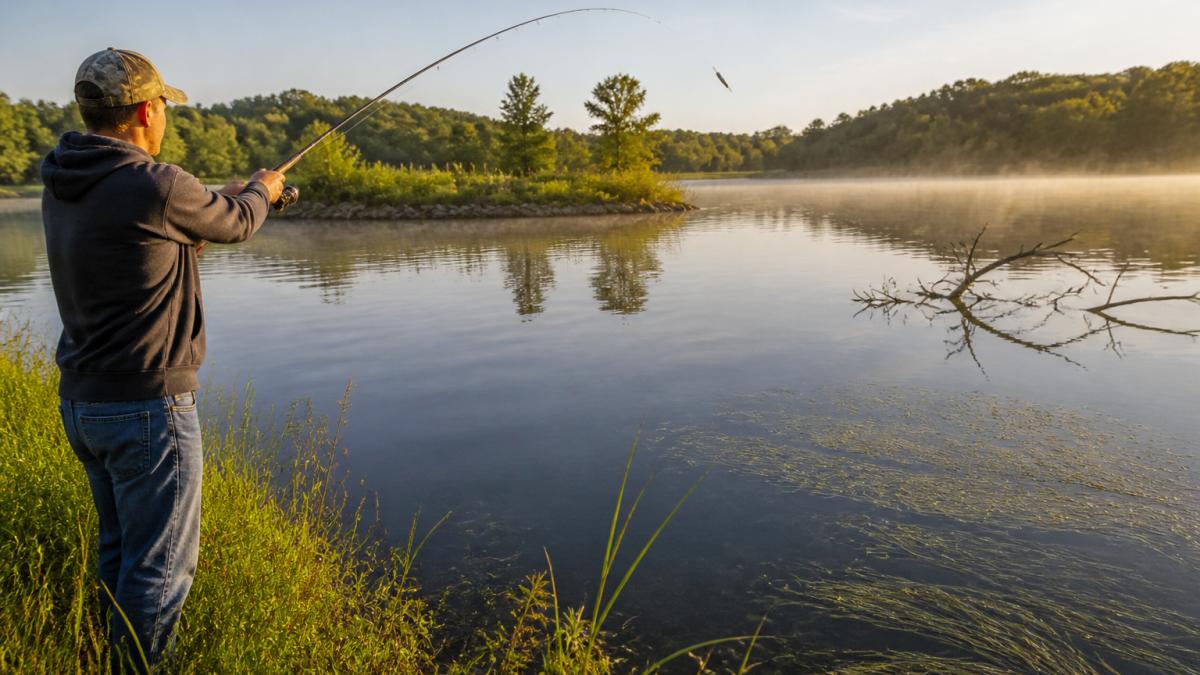
- Walk the bank before you cast. Cover water on foot first. You'll spot more from the bank than from a single fishing position.
- Mark every point and pocket. Points are the most reliable fish-holding structure in any pond.
- Watch the surface for color changes. Darker patches usually mean deeper water or soft bottom. Lighter patches often mean sand, gravel, or a shallow flat.
- Note where weeds start and stop. A weed line that runs straight then juts out usually follows a depth change.
- Find the drains and inflows. Water entering the pond carves a channel and concentrates bait.
- Cast across contours, not along them. A retrieve that crosses a drop-off passes through more depth zones.
- Log what you find. A simple note on your phone beats memory every time.
That's the whole method. The rest of this guide fills in what each clue means.
Here is the field workflow the article recommends, which takes one lap around the pond and no special gear.
| Step | What to do |
|---|---|
| 1 | Walk the bank before you cast |
| 2 | Mark every point and pocket |
| 3 | Watch the surface for color changes |
| 4 | Note where weeds start and stop |
| 5 | Find the drains and inflows |
| 6 | Cast across contours, not along them |
| 7 | Log what you find |
Finding Structure in Small Ponds
Small ponds are easier to read than big water, and that's good news. You can walk the entire shoreline in under an hour.
Start with the shape of the bank. Every point on shore continues underwater. Every cove usually has a shallow flat inside it. Every straight stretch of dam or levee drops off faster than a natural bank.
Look for these in small ponds:
- Points that stick out from shore
- Coves with shallow, sun-warmed water
- Inlets where runoff enters
- Old creek channels that cut across the pond floor
- Humps that top out just below the surface
A pond that gets drawn down or drains seasonally is a gift. Walk it when the water is low. You'll see the actual contours, old stumps, and creek channels laid out in front of you. Take photos. That map stays useful for years.
Bank anglers probing these spots from shore need tackle that reaches structure without snagging on every cast. Our guide to bank fishing gear for small ponds covers the setup.
How to Find Fish in a Pond Without a Fish Finder
No electronics? You still have three tools: your eyes, your lure, and your line.
Step 1: Read the surface before you make a cast. Baitfish dimpling, birds diving, and bass pushing wakes all tell you where fish are active right now.
Step 3: Feel for bottom composition. Mud feels soft and gives. Gravel and rock feel sharp and transmit a distinct tick. Sand feels smooth.
Step 4: Watch your line on the fall. If it stops early, a fish took it or you hit cover. Both are useful information.
Step 5: Map the results on a simple grid. Sketch the pond outline on a notepad and divide it into rough squares.
Beginners fishing blind benefit from a simple, proven tackle list. Essential tackle for pond fishing beginners covers the basics without overspending.
Pond Drop-Offs and Depth Changes: The Highways Fish Use
Drop-offs are the single most important feature to find. Fish use them like roads, moving from deep water to shallow feeding areas and back.
How to find a drop-off from shore:
- Watch the bank slope. A steep bank usually means a steep drop nearby. A gentle, gradual bank usually means a long shallow flat before the bottom falls away.
- Look for a color change in the water. Deep water reads darker. A sharp line where light green shifts to dark green is often a depth break.
- Follow the weed line. Weeds grow only as deep as sunlight reaches. Where they stop, the bottom usually falls away. A weed line that runs straight then juts out is following a contour change.
- Cast perpendicular to shore and count the fall. Make three casts: one close, one medium, one far. Count the seconds from splash to bottom tick on each. The cast where the count jumps by two or more seconds is your break. Repeat at 10-foot intervals along the bank to trace the drop-off's path.
- Use a jig or Texas rig as a bottom probe. Drag it slowly back to you. A sudden increase in depth feels like the line going slack earlier than expected. A sudden decrease feels like the lure ticking up. Both are structure edges worth marking.
Bottom composition matters as much as depth. A drop-off that transitions from sand to gravel to mud holds fish differently than one that goes from weed bed to bare clay.
Map the drop-off as you go. On your pond sketch, draw a line where the depth count jumps. That line is the highway.
Watch out: A drop-off that looks sharp from the bank may be a gentle slope underwater. Always confirm with a cast-and-count before you commit to fishing it as a break.
If weeds are fouling your probe casts, the Fishing Weed Blocker keeps your lure clean so you can feel the bottom instead of clearing debris. For more on fishing these edges, see our guide to bank fishing gear for small ponds.
How to Read a Pond for Bass
Bass relate to structure more predictably than any other pond fish. Learn their patterns and the rest of the pond makes sense.
Seasonal movement drives everything. In spring, bass move shallow to spawn and hold on flats and points near spawning cover. In summer, they split between shallow cover in low light and deeper structure during bright hours.
Weather changes the depth. A stable, warm stretch pushes fish shallow. A cold front pulls them tight to cover and slows them down. Wind blowing into a bank stacks baitfish there, and bass follow.
Bass use edges. The edge of a weed bed, the lip of a drop-off, the shade line of a dock. Fish the edge before you fish the middle.
A pond with heavy vegetation rewards a different approach than a bare, rocky one. How to fish heavy vegetation for bass goes deeper on the thick stuff.
Probing Structure with the Right Tackle and Presentation
Reading the pond is half the job. Putting a lure where you read it is the other half.
Match the lure to the structure. For bottom contact on hard structure, use a Texas-rigged worm or jig.
Slow down on structure. Most anglers fish too fast over the best spots.
This is where weeds become the real problem. A lure that fouls on the first cast into a weed line isn't fishing.
Our Fishing Weed Blocker is built for exactly this.
If you're choosing lures for this kind of fishing, top weedless lures for thick cover pairs well with a weed-blocking setup.
Reading a pond is a skill you build one lap at a time. The anglers who catch consistently aren't lucky.
If weeds are what's costing you fish, that's a solvable problem.
Frequently Asked Questions
How do you read a pond for fishing if you can't see the bottom?
Start above the water. Read the shoreline shape, look for points and coves, and note where weeds and brush show. Then probe with a lure that touches bottom, like a jig or a Texas-rigged worm, and count how long it takes to hit. A slow, ticking retrieve tells you hard bottom; a soft, spongy feel means mud or silt. Pair those clues with a depth finder if you have one, and you can build a working picture of the pond bottom structure without ever seeing it.
What bottom features attract fish in a pond?
Points, drop-offs, depth changes, and hard-bottom patches draw fish because they concentrate baitfish and give predators an edge. Weeds and brush add cover. The best spots combine two or three: a point that falls into deeper water next to a weed line, for example. Fish use these edges as feeding areas and travel routes, so a lure worked along the transition gets more looks than one cast into open water.
How can you find drop-offs in a pond without a fish finder?
Watch the shoreline first. A steep bank usually means a steep drop nearby, and a flat bank usually means a gradual slope. Cast a jig or worm and count the fall; a sudden change in how long it takes to reach bottom marks a drop-off. You can also drag a heavy lure slowly and feel for the moment the line goes slack. Mark the spot with a buoy or a mental landmark and work it from several angles.
How do you find structure in a small pond?
Small ponds are easier to read because everything is close. Walk the bank and look for points, inflows, and weed edges. Then fish a grid: cast to the same spot from two or three directions and compare what you feel. Laydowns and brush piles often show as snags or odd ripples. Keep notes on where you get bit, and you will build a structure map in a few trips that works for years, especially with a weed-blocking device keeping your bait clean.
