
Table of Contents
- Understanding Vegetation Types and Seasonal Patterns
- Bass Fishing Heavy Cover Setup: Rod, Reel, and Line
- Best Lures for Matted Vegetation and Thick Grass
- Punching, Flipping, and Pitching Techniques That Work
- Fishing Weed Flats vs. Deep Grass with Sonar
- Fishing Weed Blocker Device: Keeping Your Lure Clear
- Troubleshooting Snags, Break-offs, and Hook Sets
- Conclusion
- Frequently Asked Questions
Last Updated: September 18, 2026
Understanding Vegetation Types and Seasonal Patterns
Learning how to fish heavy vegetation for bass starts with knowing what you're fishing in. Vegetation is a living habitat that changes with the seasons, and bass move with it.
Identifying Common Vegetation Species
Bass relate to different plants in different ways, and the plant tells you which lure to tie on. Here is how the main species differ:
- Hydrilla: Grows in long vertical strands and forms a dense surface canopy. It creates the thickest mats and the most reliable punching targets, so you need a compact bait and heavy weight to break through. It also grows in deep water, holding fish out past the bank.
- Eurasian milfoil: Feathery, softer stems in shallower flats that top out at or just below the surface. Because the stems are less rigid than hydrilla, a hollow-body frog or swim jig over the top often outproduces a punch rig, and the looser mats let a lighter weight fall through naturally.
- Lily pads: Floating leaves rooted to the bottom. Pads shade bass in summer heat and create open pockets between clusters. Walk a frog across the pads and pause in the pockets; drop a weightless soft plastic into a gap when fish are pressured.
- Cattails and reeds: Tall emergent shoreline grass that holds fish in spring and early summer. The water is usually shallow, so flip and pitch a Texas rig tight to the base rather than punching.
- Coontail: Dense, bushy growth with no real roots that tangles lures fast. It suspends in the water column rather than matting, so a slow-falling soft plastic or a swim jig retrieved just above the tops keeps you out of the snag cycle.
How Seasonal Changes Affect Bass Location
Bass follow the grass as water temperatures shift, and the vegetation's growth cycle dictates where fish sit. Treating a weed bed as static is the most common mistake we hear about.
- Early spring (pre-spawn): New green growth emerges, and bass push shallow into the first green stems because that growth holds warmth and the first baitfish. Target the leading edge of new grass, not the dead stalks behind it.
- Late spring (spawn): Bass move into the shallowest hard-bottom pockets inside the vegetation. The grass is still thin enough for moving baits, so cover water until you find beds.
- Summer: Vegetation peaks. Hydrilla and milfoil canopy over, oxygen drops under the thickest mats, and bass slide to the edges and open pockets where light penetrates. Punching and topwater frogs take over.
- Early fall: Vegetation dies back, bass pull toward the edges as the mat breaks up, and the "green edge", healthy grass meeting dying grass, becomes the highest-percentage zone on the lake.
- Late fall and winter: Most vegetation decays. Bass move to deeper structure and any remaining green grass, often the deepest hydrilla or last standing coontail. Slow down and fish vertically.
Reading Vegetation Density Before You Cast
Density tells you which technique to reach for before you cast. A mat you can push a rod tip through with light pressure is a frog or swim jig mat; one that resists the rod tip is a punching mat. Bright green grass is actively growing and holds more oxygen and bait, while brown or black patches are decaying and often fishless.
Bass Fishing Heavy Cover Setup: Rod, Reel, and Line
A bass fishing heavy cover setup is built for power, not finesse. You need gear that can pull a hooked fish out of a mat before it wraps you around a stem.
Choosing Braided Line and Leader Strength
Braid is the only line that makes sense in heavy vegetation. It slices through stems on the hook set and gives zero-stretch power. Add a 20- to 25-pound fluorocarbon leader in clear, pressured water; in muddy water or thick mats, tie straight to braid.
Best Lures for Matted Vegetation and Thick Grass
The best lures for matted vegetation stay weedless and make a commotion. Bass under mats are ambush feeders that strike on reaction, not inspection.
| Lure Type | Best For | Why It Works |
|---|---|---|
| Hollow-body frog | Surface mats | Weedless, walks over slop |
| Topwater popper | Open pockets | Splash draws strikes |
| Punch rig + soft plastic | Dense mats | Drops through the canopy |
| Weightless senko | Weed edges | Slow fall triggers bites |
| Swim jig | Weed flats | Covers water fast |
Topwater Frogs and Poppers
Frogs are the go-to for matted vegetation, gliding over slop without snagging. Work them with a steady retrieve and pause at open pockets. Poppers shine in smaller gaps where you can create a splash. Both work best at dawn and dusk.
Punching Rigs and Soft Plastics
When the mat is too thick for a frog, punch through it. A punch rig uses a 1- to 1.5-ounce tungsten weight and a compact soft plastic like a brush hog or beaver-style bait. The weight breaks the canopy and the bait falls into the strike zone below.
Punching, Flipping, and Pitching Techniques That Work
Punching, flipping, and pitching are three ways to put a bait into cover without spooking fish. Each suits a different distance and density, and anglers who blur them together lose fish they should have landed.
Punching: Straight Through the Canopy
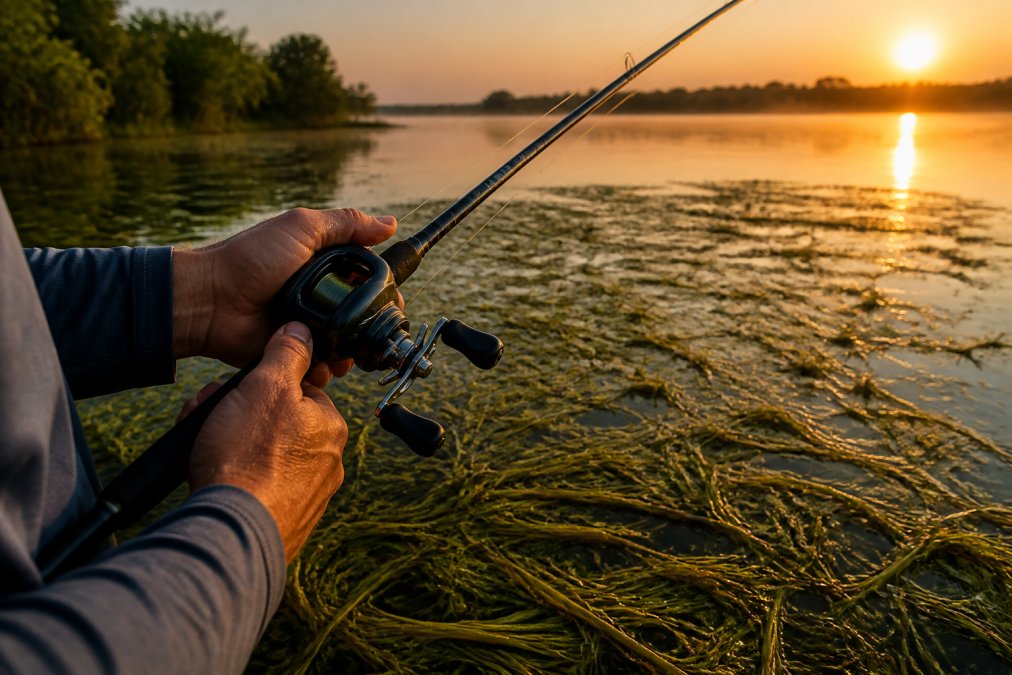
Punching is a vertical presentation for the thickest mats. Position the boat over the mat, drop the bait straight through the canopy, and let it fall into the open water beneath. A 1- to 1.5-ounce tungsten weight breaks through hydrilla and milfoil a frog cannot penetrate.
Key mechanics:
- Position directly over the target. Punching is a vertical game. If you are casting at an angle, you are not punching, you are pitching into a snag.
- Use a compact bait. A brush hog or beaver-style plastic slides through the canopy. Long, bulky trailers catch on the way down.
- Keep your rod tip high on the fall. You want a semi-tight line so you can feel the strike the moment the bait clears the canopy. Bass often eat it on the initial drop.
- Reel down and drive the hook hard. Penetration through a thick plastic and a bass's jaw takes real force. A sweeping hook set with a heavy-action rod is the standard.
Flipping: Quiet, Close-Range Precision
Flipping is an underhand presentation for close targets, pad clusters, dock edges, and the inside edge of a mat. Pull line off the reel with your non-rod hand and swing the bait low and quiet into the target. The bait never leaves the surface, which keeps spooky fish calm.
Pitching: Mid-Range Accuracy
Pitching is a short, low cast to mid-range targets, weed edges, holes in the mat, and the seam between two densities. Load the bait with the rod tip and swing it forward underhand, keeping the trajectory flat. It covers more water than flipping without a full cast's splash.
Choosing Between the Three
- Distance to target: Flipping for arm's-length targets, pitching for 15 to 30 feet, punching for straight down.
- Density: Punching for mats you cannot see through, flipping and pitching for edges and pockets.
- Fish mood: Flipping and pitching for pressured, shallow fish; punching for fish buried under canopy.
Troubleshooting Snags and Break-offs Without Spooking the Area
Snags and break-offs are part of heavy cover fishing, but most are avoidable, and how you handle them matters as much as how you avoid them.
- Snags on the retrieve: Switch to a more weedless bait or a lighter weight. A bait that fouls on every cast is the wrong bait for that density.
- Break-offs on the hook set: Check your braid for fraying and retie often. Braid abrades on stems and pad edges, and a frayed section will fail under load.
- Missed hook sets: Reel down before you swing, and use a sharp, heavy-gauge hook. A dull hook will not penetrate a thick plastic and a bony jaw.
- Lure fouled with weeds: Slow your retrieve or add a weed guard. A bait that plows weeds telegraphs its presence to every bass in the area.
Fishing Weed Flats vs. Deep Grass with Sonar
Weed flats and deep grass hold bass for different reasons. Flats are shallow, sun-warmed, and full of bait. Deep grass offers cooler water and cover in summer.
Fishing Weed Blocker Device: Keeping Your Lure Clear
The Fishing Weed Blocker is a simple fix for a frustrating problem: weeds covering your bait. This patent pending device grabs weeds before they can wrap your lure or bait, so your presentation stays clean. Built for trolling and bait fishing, it glides through the water with minimal drag, casts like a rocket, and stacks neatly in your tackle box.

Troubleshooting Snags, Break-offs, and Hook Sets
Snags and break-offs are part of heavy cover fishing, but most are avoidable if you match your gear and technique to the density of the grass.
- Snags on the retrieve: Switch to a more weedless bait or a lighter weight
- Break-offs on the hook set: Check your braid for fraying and retie often
- Missed hook sets: Reel down before you swing, and use a sharp, heavy-gauge hook
- Lure fouled with weeds: Slow your retrieve or add a weed guard
Conclusion
Heavy vegetation fishing rewards preparation more than luck. Match your rod, line, and lures to the grass in front of you, and the bites will come. If weeds covering your bait are costing you fish, the Fishing Weed Blocker grabs weeds before they reach your lure and protects your bait on every cast. Get started with Fishing Weed Blocker and spend less time cleaning weeds and more time catching bass.
Frequently Asked Questions
How do you keep weeds off your lure when bass fishing?
Use a combination of weedless rigs and a device like the Fishing Weed Blocker. Texas rigs and punching setups hide the hook point inside soft plastics. The Fishing Weed Blocker grabs vegetation before it covers your bait, protecting your presentation whether you're trolling or bait fishing. It costs $15.97 and comes in a pack that stacks in your tackle box.
What is the best rod and reel setup for heavy cover bass fishing?
A heavy action rod paired with a high-speed baitcasting reel (7.1:1 or faster gear ratio) handles heavy vegetation bass well. Spool with 50-65 lb braided line for punching through mats. Add a fluorocarbon leader in clearer water. This bass fishing heavy cover setup gives you the power to pull fish out of thick grass without losing them in the salad.
What are the best lures for matted vegetation?
Top options include hollow-body frogs, swim jigs with trailers, weightless Senkos, and punching rigs with creature baits like brush hogs. The best lures for matted vegetation share one trait: they stay weedless until a bass strikes. Match your lure to the density. Frogs work over mats, while punching rigs penetrate through to deeper water underneath.
How do you fish a Texas rig in thick grass?
Cast to the edge or into pockets, let it fall on a tight line, and watch your line for ticks. In thick grass, use a 1/2 to 1 oz tungsten weight for penetration. When you feel weight, set the hook hard to drive it through vegetation. A fishing weed blocker device keeps grass from covering your bait during the retrieve.