
Table of Contents
- Quick Comparison: Top 10 Weedless Lures for Thick Cover
- How to Fish Heavy Grass and Weeds Without Getting Snagged
- 1. Texas-Rigged Soft Plastics: The Standard for Matted Vegetation
- 2. Topwater Frogs: Best for Slop and Grass Mats
- 3. Swim Jigs and Skirted Lures for Heavy Cover
- 4. Weightless Flukes and Soft Plastic Swimbaits
- 5. Punch Rigs and Flipping Setups for Dense Canopy
- 6. Wacky and Neko Rigs: Finesse Weedless Options
- Frequently Asked Questions
Last Updated: September 24, 2026
Quick Comparison: Top 10 Weedless Lures for Thick Cover
Picking the right weedless lures for thick cover 2026 comes down to matching the lure to vegetation density. This guide breaks down the ten best options, from Texas-rigged plastics to topwater frogs, and when to throw each one.
| Lure Type | Best For | Key Strength | Main Trade-Off |
|---|---|---|---|
| Texas-rigged soft plastics | Matted vegetation | Snag-free, versatile | Needs a strong hookset |
| Topwater frogs | Slop and grass mats | Weed shedding, explosive strikes | Lower hookup ratio |
| Swim jigs and skirted lures | Heavy cover edges | Cover penetration, bulk | Can snag on hard structure |
| Weightless flukes | Sparse to moderate grass | Natural glide, slow fall | Hard to cast in wind |
| Punch rigs | Dense canopy | Reaches fish under mats | Heavy tackle required |
| Wacky and Neko rigs | Finesse weedless situations | Subtle action, exposed hook point | Not for thick mats |
How to Fish Heavy Grass and Weeds Without Getting Snagged
Fishing heavy grass and weeds without snagging starts with reading the vegetation before you cast. Dense mats, sparse clumps, and submerged grass each demand a different lure, line, and retrieve, treating "weeds" as one condition is the biggest reason anglers get fouled.
Reading Vegetation Density Before You Cast
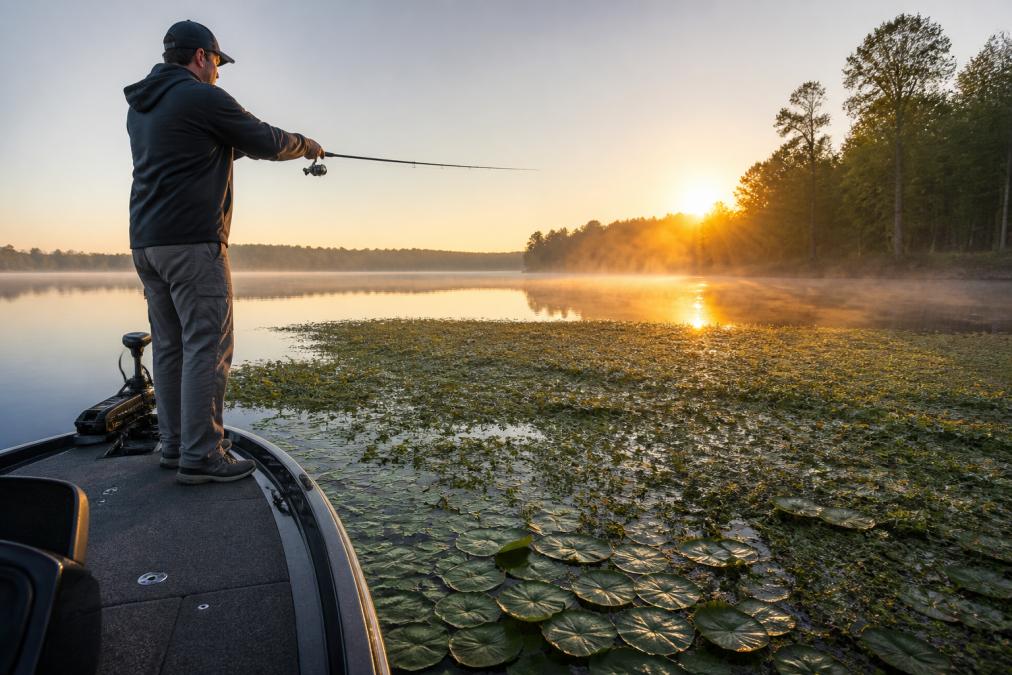
Look at the surface first. A solid, unbroken mat needs a lure that punches through or rides on top. Gaps and open pockets suit a swim jig or weightless fluke worked along the edges. Fishing the same weedless lure everywhere is a common mistake, the vegetation tells you what to throw.
- Solid mats: Punch rigs, topwater frogs
- Scattered clumps: Texas rigs, weightless flukes
- Submerged grass: Swim jigs, skirted lures
- Open pockets in cover: Wacky and Neko rigs
Vegetation-Specific Lure Matching
Not all weeds are the same, and a lure that excels in one type will fail in another.
- Lily pads: Hard stems and a canopy above the water. A hollow-body frog with a pointed nose and upward-facing hooks is standard; the body must shed the pad's waxy surface without collecting water. Trimming the legs about 1/4 inch shorter than stock makes the frog sit lower and walk more erratically.
- Hydrilla and milfoil: Submerged and mat-forming; at the surface they create a soft, dense canopy. Use a punch rig with a compact creature bait or beaver-style plastic, narrow enough to slip through the mat, bulky enough to displace water on the fall. Trim the tail so the profile is no wider than the punch weight.
- Matted grass (mixed species): The thickest condition. A Texas rig with a pegged bullet weight works, but a punch rig with a 1- to 1.5-ounce tungsten weight is more efficient, it creates a cleaner entry hole and reaches fish faster. A punch skirt adds bulk and slows the fall.
- Sparse to moderate grass: A weightless fluke or a swim jig with a light weed guard. The lure must glide and dart without collecting scattered strands. A fluke rigged with a 4/0 or 5/0 offset hook and no weight skips under overhangs and falls naturally.
Line and Knot Selection for Heavy Cover
In thick cover, your line is the only thing connecting you to a fish that will immediately try to bury itself.
- Braid is the standard for heavy cover. A 50- to 65-pound braid has almost no stretch, so your hookset drives home instantly and you can pull a fish through the grass instead of letting it dig in. Around hard structure mixed with grass, add a 20- to 25-pound fluorocarbon leader joined with a braid-to-leader knot.
- The knot matters as much as the line. A poorly tied knot will slip or break under a heavy hookset. The FG knot is thinner and passes through guides more smoothly on long casts to mat edges; the double uni is easier to tie and reliable for most anglers. Whichever you choose, wet the knot before tightening and test it with a hard pull.
- Line diameter affects lure action. A thicker braid (65-pound) floats more and can slow a weightless fluke's fall; a thinner braid (30- to 40-pound) casts farther and sinks faster but pulls less. Match diameter to cover: heavier for mats, lighter for sparse grass.
1. Texas-Rigged Soft Plastics: The Standard for Matted Vegetation
The Texas rig remains the most reliable weedless setup for matted vegetation. An offset hook buried in a soft plastic creates a completely snag-free profile that slides through the thickest cover. Rig it with a bullet weight pegged tight to the nose for punching, or weightless for a slow, natural fall along grass edges.
Pros:
- Nearly snag-free in any vegetation
- Works weightless or weighted
- Endless soft plastic options
Cons:
- Requires a firm hookset to drive the hook through the plastic
- Weightless versions cast poorly into wind
2. Topwater Frogs: Best for Slop and Grass Mats
A hollow-body topwater frog is built for slop and grass mats. Its upward-facing hook points and weed-shedding body let it crawl across the surface without collecting debris.
Pros:
- Excellent weed shedding on matted surface cover
- Produces explosive, visible strikes
- Floats over the thickest slop
Cons:
- Lower hookup ratio than subsurface lures
- Requires patience on the hookset
3. Swim Jigs and Skirted Lures for Heavy Cover
Swim jigs and skirted lures shine when you're working the edges of heavy cover. The weed guard deflects grass while the skirt adds bulk and pulsing action. Match jig weight to cover density: a lighter jig swims higher, a heavier one penetrates deeper into the grass line.
Pros:
- Weed guard keeps the hook point clear
- Skirt adds realistic bulk and movement
- Versatile for both swimming and flipping
Cons:
- Can snag on hard structure like wood
- Heavier weights reduce the natural fall
4. Weightless Flukes and Soft Plastic Swimbaits
A weightless fluke or soft plastic swimbait glides and darts with a slow, natural fall that triggers strikes in moderate grass. With no exposed weight, it stays snag-free and skips under overhanging cover.
Pros:
- Natural glide and darting action
- Skips well under docks and overhangs
- Snag-free with a proper weedless rig
Cons:
- Hard to cast accurately in wind
- Slow sink limits deep-cover use
5. Punch Rigs and Flipping Setups for Dense Canopy
Punch rigs and flipping setups exist for one purpose: getting a bait through a dense canopy to the fish underneath. A heavy tungsten weight and compact soft plastic punch straight through the mat. This is a power technique, and the details matter.
The Punch Rig Components
A punch rig is a system, not a single lure.
- Weight: Tungsten is denser than lead, so a 1-ounce tungsten weight is roughly the size of a 3/4-ounce lead weight and slips through the mat with less resistance. For most matted vegetation, 1 to 1.5 ounces is the working range; in extremely thick mats or strong current, 2 ounces is not uncommon. Peg the weight tight to the bait with a bobber stop or small rubber peg.
- Hook: A heavy-gauge offset worm hook or straight shank flipping hook. It must handle a heavy weight and hard hookset without bending; 4/0 to 5/0 is typical for a 4- to 5-inch bait. Bury the point completely in the plastic to stay weedless, but keep it sharp enough to penetrate on the set.
- Bait: Compact creature baits, beaver-style plastics, and punch-specific craws are most common. The bait should be dense and salty so it sinks fast and stays on the hook; a buoyant bait floats up into the mat and fouls. Trim the tail or legs so the profile is no wider than the punch weight.
- Skirt: Optional but useful. A punch skirt adds bulk and a slower fall, triggering strikes from fish conditioned to a compact bait dropping through the mat, plus a flash of color that helps in stained water.
Flipping vs. Punching
Flipping and punching are related but distinct. Flipping is short-range: you swing the bait into a pocket or along a grass line. Punching is a longer cast to a specific mat followed by a vertical drop through the canopy. Both use similar tackle, but the presentation differs.
- Flipping: Targeting a specific hole or edge. The bait enters quietly and falls on a semi-tight line, controlled with your rod tip, a precision technique for pressured fish.
- Punching: Casting to a mat and driving the weight through. The splash can trigger a reaction strike; keep your line tight and watch for the tick on the fall. A search technique for covering water and finding active fish.
Gear for Punching and Flipping
Heavy cover punishes light gear. Rod, reel, and line must work together to drive the hook and pull the fish out.
- Rod: A 7-foot-6 to 7-foot-11 heavy or extra-heavy casting rod with a fast tip. The fast tip loads for accurate casts; the heavy backbone powers the hookset and pulls fish through grass. A longer handle gives more leverage for two-handed hooksets.
- Reel: A high-speed casting reel, 7.1:1 or faster, to pick up slack quickly after the hookset, critical when a fish is trying to bury itself in the mat. A strong drag matters too: lock it down and winch the fish out, not let it run.
- Line: Braid is non-negotiable. A 50- to 65-pound braid has the strength and low stretch to handle the weight and cover. A fluorocarbon leader is optional but helps with abrasion resistance around wood or rock; join it with an FG knot or double uni.
Modifying Your Punch Rig for Better Weedlessness
Small modifications make a standard punch rig significantly more weedless.
- Trim the bait: Trim the tail or legs so the bait is no wider than the weight, reducing surface area that catches on grass.
- Peg the weight: A pegged weight stays tight to the bait, keeping the profile compact and preventing separation on the fall.
- Use a punch stop: A small plastic or rubber stop above the weight keeps it in place and protects your knot from impact.
- Sharpen the hook: Check the point before every cast and replace it if dull, a dull hook won't penetrate heavy plastic or a fish's jaw.
6. Wacky and Neko Rigs: Finesse Weedless Options
Wacky and Neko rigs are finesse weedless options for pressured fish in lighter vegetation. A wacky-rigged stickbait falls with a subtle shimmy; a Neko rig adds a nail weight for a head-down descent.
Pros:
- Subtle action for pressured fish
- Exposed hook point improves hookups
- Great for sparse to moderate grass
Cons:
- Not built for thick mats
- Exposed hook snags on hard cover
Frequently Asked Questions
What are the best weedless lures for bass in thick cover?
Texas-rigged soft plastics, topwater frogs, and swim jigs top the list for bass in heavy cover. A Texas rig with an offset hook keeps the hook point buried until you set it, so it slides through grass mats without snagging. Hollow-body frogs work best over slop and matted vegetation where fish strike from below. For punching through dense canopy, a punch rig with a heavy tungsten weight and a compact craw or creature bait gets down fast. Match the lure to the vegetation density, not just the species.
How do you fish thick matted vegetation effectively?
Cast onto the mat, not at its edge. Let the lure sit for a few seconds, then work it with short hops or a steady retrieve depending on the lure type. When a fish strikes, drop your rod tip, reel down until you feel weight, then drive the hook home with a hard, fast hookset. Braided line at 50-65 lb test gives you the hook penetration and cover penetration you need. A rod with enough backbone to pull fish out of grass is essential.
Are weedless lures effective in all water conditions?
No. Weedless lures shine in vegetation, wood, and shallow cover, but they are not the best choice in open water where a exposed hook lure gives better hookup ratios. In clear, open water, a standard jig or crankbait outperforms most weedless options. Use weedless profiles when snag-free performance matters more than maximum hook exposure. The trade-off is worth it in heavy cover, but not in open flats or deep structure.
What line and knot should I use with weedless lures in heavy cover?
Braided line in the 50-65 lb range is the standard for heavy cover because it cuts through vegetation and has almost no stretch, which improves hooksets at distance. For a leader in clearer water, tie on 20-25 lb fluorocarbon with a double uni knot. The Palomar knot is the simplest reliable choice for braid to hook connections. Check your knot after every few casts in abrasive cover, and retie if you feel any roughness.