
Last Updated: October 28, 2026
Quick Summary
The best topwater lures for shallow pond bass are poppers for calm, clear water, walking and prop baits for open lanes and stained water, and hollow-body frogs or weedless plastics for grass and cover. Start with a popper and a frog, then match lure size to the pond's forage and clarity.
- Poppers are the easiest topwater bait to fish and the right starting point for pond bass.
- Fish a hollow-body frog with a slow, steady retrieve and pause in open pockets.
- In clear, pressured ponds start with a 1/4 oz to 3/8 oz popper or 3- to 4-inch walking bait.
- When a bass swipes and misses, lengthen the pause before changing lure families.
- A medium-heavy, fast-action rod with braid for frogs and monofilament for treble-hooked baits covers pond topwater.
Table of Contents
- Why Shallow Ponds Reward the Right Topwater Lure
- Poppers: The Surface Strike Starter
- Walking Baits and Prop Baits for Open Water and Surface Disturbance
- Hollow-Body Frogs and Weedless Plastics for Vegetation and Shallow Cover
- Matching Lure Size to Pond Bass and Shallow Water Conditions
- How to Keep Weeds Off Fishing Lures in Shallow Ponds
- Topwater Fishing Tips for Small Ponds: Timing, Retrieves, and Seasonal Adjustments
- Building Your Shallow Pond Topwater Setup
- Frequently Asked Questions
Why Shallow Ponds Reward the Right Topwater Lure
Shallow ponds are the best classroom for topwater lures, and also the most unforgiving. Bass in a pond that averages two to four feet deep have nowhere to retreat. They hold tight to cover, they see your lure from a distance in clear water, and they spook at a sloppy cast. Get the lure right and the strike zone shrinks to a few feet of water you can actually reach.
In shallow ponds, lure choice is less about what bass "want" and more about what the water lets you present cleanly. A bait that fouls on the first cast is a bait you will not throw twice.
Shallow-pond topwater baits can be grouped into four working families, each with retrieves and conditions that can affect the choice.
Poppers: The Surface Strike Starter
A popper is a cupped-face topwater lure that spits water and throws a small splash when you snap the rod tip. That splash is the whole point: it imitates a wounded baitfish and triggers a reaction strike from bass holding under shallow cover.
Poppers are the easiest topwater bait to fish well, which makes them the right starting point for pond bass. Cast past your target, let the rings fade, then give two or three sharp twitches and pause. Most strikes come on the pause, not the pop. A common mistake is working a popper too fast and too loud in a small pond. Calm water and pressured fish respond better to a quieter cadence with longer dead stops.
Walking Baits and Prop Baits for Open Water and Surface Disturbance
Walking baits are the pick when a pond has a stretch of open water between weed lines. These lures swing side to side in a walk-the-dog action, and that wide, continuous surface disturbance pulls bass from further out than a popper will.
The retrieve is a steady rhythm of rod-tip taps with slack line fed back after each one. It takes a few casts to find the cadence. If the bait rolls or dives, you are tapping too hard.
Prop baits sit between the two. A propeller at one or both ends creates surface disturbance with almost no input from you, which suits ponds with stained water or a light chop. Where a walking bait needs your rhythm, a prop bait does the work on a slow, straight retrieve.
Hollow-Body Frogs and Weedless Plastics for Vegetation and Shallow Cover
For vegetation, nothing beats a hollow-body frog. It is the one topwater bait you can throw straight into grass, lily pads, and matted weeds, and it lands soft enough not to spook fish sitting under the canopy.
Fish a frog with a slow, steady retrieve over the mat. When you hit an open pocket, pause and let it sit. Bass in shallow cover often take on that stop. Wait until you feel weight before setting the hook, then lean into it hard.
Weedless plastics rigged with a weighted hook cover the same water when bass want a slower, more subtle presentation. For a deeper walkthrough on fishing these baits around pads, see our guide on how to fish topwater frogs in lily pads.
Matching Lure Size to Pond Bass and Shallow Water Conditions
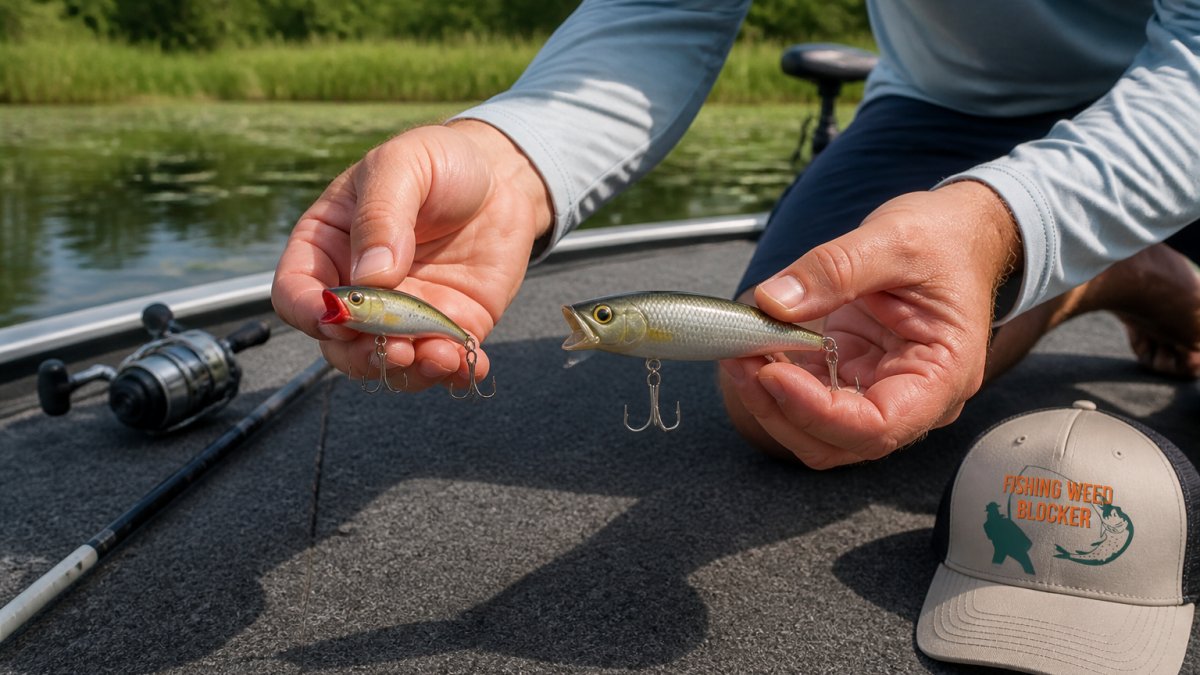
The most common sizing mistake in ponds is going too big. Pond bass are rarely giants, and a bait that looks oversized in two feet of clear water gets refused.
Use this pond-specific sizing matrix as a starting point, then adjust one variable at a time:
| Pond Condition | Lure Size to Start With | Why It Works |
|---|---|---|
| Clear, calm, heavily pressured | 1/4 oz to 3/8 oz popper; 3-inch to 4-inch walking bait | Small profile matches the small forage ponds actually hold and lands softly in spooky water |
| Stained or lightly windy | 3/8 oz to 1/2 oz popper; 4-inch to 5-inch walking bait | A larger profile pushes more water and is easier for a bass to track in low visibility |
| Matted grass and pads | Standard hollow-body frog (roughly 2.5 to 3 inches body, 1/2 oz class) | Compact enough to land on the mat without spooking fish underneath |
| Sparse grass and brush | 4-inch to 5-inch weedless plastic on a weighted hook | Skips under cover and slips through gaps a treble bait cannot |
| Big-fish pond with open lanes | 4.5-inch to 5-inch walking bait or prop bait | More surface disturbance pulls larger bass from farther out |
Three adjustments matter more than the number on the package:
- Match the forage, not the package. If you see small bluegill or shad flicking at the surface, a bait in that size class gets eaten more readily than a bigger profile that only looks impressive to you.
- Downsize before you downsize again. If bass are swiping and missing, drop one size class and lengthen the pause before changing lure families. A smaller bait with a longer dead stop often converts those swipes.
- Size up for distance and wind, not for ego. In a pond with a long open lane, a slightly larger walking bait casts farther and stays visible in chop. In a tight, pressured pond, the smaller bait usually wins.
Watch the fish, not the packaging. If bass are swiping and missing, your bait is probably too large or moving too fast. If they ignore it entirely in open water, it may be too small to notice. Change one variable, size first, then cadence, and you will learn more from a single pond session than from a season of guessing.
How to Keep Weeds Off Fishing Lures in Shallow Ponds
Weeds are the real constraint in shallow ponds, and the honest answer is that you manage them in three ways: bait choice, presentation angle, and hardware.
Bait choice comes first. Frogs and weedless plastics are built to slide through cover. Treble-hooked baits are not, so save them for open lanes.
Presentation angle comes second. A high rod tip keeps the line off the surface and pulls the bait over grass instead of into it. Casting parallel to a weed line rather than across it keeps you in the strike zone longer.
A weed-blocking device can catch weeds before they cover your bait and help keep the hook free of debris. For more, see how to keep weeds off fishing lures.
Topwater Fishing Tips for Small Ponds: Timing, Retrieves, and Seasonal Adjustments
Topwater fishing tips for small ponds come down to timing and restraint. Low light is your window: early morning and late evening, plus any stretch of overcast weather. Bass move shallow to feed in those hours, and surface lures get looked at instead of ignored.
Use this compact decision guide before your first cast:
| Condition | What It Tells You | Bait and Cadence Adjustment |
|---|---|---|
| Clear water, calm surface | Bass see the lure from a distance and spook easily | Smaller popper or compact walking bait; longer pauses, quieter pops |
| Stained water or light chop | Bass track by feel and silhouette more than sight | Prop bait or larger walking bait; steady retrieve, less dead-stopping |
| Falling water temperature (fall) | Bass feed up before winter and push toward banks | Walking bait and prop bait in open lanes; speed up slightly to cover water |
| Rising water temperature (spawn through early summer) | Bass hold tight to shallow cover | Frog over mats and weedless plastics in pockets; slow over cover, pause at openings |
| Midday heat or cold front | Bass pull tighter to cover or deeper | Fish the shade lines and deeper edges of cover; slow down and downsize |
| Heavy pressure (clear, small pond) | Bass have seen every bait | Quieter cadence, smaller profile, and change the pause before changing lures |
Retrieve cadence matters more than lure brand. Start slow. Speed up only if bass are actively chasing. When a fish boils behind the bait and misses, do not change lures. Change the pause. That is the single most useful adjustment in pond fishing.
Seasonally, shallow-dwelling bass push to the banks during spawning season and stay close through fall fishing as they feed up. For spooky fish, see how to approach skittish fish in clear shallow water.
Building Your Shallow Pond Topwater Setup
A pond topwater setup does not need to be expensive, but it does need to be matched. Beginners can also review our essential tackle for pond fishing beginners.
- Rod: medium-heavy, fast action, long enough to cast accurately from a bank or small boat
- Line: braid for frogs in cover, monofilament for treble-hooked baits that need a softer hookset
- Baits: one popper, one walking bait, one prop bait, two frogs in different sizes
- Weed control: a weed-blocking device ahead of treble-hooked baits, plus a hook file
- Retrieve discipline: one slow cadence you trust, adjusted by pause length before you ever swap lures
Beginners should start with a popper and a frog and add the rest as they learn how each bait reacts to their water. When rigging topwater baits, check our guide to the best weedless hooks for topwater lures.
| Bait Type | Best Water | Retrieve | Weed Tolerance |
|---|---|---|---|
| Popper | Calm, clear shallows | Twitch, pause | Low |
| Walking bait | Open water | Steady tap and slack | Low |
| Prop bait | Stained or choppy water | Slow, straight | Low |
| Hollow-body frog | Grass, pads, matted weeds | Slow over cover, pause at pockets | High |
| Weedless plastic | Sparse grass, brush | Slow lift and drop | High |
Shallow ponds can make lure presentation challenging. Fishing Weed Blocker’s patented device grabs weeds before they cover your bait and helps keep the hook free of debris. It is designed to cast with minimal drag, stacks in your tackle box, and is designed for trolling and bait fishing.
Frequently Asked Questions
Are poppers or walking baits better for small ponds?
Poppers win in tight quarters and around cover because they stay on a short leash and throw a splash that pulls bass from a few feet away. Walking baits cover more open water and shine when pond bass are spread out and willing to chase. A practical split: start with a popper along the bank and around weed edges, then switch to a walking bait over the middle of the pond once you have located fish.
How do you prevent weeds from fouling your topwater lure?
Keep the lure moving just fast enough to stay on top, and pause only briefly over open pockets rather than dense grass. A weed-blocking device can grab weeds before they cover your bait and help keep the hook free of debris.
What time of day is best for topwater bass fishing in shallow ponds?
Low light is the reliable window: first light and the last hour before dark, plus any overcast stretch when wind ripples the surface. In shallow ponds the water warms fast, so bass push into the shallows to feed during those cooler, dimmer periods. Midday topwater action usually means cloud cover or a wind-blown bank, so plan your casts around shade and surface chop rather than the clock.
What is the best retrieve speed for shallow water topwater baits?
Slow enough that the lure leaves a visible wake, fast enough that it never stalls and sinks. For poppers, two or three sharp pops followed by a one-second pause works in most shallow ponds. Walking baits want a steady rod-tip rhythm with no pause, while frogs and weedless plastics tolerate longer dead stops over thick cover. Let the bass tell you: if they swipe and miss, add a pause before the next twitch.
