
Table of Contents
- What Weedless Hooks Are and How Weed Guards Work
- Weedless Hook Sizes for Soft Plastics
- Weedless Hook Wire Guard vs Brush Guard
- How to Rig a Weedless Hook
- Durability Criteria and Hook Construction Quality
- Weedless Hook Maintenance and Testing
- Balancing Snag Resistance with Hookup Rate
- Frequently Asked Questions
Last Updated: October 19, 2026
What Weedless Hooks Are and How Weed Guards Work
Weedless fishing hooks are fishing hooks designed with a guard that keeps weeds, grass, and debris from snagging on the hook point. The guard is typically made of flexible wire or monofilament that sits just above the hook's barb. When your lure moves through thick vegetation, the guard deflects weeds away from the hook gap. Once a fish bites and you set the hook, the guard flexes back, exposing the point for a solid hookset.
The core problem is simple: standard hooks catch weeds as easily as they catch fish. A weedless design solves this by creating a barrier between your hook point and the vegetation around it.
Hook Point Protection Mechanisms
The guard works through one of two main approaches: wire guards and brush guards. Wire guards use a single strand of stiff monofilament or flexible wire that runs along the hook shank and curves over the hook point. This design is lightweight and casts smoothly. Brush guards, by contrast, use multiple strands of monofilament bundled together, creating a denser barrier. Brush guards shed weeds more aggressively but can slightly slow your lure's action if they're too stiff.
The key is guard stiffness. A guard that's too soft won't deflect weeds effectively. One that's too stiff will interfere with your hookset and may prevent fish from being hooked cleanly. The best guards balance snag resistance with reliable hook penetration.
Weedless Hook Sizes for Soft Plastics
Matching hook size to your soft plastic lure is critical for both weed protection and fish-catching performance. A hook that's too small won't hold larger fish. One that's too large will look unnatural and may not penetrate properly on the hookset.
For stick baits and worms in the 4-6 inch range, use 2/0 to 3/0 hooks. These sizes provide enough mass to drive through a fish's mouth while remaining proportional to the lure. For smaller finesse plastics (2-3 inches), drop down to 1/0 or even a #1 hook.
Wire gauge also matters. A heavier gauge (thicker wire) resists bending when you're ripping through heavy cover or fighting larger fish. Lighter gauges are more forgiving for finesse applications where you're targeting smaller species or using light line. Most weedless hooks in the freshwater market range from 0.035" to 0.045" wire diameter.
Weedless Hook Wire Guard vs Brush Guard
Wire guards use a single flexible strand, typically monofilament or a stiff wire, that runs from the hook eye, along the shank, and curves back over the hook point. They cast cleanly, preserve lure action, and are simple to inspect and adjust. The weakness is that a single strand can allow fine weeds to slip past in dense vegetation, and the attachment point at the eye or shank is a common failure spot if the weld or wrap is poorly finished.
Brush guards bundle multiple monofilament strands into a dense tuft. The extra material sheds weeds more aggressively, but it adds weight, creates drag on the retrieve, and can slow a lure's fall rate. Brush guards also tend to be stiffer, which raises the trade-off between snag resistance and hook penetration.
Construction and Durability Criteria
Guard durability comes down to three things you can check before you buy:
- Attachment quality. The guard should be wrapped or welded to the shank with no rough edges, gaps, or exposed wire ends. A loose or poorly finished attachment is the first thing to fail after repeated casts into cover.
- Material memory. Flex the guard gently toward the point and release it. It should return to its original position without cracking, splitting, or staying bent. Monofilament guards that have taken a set or gone brittle will not deflect weeds reliably.
- Wire gauge and finish. Heavier wire resists bending when you rip through grass mats, but it also stiffens the guard and can reduce hookup rate. A uniform coating or finish, matte rather than glossy, usually indicates a thicker protective layer that resists corrosion better than a thin shiny plating.
Matching Guard Style to Cover
Use a wire guard in moderate weed coverage where lure action and clean casts matter most. Use a brush guard in heavy vegetation where you are constantly ripping through grass mats and are willing to trade some sensitivity and fall rate for fewer fouled lures. In either case, inspect the guard after every few fish: a bent guard, a loose strand, or a dull point means it is time to replace the hook rather than risk a missed hookset.
How to Rig a Weedless Hook
Setting up a weedless hook correctly takes just a few steps. Start by inserting the hook point into the head of your soft plastic lure, pushing it through about a quarter-inch. Then thread the hook through the body of the plastic, keeping the point slightly offset to one side.
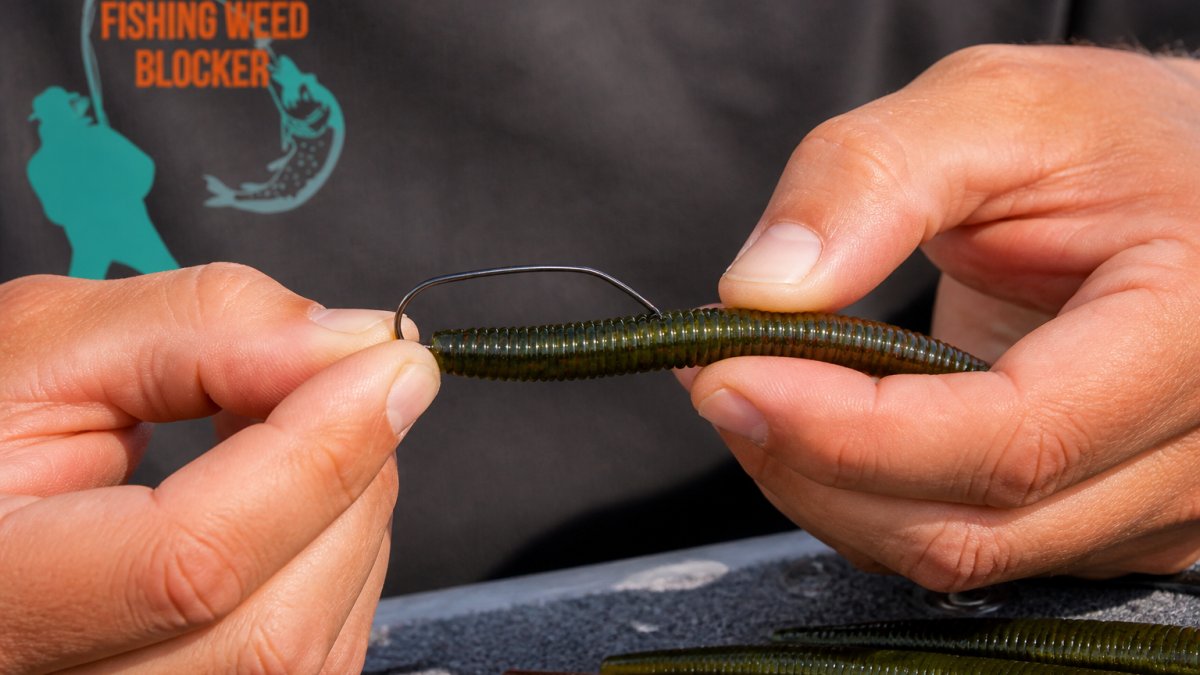
Make sure the guard sits cleanly above the hook point with no gaps. If the guard is bent or misaligned, weeds will find their way through. Thread the hook all the way through the plastic so the eye exits near the tail. This creates a balanced presentation that casts true and moves naturally through the water.
Wacky-Rig and Neko-Rig Setup
A wacky rig is one of the most effective finesse presentations for weedless hooks. Pierce the hook through the middle of a stick bait, perpendicular to the lure's body. This creates a horizontal orientation that allows the lure to flutter and fall on slack line. Wacky rigs work exceptionally well in light to moderate vegetation because the hook sits in the middle of the bait, keeping the point protected while still allowing natural movement.
A Neko rig is similar but adds a small weight (typically 1/8 to 1/4 ounce) to the tail of the stick bait. The hook still pierces the middle of the lure, but the weight gives you better casting distance and a more controlled fall. Neko rigs excel in deeper vegetation or when you need to cover water more efficiently.
Durability Criteria and Hook Construction Quality
Hook durability depends on three factors: material quality, weld strength, and guard construction. Premium hooks are forged from high-carbon steel, which resists bending and maintains sharpness longer than lower-grade materials.
Corrosion resistance matters too, especially in freshwater where you're constantly exposing the hook to wet conditions. Look for hooks with a reliable coating or finish that won't rust after a few trips. A dull finish is often more durable than a shiny one because it indicates a thicker protective layer.
Test weedless fishing hooks' durability before committing to a full pack. Bend the guard gently, it should flex smoothly without cracking or splitting. Check the hook point with your fingernail; it should be sharp enough to stick without sliding. A quality weedless hook will maintain these properties through dozens of casts and several fish.
Weedless Hook Maintenance and Testing
Keep your weedless hooks clean and dry between fishing trips. Rinse them with fresh water and store them in a dry tackle box. Moisture and salt can corrode even quality hooks over time.
Before each outing, inspect your hooks for damage. Look for bent guards, dull points, or rust spots. A dull hook won't penetrate a fish's mouth reliably, even if the guard is perfect. If you notice any deterioration, replace the hook. It's not worth losing a fish because you tried to save a few cents on worn-out gear.
Test your guard's flexibility by gently pressing it toward the hook point. It should move smoothly and return to its original position. If the guard feels brittle or won't flex, it's time for a replacement. A compromised guard defeats the entire purpose of using a weedless hook.
Balancing Snag Resistance with Hookup Rate
The core tension is simple: the more protection your guard provides, the harder it can be to drive the hook point home. A stiff, heavy guard sheds weeds beautifully but may block penetration on light bites. A soft, flexible guard hooks fish more reliably but lets more vegetation reach the point.
A Systematic Selection Process
Instead of guessing, work through four variables in order:
- Target species and size. Larger fish with harder mouths need a heavier wire and a guard stiff enough to stay out of the way on a firm hookset. Finesse species call for lighter wire and a softer guard so the point can penetrate with minimal pressure.
- Cover density. Light to moderate vegetation favors a wire guard and lighter line for sensitivity. Heavy grass mats and wood favor a brush guard or a stiffer wire guard, accepting some loss of feel in exchange for fewer snags.
- Lure size and action. Match hook size and wire gauge to the plastic: 2/0 to 3/0 for 4-6 inch stick baits and worms, 1/0 or #1 for 2-3 inch finesse plastics, and 4/0 to 5/0 for 7-inch-plus swimbaits and creature baits. A guard that is too stiff can deaden the action of a lightweight finesse plastic.
- Rod and line. A stiffer rod and heavier line (15-20 lb test) let you set the hook harder through a stiff guard. Lighter line (8-12 lb test) requires a smoother, more controlled hookset and pairs better with a softer guard.
Adjusting the Guard
Many wire guards can be tuned. Bending the guard slightly away from the point increases exposure and improves hookup rate at the cost of some weed protection; bending it closer increases protection but can interfere with penetration. Make small adjustments and test in the water rather than bending the guard repeatedly, which weakens the material.
Durability and Maintenance Checks
Balance is not just about the guard, it is about the whole hook staying reliable. Before each trip, check the point with a fingernail (it should stick without sliding), inspect the guard attachment for looseness or rough edges, and look for rust or finish wear. Rinse hooks in fresh water and dry them before storage. A hook that has lost its point or has a brittle guard will fail you on the hookset no matter how well you matched it to the cover.
Frequently Asked Questions
What should I look for in a durable weedless fishing hook?
Look for hooks made from high-carbon steel or forged materials that resist bending and corrosion. The wire gauge should match your target species and cover type, thicker wire for heavy cover, lighter gauge for finesse applications. Check that the weed guard is flexible enough to shed vegetation but stiff enough to protect the hook point. Examine the hook's sharpness and ensure the point hasn't been dulled by manufacturing. Reputable brands consistently maintain sharp points and consistent guard stiffness across batches.
Which weedless hook style works best in thick weeds?
Wire guards typically outperform brush guards in thick vegetation because they're more rigid and actively push weeds away from the hook point. In heavy cover like matted grass or dense wood, a wire guard with a stiffer construction resists weeds better while still allowing solid hooksets. For lighter vegetation, monofilament or fluorocarbon guards offer better lure action and can be equally effective. Test your setup by retrieving through your target cover, the guard should shed weeds cleanly without fouling.
How often should I replace a weedless fishing hook?
Replace weedless hooks when the point becomes visibly dull, bent, or chipped, typically after 10-20 fish depending on cover density and hook quality. Inspect your hook after every fishing trip, especially if you've been ripping through heavy vegetation or wood. A simple test: drag the hook point gently across your thumbnail. If it doesn't catch or leaves no mark, it's time to replace it. Bent or weakened guards should also trigger replacement, as they won't protect effectively or may fail during a hookset.
Do weed guards reduce hook-up rates?
Weed guards can reduce hook-up rates if they're too stiff or poorly designed, but quality guards with proper flexibility maintain reliable penetration. The trade-off exists: maximum snag resistance requires stiffer guards, which slightly delay point contact. However, a well-tuned guard, flexible enough to collapse on hookset but stiff enough to shed weeds, minimizes this penalty.