
Table of Contents
- Weedless Hooks vs Standard Hooks for Bass: The Core Tradeoff
- Hook-Up Ratio and Hooking Percentage: What You Give Up
- How to Rig Weedless Hooks for Bass
- Hook Set Techniques for Bass With Weedless Rigs
- Weed Guard, Wire Gauge, and EWG vs Standard Profiles
- Fishing Weed Blocker Benefits for Trolling and Bait Fishing
- When to Choose a Standard Hook Over a Weedless Design
- Conclusion
- Frequently Asked Questions
Last Updated: October 1, 2026
Weedless Hooks vs Standard Hooks for Bass: The Core Tradeoff
Weedless hooks vs standard hooks for bass comes down to one question: do you want more bites or more landed fish? A weedless hook hides its point behind a weed guard so you can fish grass, brush, and wood without snagging. A standard hook leaves the point exposed for maximum penetration. You trade hook-up ratio for snag-free fishing, and the water you fish decides which trade is worth it.
This guide from Fishing Weed Blocker breaks down exactly when each design wins, how to rig both, and how to set the hook so you stop losing fish.

Hook-Up Ratio and Hooking Percentage: What You Give Up
Hook-up ratio is the percentage of detected bites that end with a fish on the line. A standard hook with an exposed point converts more of those bites because nothing stands between the point and the fish's mouth. A weedless hook gives some of that back, and understanding exactly where the loss happens is what lets you minimize it.
Three mechanical factors drive the gap:
-
Guard collapse time. The weed guard has to fold flat before the point can travel. On a stiff, multi-strand guard, that collapse can eat a fraction of a second, enough for a short-striking bass to clamp down and spit before the point ever reaches tissue.
-
Point-to-shank geometry. On a standard hook, the point sits in line with the pull direction. On a weedless hook, the point is offset behind the guard, so the set has to rotate the hook before it drives. A wide-gap profile shortens that rotation; a narrow offset lengthens it.
-
Plastic displacement. In a Texas rig, the point has to punch through the bait body before it reaches the fish. The more plastic between the point and the surface, the more energy the set loses.
-
Standard hook: highest hooking percentage, zero snag protection
-
Weedless hook: lower hooking percentage, fishes where standard hooks cannot
-
The gap: most of the difference comes from guard stiffness, plastic displacement, and hook set power, not the hook itself
What most anglers never test is the guard itself. A common pattern is to thin a stiff factory guard by clipping a few strands, then fish the same bait on the same water and compare. Many practitioners find that a properly thinned guard recovers most of the lost hook-up ratio without giving up meaningful snag protection. The hook was rarely the problem. The guard was too stiff, or the plastic was too thick over the point.
One more variable competitors rarely mention: water clarity. In clear water, bass tend to inspect a bait longer before committing, which means more short strikes and more chances for the guard to cost you. In stained or muddy water, fish commit harder and faster, and the guard's delay matters less. That is one reason a weedless hook can feel "worse" on a clear lake and "fine" on a muddy one, the fish, not the hook, changed the math.
How to Rig Weedless Hooks for Bass
Rigging a weedless hook correctly is the difference between a bait that swims true and one that spins, snags, or misses fish. The Texas rig is the standard method for soft plastics.
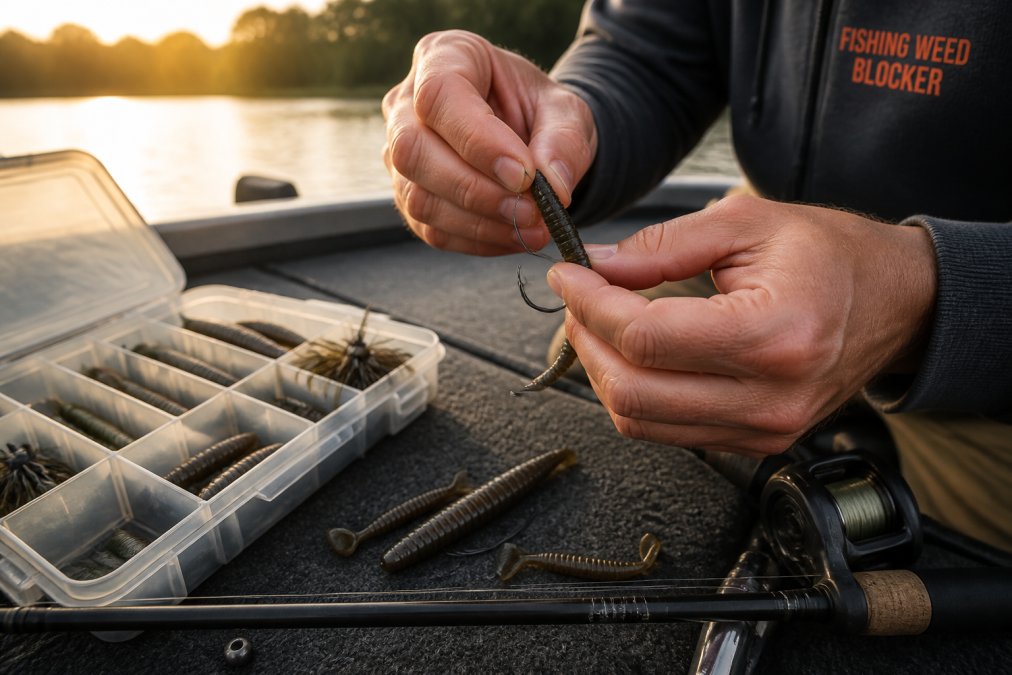
- Thread the hook point into the nose of the soft plastic and push it through about a quarter inch.
- Bring the point out the top, then slide the bait up the shank past the hook eye.
- Rotate the bait so it sits straight, then bury the point back into the plastic body.
- Pull the nose of the bait up over the hook eye to lock it in place.
- Check that the bait hangs straight. If it curls, re-center it on the shank.
Hook Set Techniques for Bass With Weedless Rigs
Hook set techniques for bass change completely when you fish weedless. A soft, sweeping hook set that works with an exposed point will miss fish behind a weed guard.
- Heavy cover: cross their eyes. Short, violent hook set, then reel fast to keep them out of the grass.
- Open water with weedless: a firm sweep is enough. Do not overdo it and rip the bait free.
- Braided line: zero stretch, so a shorter stroke delivers more power to the point.
- Fluorocarbon: some stretch, so lengthen the sweep to compensate.
Weed Guard, Wire Gauge, and EWG vs Standard Profiles
Weed guard thickness and wire gauge decide how a weedless hook performs. A thick, stiff guard protects the point but kills your hooking percentage. A thin, flexible guard collapses easily but snags more.
| Feature | Thin Guard / Light Wire | Thick Guard / Heavy Wire |
|---|---|---|
| Snag protection | Moderate | High |
| Hook-up ratio | High | Lower |
| Best for | Light grass, open water | Heavy cover, wood, mats |
| Hook set needed | Firm sweep | Hard, fast drive |
Fishing Weed Blocker Benefits for Trolling and Bait Fishing
Fishing Weed Blocker benefits show up most when you troll or soak bait in weedy water. The device grabs weeds before they reach your bait, so your presentation stays clean cast after cast.
- Grabs weeds before they cover your bait
- Protects your lure from being covered in weeds
- Works for trolling and bait casting
- Casts like a rocket with minimum drag
When to Choose a Standard Hook Over a Weedless Design
Reach for a standard hook when you fish:
- Rock and gravel banks with no grass
- Deep ledges and drop-offs
- Suspended fish in open water
- Finesse presentations where every bite counts
- Clear water where fish inspect before committing
A simple decision path. Work through these in order:
- Is there cover in the strike zone? If yes, go weedless. If no, go standard.
- How dense is the cover? Light grass or scattered wood favors a thin-guard weedless hook. Mats, milfoil, and hydrilla favor a heavy guard or a weed-blocking device in front of a standard hook.
- How big is the bait? Bulky soft plastics need a wide-gap hook to clear the body on the set. Slim finesse baits fish fine on a standard offset hook.
- How clear is the water? Clear water rewards natural presentation and a standard hook on finesse baits. Stained water rewards penetration and a standard hook on power presentations.
- How pressured are the fish? High pressure favors exposed points and natural profiles. Low pressure tolerates weedless hardware.
Unlike a weedless hook, which hides the point, a weed-blocking device in front of a standard hook keeps the whole presentation clear while preserving the exposed point's penetration. That combination is the real answer for anglers who fish cover edges where the bottom is clean one cast and matted the next.
Conclusion
The real challenge is not choosing a side. It is matching your hook and your presentation to the water in front of you, and keeping weeds off your bait long enough to get a clean bite.
Frequently Asked Questions
Do weedless hooks actually reduce your hook-up ratio?
Yes, they can. The weed guard or buried hook point that keeps grass off your bait also absorbs some of the force when you set the hook. On a standard hook, the point is already exposed, so it drives home faster. On a weedless hook, the guard has to flex out of the way first. The gap narrows slightly too, which matters when a bass barely nips the bait. You trade some hooking percentage for staying snag-free in cover. In open water with no grass, that trade usually is not worth it.
How does the Fishing Weed Blocker compare to traditional weedless hooks?
They solve different problems. A weedless hook hides the point behind a guard so the hook itself slides through grass. The Fishing Weed Blocker is a separate device that grabs weeds before they reach your bait or lure, and it is built for trolling and bait fishing. It costs $15.97 and comes in a three pack. If you are trolling a bait through scattered vegetation, the blocker protects the presentation. If you are casting a Texas rig into a brush pile, a weedless hook is the better fit.
What are the best hook set techniques for bass with weedless rigs?
Reel down until you feel the fish's weight, then sweep the rod hard and fast to the side. A sideways sweep drives the point through the guard better than a straight-up snap, which can pull the bait out of the fish's mouth. Use a heavy-action rod with braided line so the force transfers through the soft plastic. Do not set the hook the instant you feel a tap; wait until the line loads up. A slow, weak set is the most common reason anglers miss fish on weedless rigs.
Are weedless hooks necessary for open water bass fishing?
No. In open water with little or no vegetation, a standard hook gives you a wider gap, an exposed point, and a cleaner hook set. There is nothing to snag on, so the weed guard only adds resistance. Save weedless hooks for grass, pads, brush, and heavy cover. If you fish both, keep a few of each tied on separate rods so you are not re-rigging every time the bottom changes. Match the hook to the cover, not the other way around.