
Table of Contents
- Weedless Lures in Heavy Vegetation: What You Need to Know
- Best Weedless Lures for Bass in Thick Cover
- How to Prevent Weeds on Fishing Lures: Rigging and Tackle
- Fishing Heavy Cover Techniques: Casting and Retrieve
- Hook-Setting and Extracting Fish from Vegetation
- Seasonal and Environmental Adjustments
- Tackle Specifications by Cover Density
- Troubleshooting Common Problems
- Frequently Asked Questions
Last Updated: October 6, 2026
Weedless Lures in Heavy Vegetation: What You Need to Know
A weedless lure is built or rigged so its hook point stays hidden or shielded, letting it slide through grass, pads, and mats without snagging.
Heavy vegetation is where bass live, though. Shade, oxygen, and ambush points all sit inside the green stuff, so anglers who fish it well catch fish others never reach.
Best Weedless Lures for Bass in Thick Cover
The best weedless lures for bass depend on where the vegetation sits in the water column. Surface mats call for frogs, sparse or submerged weeds suit spinnerbaits, and dense, mid-depth cover belongs to Texas-rigged soft plastics.
Frogs for Surface Mats
Hollow-body frogs are the top choice over surface mats. The body sits on top of the vegetation and the hooks stay tucked until a bass strikes, letting you drag the frog across slop that would swallow any exposed hook. Fish it with a steady retrieve, pause at every opening, and wait a beat after a blow-up before setting the hook.
Spinnerbaits for Submerged and Sparse Weeds
A spinnerbait shines in submerged weeds and sparse grass. The wire frame and single hook deflect off stalks instead of digging in, and the spinning blade draws reaction strikes in stained water. Reel slow and steady so the bait ticks the tops of the weeds; when it bumps cover, speed up for a second to trigger following bass.
Soft Plastics: Texas Rig and Weightless Options
Soft plastics cover the widest range of heavy cover. A Texas rig punches through mats and dense grass. A weightless worm or stickbait skips and glides over the top.
Rig the plastic straight and check the hook point often. A hook that pokes through the plastic will grab weeds on every cast.
| Lure | Best Cover | Retrieve Style | Hook Exposure |
|---|---|---|---|
| Frog | Surface mats | Steady with pauses | Tucked |
| Spinnerbait | Submerged, sparse weeds | Slow and steady | Shielded by wire |
| Texas-rigged plastic | Dense grass, mats | Hop and drag | Buried in plastic |
| Weightless plastic | Open pockets, edges | Slow sink, twitch | Buried in plastic |
How to Prevent Weeds on Fishing Lures: Rigging and Tackle
Preventing weeds starts with rigging, not luck. A lure that collects grass on every cast is usually rigged wrong, not fished wrong. Two rigs solve most of it: the Texas rig with a bullet weight, and the weightless setup.
Texas Rigging with a Bullet Weight
A Texas rig hides the hook point inside the plastic and slides a bullet weight ahead of it. The pointed weight slips through grass instead of catching it, making it the workhorse for dense cover.
How to rig it:
- Slide a bullet weight onto your line, point first.
- Tie on an offset worm hook.
- Push the hook point into the nose of the plastic and out the side.
- Slide the plastic up over the hook eye.
- Bury the hook point just under the surface of the plastic.
Test the rig in the water before your first cast. If the plastic rolls or the hook point shows, redo it.
Weightless Soft Plastics
Weightless soft plastics work best around open pockets and weed edges. With no weight, the bait sinks slowly and stays high in the water column, and that slow fall draws strikes from bass watching the cover. Rig it like a Texas rig minus the bullet weight, cast into openings, and let it fall on a semi-slack line.
Fishing Heavy Cover Techniques: Casting and Retrieve
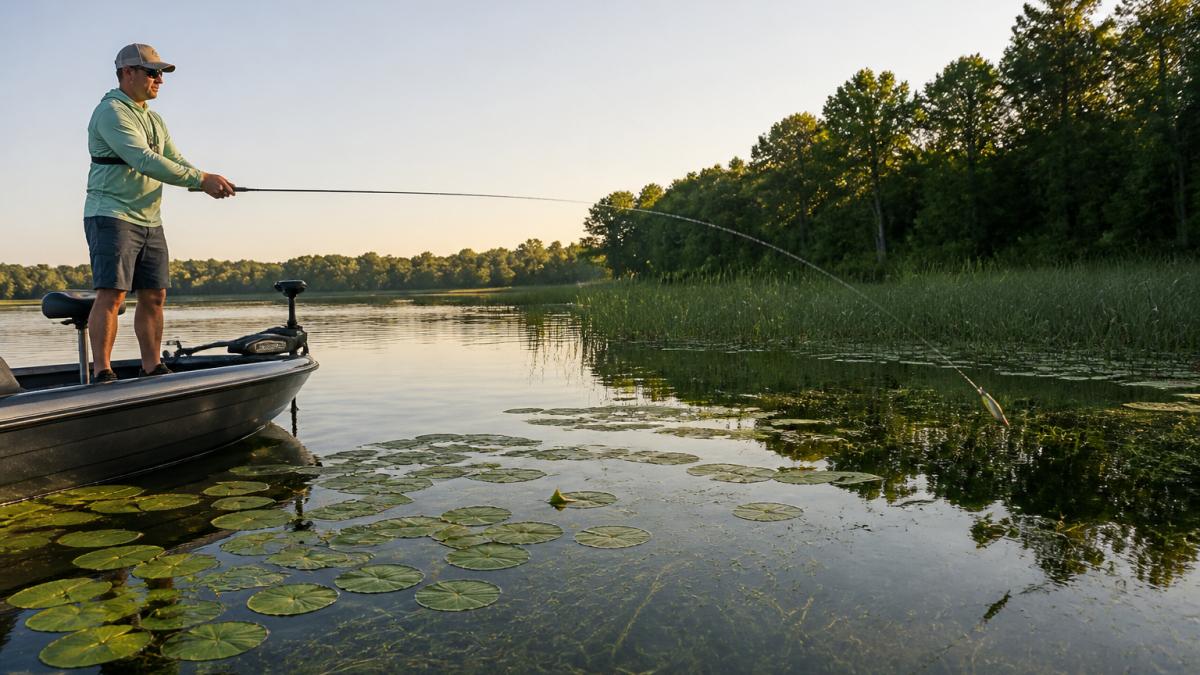
Fishing heavy cover comes down to two moves: cast past the pocket, and retrieve toward it.
Casting Mechanics
Accuracy beats distance in heavy cover. A short, accurate cast into a pocket produces more than a long cast that lands on top of a mat. Use a sidearm or roll cast to keep the lure low and skip it under overhanging vegetation; a high, lobbing cast often lands on top of the mat instead of in the opening.
Retrieve Cadence by Lure
Each lure has a natural cadence. Match it to the lure and the mood of the fish.
Frog over a mat:
- Steady reel with the rod tip high, 12-18 inches of line retrieved per turn.
- Pause for one to two seconds at every opening or edge.
- After the pause, twitch the rod tip once and resume.
Spinnerbait through sparse weeds:
- Slow, steady reel just fast enough to keep the blade thumping.
- When the bait ticks a stalk, speed up for two or three turns, then slow back down.
- Keep the rod tip at 10 o'clock so the bait rides above the weeds.
Texas rig through dense grass:
- Hop-and-drag: lift the rod tip, reel down, let the bait fall on a semi-slack line.
- Pause two to three seconds on the fall, most strikes come as the bait drops.
- If you feel a tick, reel down until the line is tight, then sweep.
Weightless plastic in pockets:
- Cast, then let the bait fall on a semi-slack line.
- Watch the line where it meets the water. A jump or sideways move means a fish.
- Twitch once, pause, twitch again. Slow is usually better than fast.
Working Openings and Edges
Openings and edges are where bass ambush. Work them in a pattern:
- Cast past the opening.
- Retrieve into it and let the lure fall through.
- If no strike, twitch once and continue.
- Cast the next opening 10-15 feet down the edge.
Fan your casts along the weed line before moving, and keep the trolling motor low so bass don't scatter.
Pulling a Lure Free Without Fouling
When a lure hangs up, do not jerk, that drives the hook deeper and often tears the plastic. Instead:
- Give the line a sharp, short pop with the rod tip to break the bait free.
- If that fails, reel down until the line is tight, then bow the rod and pull steadily.
- If still stuck, move the boat past it and pull from the opposite direction.
After any hang-up, check the hook point. Vegetation often pushes the hook back through the plastic, and a re-buried hook prevents the next snag.
Hook-Setting and Extracting Fish from Vegetation
Hook sets in heavy cover need power and speed. Braided line and a heavy rod let you drive the hook home and pull the fish out fast.
Follow this sequence:
- Reel down until the line is tight.
- Sweep the rod hard to the side, not straight up.
- Keep the rod bent and reel fast.
If the fish buries in the weeds, don't panic. Keep steady pressure and wait. Most bass will work free on their own. Pulling harder only tears the hook loose.
Seasonal and Environmental Adjustments
Vegetation changes through the year, and so does the way bass use it. Four variables drive most of the adjustment: water temperature, water clarity, light level, and vegetation growth stage.
Water Temperature
Bass are cold-blooded, so temperature sets their metabolism and position. A common pattern anglers report:
- Below 50°F: Bass hold on the deepest remaining green vegetation and feed rarely. Downsize to a small, slow finesse plastic on the bottom.
- 50-60°F: Fish move to the outside edge and the first drop-off next to cover. A slow-moving jig or Texas rig on the bottom produces.
- 60-70°F: Pre-spawn and spawn activity pushes bass into shallow, new growth. Slow plastics and weightless stickbaits near emerging stems.
Water Clarity
Clear water lets bass see your lure from farther away, so a natural, slower presentation usually outperforms a fast reaction bait. Stained or muddy water cuts visibility, so a spinnerbait with a large blade, a louder rattle, or a darker silhouette helps fish find the bait by feel and vibration.
Light Level
Low light, dawn, dusk, overcast, or a shaded mat, pushes bass shallower and more aggressive. That is when topwater frogs and fast-moving spinnerbaits earn their keep. Bright, high-sun conditions push fish tight to cover or deeper, and a slow, bottom-oriented Texas rig usually beats a fast retrieve.
Vegetation Growth Stage
Vegetation is not static. Early in the season, new stems are sparse and easy to fish through; as the season progresses, mats thicken and open pockets shrink; by late season, decay can create soft, gassy bottoms that foul baits and reduce oxygen. Match your lure to the stage:
- New growth: Spinnerbaits and weightless plastics work the edges.
- Mid-season mats: Frogs and punch rigs.
- Late-season decay: Slow plastics on the bottom, and be ready to clear fouled hooks often.
Depth and Bottom Type
Bass relate to depth as much as cover. A shallow mat over a hard bottom holds fish differently than a deep weedline over muck. Use your electronics or a weighted probe to find the depth break, then position your cast so the lure crosses it. On soft, gassy bottoms, a lighter weight or a slow-fall plastic keeps the bait from burying in the muck.
Tackle Specifications by Cover Density
Tackle should match the cover, not your favorite rod. Heavy cover needs heavier gear. Light cover lets you downsize and cast farther. Use this as a starting point:
| Cover Density | Line | Rod Power | Lure Type |
|---|---|---|---|
| Light weeds | 30 lb braid | Medium-heavy | Weightless plastic |
| Sparse to medium | 40 lb braid | Medium-heavy | Spinnerbait |
| Dense grass | 50 lb braid | Heavy | Texas rig |
| Surface mats | 65 lb braid | Heavy | Frog |
Braided line is the standard for heavy cover. It cuts through grass, has almost no stretch, and lets you feel soft bites. Pair it with a heavy rod and a fast reel, and you can pull bass out of almost anything.
Troubleshooting Common Problems
Most weedless lure problems trace back to three causes: fouled hooks, wrong lure choice, and slow hook sets. Fix those and your catch rate climbs.
- Lure keeps collecting weeds: The hook point is exposed. Re-bury it in the plastic.
- Missed strikes on frogs: You're setting too fast. Wait until you feel weight.
- Bait won't run straight: The plastic is rigged crooked. Slide it off and start over.
For trolling and bait fishing, a weed guard device can help keep grass off your presentation. Our Fishing Weed Blocker grabs weeds before they reach your bait, so your hook stays clean and your lure stays visible.

Frequently Asked Questions
What is the best way to fish heavy vegetation for bass?
Target the edges and openings first. Cast beyond the weed pocket and retrieve toward it, using frogs over surface mats, spinnerbaits around submerged weeds, and Texas-rigged soft plastics through the thickest cover. Use braided line and heavy tackle to pull fish out. Keep your lure moving just fast enough to stay above the vegetation and avoid fouling.
How do you keep weeds off your lure when fishing?
Rig soft plastics weedless with the hook point buried in the plastic. Use a bullet weight for Texas rigs and choose lures with built-in weed guards. Cast past the pocket and retrieve toward it. For trolling or bait fishing, a device like the [Fishing Weed Blocker](https://fishingweedblocker.store/products/fishing-weed-blocker) ($15.97) grabs weeds before they cover your bait, keeping the hook free of debris.
What are the best weedless lures for thick cover?
Hollow-body frogs work best over surface mats. Spinnerbaits handle submerged and sparse weeds. Texas-rigged plastic worms and weightless soft plastics get through heavy vegetation. Match the lure to the cover type: frogs for mats, spinnerbaits for submerged weeds, and soft plastics for fishing through openings and edges.
How do you retrieve a lure through heavy weeds?
Cast beyond the weed pocket, then retrieve toward it. Use a steady, moderate speed for spinnerbaits and soft plastics. For frogs, use a stop-and-go action over surface mats. Keep the rod tip up to guide the lure over weeds. If you feel it collecting weeds, give a sharp snap to clear it before continuing.
Heavy vegetation doesn't have to mean lost lures and empty livewells. With the right weedless lures, the right rig, and a hard hook set, you can fish cover most anglers avoid. Fishing Weed Blocker makes that easier with a patented, award-winning device that grabs weeds before they cover your bait, protects your presentation, and cuts drag in the water. Get started with Fishing Weed Blocker and spend more time fishing and less time clearing grass off your hook. 🎣