

Table of Contents
- Why Bass Hide in Lily Pads and Heavy Cover
- Best Weedless Lures for Bass in Lily Pads
- How to Rig a Frog for Lily Pads
- Gear Setup for Fishing Heavy Cover Without Snagging
- How to Use a Fishing Weed Blocker
- Retrieval Speed and Cadence Through Thick Vegetation
- Post-Hookup Extraction From Lily Pads
- Frequently Asked Questions
Last Updated: September 29, 2026
Why Bass Hide in Lily Pads and Heavy Cover
Bass love lily pads because they're perfect ambush spots. 🎣 The thick vegetation provides shade, protection, and a hunting ground all in one. When you're fishing lily pads without getting snagged, you're targeting fish in their comfort zone, but that comfort zone is exactly what makes it tricky to fish.
Heavy cover creates structure. Fish use stems and matted vegetation as highways and hiding spots. They dart out to strike prey, then retreat back into the weeds. Understanding this behavior changes how you approach the water.
The challenge isn't finding bass in lily pads. It's reaching them without your lure getting tangled in vegetation. Most anglers either avoid these areas entirely or lose too many lures to frustration. That's where technique and the right gear make all the difference.
Best Weedless Lures for Bass in Lily Pads
Topwater frogs are the gold standard for lily pad fishing. They glide across the surface and skip through vegetation without sinking into the mess. When a bass strikes a frog, the hookset is immediate and satisfying.
Soft plastic worms rigged Texas-rigged work exceptionally well in heavy cover. The weed guard protects the hook point, and the finesse profile lets the lure slip through stems easily. Pitch these into pockets between lily pads and work them with a slow, deliberate retrieve.
Spinnerbaits and chatterbaits cut through vegetation with their blade action. The blade deflects off weeds while the lure stays weedless. These are excellent choices when you need to cover water quickly and draw aggressive strikes from bass in the area.
Key lure characteristics for lily pad success:
- Weedless design, hook guard or protected point
- Light profile, slips through stems without snagging
- Vibration or flash, helps bass locate your lure in murky water
- Buoyancy, topwater options work best in shallow pads
How to Rig a Frog for Lily Pads
Rigging a frog correctly ensures it performs as designed. Start with a quality weedless frog that has a reinforced hook eye. Tie it directly to your main line using a Palomar knot or improved clinch knot, both provide excellent strength and reliability.
The frog's body should sit parallel to the water surface. If it's tilted or riding at an angle, adjust your knot or try a different hook size. A properly rigged frog walks side-to-side when you twitch it, creating the characteristic "walking the dog" action that attracts bass.
For Texas-rigged soft plastics in lily pads, thread the worm through the head at a slight angle. This keeps the hook point buried inside the plastic, creating a truly weedless presentation. The worm should hang straight without any curl or twist.
Retrieval matters as much as rigging. Work your frog with short, deliberate twitches. Pause between twitches to let the lure settle slightly. This mimics struggling prey and triggers strikes from bass hiding in the vegetation.
Gear Setup for Fishing Heavy Cover Without Snagging
Your rod and reel combo is critical when fishing lily pads without getting snagged. You need a sturdy setup that can handle the pressure of pulling bass out of thick vegetation.
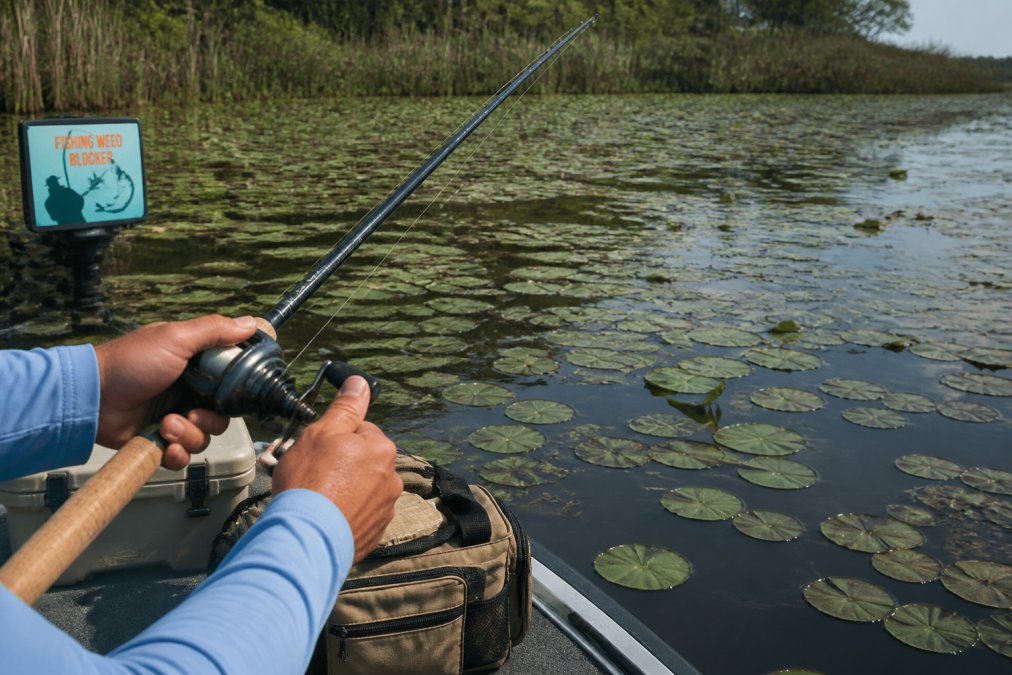
Use a rod with backbone, something in the 6.5 to 7-foot range with a fast action tip. Fast action gives you sensitivity to detect strikes while the backbone provides power to horse bass out of the weeds. Medium-heavy power is ideal for most lily pad situations. The fast tip also helps you set the hook quickly when a bass strikes a topwater frog, critical because the fish often turns and runs toward deeper water immediately after the strike.
Pair your rod with a reel that has a high gear ratio. A 7:1 or faster gear ratio lets you take up line quickly and set the hook with authority. This speed matters when a bass charges toward open water after the strike. A slower reel (6:1 or lower) forces you to crank harder to maintain tension, which tires your forearm and reduces your ability to apply side pressure during extraction.
Line selection determines your success rate in heavy cover:
- Braided line, superior strength and sensitivity, cuts through vegetation better than monofilament. Braided retains 100% of its rated strength even when wet, while monofilament loses 10-15% when saturated. In lily pads, this difference is the margin between landing a 5-pound bass and losing it to a snapped line.
- Line diameter, thinner diameter means less water resistance but adequate strength for the task. 30-40 pound braided is the sweet spot for most lily pad fishing, strong enough for hooksets and extraction, thin enough to slip through stems without constant fouling.
- Drag pressure, set your drag so the line doesn't break when you horse a fish, but tight enough to keep tension. Test your drag by pulling on the line with your hand, it should give way with firm, steady pressure but not slip under normal casting load. Too loose and you lose control; too tight and you risk breaking the line on the hookset.
Most anglers fishing lily pads use braided line in the 30-50 pound range. This gives you the strength to pull bass from dense mats while maintaining sensitivity to detect subtle strikes.
Using electronics to identify lily pad structure is a game-changer most anglers overlook. Side-imaging sonar (available on modern fish finders from major manufacturers) shows you the density of lily pad stems below the surface. Dense stem clusters appear as thick, dark bands on your screen, while open water pockets show as lighter areas. This visual information lets you target the thickest cover where bass hide, rather than fishing randomly across the entire pad field.
When you're scanning lily pads with side-imaging, look for pocket edges, the boundary between dense vegetation and open water. Bass position themselves at these edges because they can ambush prey moving through open water while staying protected in thick cover. A pocket 3-5 feet wide surrounded by dense pads is a high-probability strike zone. Your sonar shows you these pockets before you cast, saving time and increasing accuracy.
Down-imaging sonar (also called traditional sonar) shows you the depth of the lily pad root system and the hardness of the bottom.
How to Use a Fishing Weed Blocker
A fishing weed blocker is a practical device that prevents vegetation from covering your bait or lure. The Fishing Weed Blocker grabs weeds before they can tangle around your presentation, keeping your bait visible and attractive to bass.

Here's how to use one effectively:
- Attach to your line, Slide the weed blocker onto your main line above your lure or bait
- Position correctly, Keep it 12-18 inches above your hook to intercept weeds before they reach your presentation
- Cast and retrieve, The device glides through vegetation smoothly, deflecting weeds away from your lure
- Maintain tension, Keep steady pressure on your line so the blocker stays positioned properly
Retrieval Speed and Cadence Through Thick Vegetation
Your retrieve speed determines whether bass strike or ignore your lure. In lily pads, slower is almost always better. Bass in heavy cover have limited visibility, so they need time to locate your lure and commit to the strike.
Different lures require different cadences:
- Frogs, short twitches with 1-2 second pauses between movements
- Soft plastics, slow crawl with occasional hops, letting the lure rest frequently
- Spinnerbaits, steady retrieve at moderate speed, allowing the blade to maintain vibration
Post-Hookup Extraction From Lily Pads
You've set the hook. Now comes the hard part, getting your bass out of the lily pads without it breaking free or tangling in vegetation.
Frequently Asked Questions
How do you keep your lure from getting snagged in lily pads?
Use weedless lures with weed guards, fish with braided line for better sensitivity, and pair your setup with a Fishing Weed Blocker to grab vegetation before it covers your presentation. Match your retrieval speed to cover density, slow and steady through matted vegetation, faster through scattered stems. The key is combining the right gear with intentional retrieval technique.
What are the best weedless lures for fishing lily pads?
Topwater frogs, spinnerbaits, and chatterbaits excel in heavy cover. Frogs have upturned hooks that shed weeds naturally. Spinnerbaits with blade deflection push vegetation aside. Texas-rigged soft plastics with weed guards also work well. Choose based on water depth and vegetation density, frogs for shallow, matted pads; spinnerbaits for scattered stems.
Does a Fishing Weed Blocker actually work, or does it slow down your lure?
The Fishing Weed Blocker is engineered to cast smoothly and flow through water with minimal drag, so it won't noticeably slow your presentation. It actively grabs weeds before they wrap around your lure or bait, keeping your offering visible and attractive. At $15.97 for a four-pack, it's a practical solution for trolling and bait fishing without compromising lure action.
What rod and reel setup works best for fishing lily pads without snagging?
Use a medium-heavy power rod with a fast backbone for solid hook sets in heavy cover. Pair it with a reel offering 6.5:1 to 7.1:1 gear ratio for quick retrieves. Braided line (20-30 pound test) provides superior sensitivity and cuts through vegetation better than monofilament. The combination gives you the rod backbone needed for extraction and the line diameter to handle snags.