
Table of Contents
- Weeders Digest vs Pond Warehouse: What Actually Separates Them
- Category-by-Category Product Availability
- Lake and Pond Management Tools: What to Compare Before You Buy
- Aquatic Weed Control Equipment: Selection Criteria That Matter
- Water Skimmer Comparison: Manual vs Powered Units
- Lake Weed Harvester Comparison: What to Know Before Buying
- Shipping, Returns, and Customer Support
- Making the Right Choice for Your Pond
- Frequently Asked Questions
Last Updated: October 6, 2026
Weeders Digest vs Pond Warehouse: What Actually Separates Them
Weeders Digest vs Pond Warehouse comes down to one question: are you managing a half-acre backyard pond or a 40-acre lake?
This guide from Fishing Weed Blocker breaks down the real differences. We care most about the tools that keep lines, lures, and bait working. 🎣
The two retailers overlap more than their homepages suggest. Both stock aquatic weed control equipment, water skimmers, and seasonal supplies.
Category-by-Category Product Availability
Availability is where these two retailers separate fastest. Weeders Digest carries a deep bench of lake and pond management tools built around weed removal and large-water equipment.
If your list is mostly aquatic weed control equipment, Weeders Digest usually has more to choose from. If your list mixes algae treatment, aeration, and general upkeep, Pond Warehouse tends to cover more of it in one order.
Where Each Retailer Stocks Deeper
- Weeders Digest: lake weed harvesters, weed cutters, and heavier weed removal gear for larger water bodies
- Pond Warehouse: algae control, aeration kits, fountains, and everyday pond maintenance supplies
- Both: basic water skimmers, pumps, and seasonal care items
Neither store wins every category. The winner depends entirely on what you are trying to fix.
How to Check Availability Before You Commit
Catalog depth only matters if the item is in stock when you need it. Before you add anything to a cart, run the same four checks on both sites:
- Stock status on the product page. Look for an explicit "in stock," "ships in X days," or "special order" label. An "Add to Cart" button with no status is a yellow flag on oversized freight items.
- Ships-from location and lead time. Large gear like harvesters, aerators, and fountains often ships from a manufacturer or regional warehouse rather than the retailer's shelf. That changes the delivery window and who you call if something arrives damaged.
- Seasonal stock swings. Algae treatments, aeration kits, and de-icing supplies move in waves. A product easy to find in April can be backordered by July. If you are buying off-season, confirm the item is not discontinued.
- Special-order and custom options. Weed cutters with specific widths, fountain nozzles, and harvester attachments are frequently built to order. Ask whether the retailer places the order or hands you off to the manufacturer, because that determines who owns the warranty claim.
Category Notes That Actually Change the Decision
- Weed removal: This is where the two stores diverge most. If you need a harvester-class machine or heavy cutter, one retailer's catalog is built around that job. If you need a rake, cutter, and skimmer in one order, the broader catalog usually wins.
- Algae control: Options depend on whether you are treating a small ornamental pond or a larger body of water, and whether you want a chemical, dye, or biological approach. Check that the retailer carries the treatment size matching your acreage, not just the brand.
- Aeration: Diffused kits, surface aerators, and windmill units are sized by pond volume and depth. A retailer that lists recommended pond size on the product page saves you a support call.
Manufacturer warranty and parts lookup for powered pond equipment
Lake and Pond Management Tools: What to Compare Before You Buy
Start with the problem, not the product page. Lake and pond management tools range from a handheld rake to a gas-powered harvester, and the right pick depends on weed type, water depth, and how often you deal with it.
Before you compare stores, write down four things: pond size, weed type (floating, submerged, or shoreline), access for a boat or trailer, and how often the problem returns. Those four answers narrow the catalog faster than any filter tool.
Aquatic Weed Control Equipment: Selection Criteria That Matter
The criteria that matter most are reach, power source, and how the tool handles weeds once it grabs them. Aquatic weed control equipment fails for predictable reasons: too little reach, a power source that does not fit the site, or a cutting head that clogs in thick growth.
| Criterion | What to Check | Why It Matters |
|---|---|---|
| Reach | Handle or boom length vs. water depth | Short reach means wading or missing weeds |
| Power source | Manual, battery, gas, or PTO | Site access decides what you can run |
| Debris handling | Cutting vs. grabbing design | Grabbing tools clear more per pass |
| Storage | Folded size and weight | Bulky gear stays home |
| Maintenance | Replacement parts availability | Clogged or dull tools stop work |
For shoreline work, a long-handled cutter or rake covers most jobs. For open water, a harvester or skimmer earns its keep. Anglers working from a boat should think about how a tool stows and whether it interferes with casting.
Water Skimmer Comparison: Manual vs Powered Units
Manual skimmers win for small ponds and light debris; powered units win for large surface area and recurring cleanup. A water skimmer comparison comes down to volume.
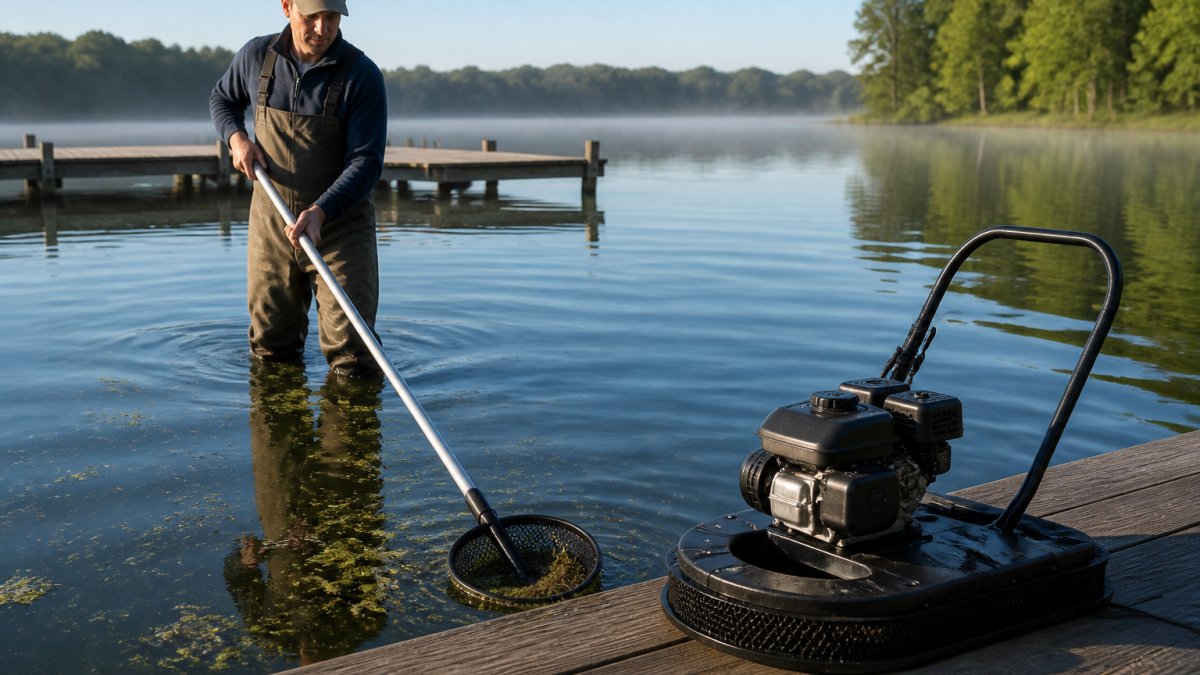
Manual units are quiet, need no fuel, and store easily. Powered skimmers cover more water per hour but add fuel or battery management and a higher upfront cost.
Lake Weed Harvester Comparison: What to Know Before Buying
A lake weed harvester is a serious purchase, and the comparison should start with throughput and disposal. Harvesters cut and collect submerged weeds, then you have to get the material out of the water, the step that surprises many buyers.
Key questions before buying:
- How wide is the cut path, and how does that match your lake?
- Where does the collected weed go once it is onboard?
- Can you trailer it, or does it stay on site?
For most recreational pond owners, a full harvester is overkill. It makes sense for lake associations, commercial properties, and anyone managing recurring growth across a large surface. Smaller operations do better with cutters and skimmers.
Shipping, Returns, and Customer Support
Shipping, returns, and support often decide the purchase more than the product itself. Large items like harvesters and aeration kits ship by freight, and terms vary by retailer. Before you buy, confirm the delivery method, who handles a damaged shipment, and whether the item ships from stock or on order.
Freight and Delivery: What to Ask Before You Pay
Oversized pond equipment rarely arrives like a normal parcel. It moves on a freight truck, so the delivery experience depends on details easy to miss at checkout:
- Curbside vs. liftgate delivery. A standard freight delivery drops the pallet at the curb. If you cannot unload a several-hundred-pound crate yourself, ask whether a liftgate truck is available and whether it costs extra.
- Residential vs. commercial address. Some carriers surcharge residential deliveries or limit delivery windows. Confirm the address type before ordering.
- Delivery appointment and access. A long driveway, low tree branch, or soft lawn can stop a freight truck. Ask how the carrier schedules the drop and what happens if the truck cannot reach your property.
Returns on Oversized Equipment
Returns on oversized equipment are rarely simple. Freight returns can cost more than the part you are sending back, so check the return window and restocking terms in writing before you buy:
- What is the return window? Standard retail windows are short, and oversized items sometimes fall outside them entirely.
- Who pays return freight? On a harvester or a large aerator, return freight can rival the price of a small accessory. Confirm this in writing, not over the phone.
- Is there a restocking fee? Many retailers apply one to opened or assembled equipment. Ask the percentage before you order.
- What voids a return? Fuel in a gas engine, cut weed material on a harvester, or assembled aeration lines can disqualify an item. Know the line before you cross it.
- Parts vs. whole-unit returns. Often the faster path is a replacement part rather than a full return. Ask whether the retailer stocks the specific blade, belt, or impeller you would need.
Customer Support: How to Test It Before You Buy
Support quality matters more than a small price difference, and you can evaluate it before spending a dollar:
- Call or chat with a product question. Ask something specific, like the recommended pond size for an aerator or the cut width of a weed cutter. A retailer that answers with a number is more useful than one that reads the spec sheet back to you.
- Ask about replacement parts. Blades, belts, and impellers wear out. A retailer that stocks spares keeps your tool running instead of turning it into a paperweight.
- Check the warranty path. Ask whether warranty service goes through the retailer or the manufacturer, and who pays shipping on a warranty claim.
Freight delivery and damage-claim guidance for oversized shipments
Making the Right Choice for Your Pond
Choosing between these two retailers is a question of fit. Weeders Digest is the stronger stop for lake-scale weed removal and harvester-class equipment.
The gap both leave is your fishing line. Retailers sell tools to clear water; they do not stop weeds from covering your bait.
It casts like a rocket, flows through the water with minimum drag, and stacks neatly in your tackle box.
Frequently Asked Questions
What products does Weeders Digest sell for lake and pond management?
Weeders Digest stocks a range of lake and pond management tools including aquatic weed control equipment, water skimmers, and lake weed harvesters. Their catalog covers both manual and powered options for shoreline cleanup, algae treatment, and seasonal maintenance. The specific inventory shifts with availability, so check their current listings for exact models and stock status before ordering.
How does Weeders Digest compare with Pond Warehouse?
Both retailers carry lake and pond management tools, but they differ in category depth and selection. Pond Warehouse tends to focus on aeration, pumps, and water quality products, while Weeders Digest leans toward weed control and harvesting equipment. Compare shipping policies, return windows, and warranty terms side by side before choosing, since those factors often matter as much as the product lineup itself.
What should I compare when buying lake or pond management equipment?
Start with the specific problem: floating weeds, submerged vegetation, algae blooms, or silt buildup. Then match the tool type to that problem, whether it is a skimmer, harvester, or treatment product. Check the working width or reach, power source, and weight against your pond size. Also review shipping costs, return policy, and warranty coverage, because large equipment is expensive to return if it does not fit your needs.
What should anglers use to keep weeds off fishing bait and lures?
Anglers fishing weedy areas can use a weed guard or weed blocker device that attaches to the line ahead of the bait. These devices grab vegetation before it reaches the lure, keeping the presentation clean during trolling or bait fishing. Look for a design that casts well, adds minimal drag, and stacks flat in a tackle box. A simple, durable blocker often outperforms complicated rigs for everyday use.
Clearing a pond is one job. Keeping your bait clear of weeds while you fish it is another, and it is the one most anglers deal with every trip. Fishing Weed Blocker solves that with a patented device that grabs weeds before they reach your lure, works for trolling and bait fishing, and stores flat in your tackle box. Get started with Fishing Weed Blocker and spend less time pulling weeds off your line.