
Table of Contents
- Why Weedless Lures Dominate in Murky Water
- Top Lure Types for Stained and Muddy Conditions
- Best Lure Colors for Murky Water
- How to Fish Weedless Lures in Thick Vegetation
- Line and Gear Pairing for Weedless Rigs
- Fishing Weed Blocker Benefits for Murky Water Anglers
- Common Mistakes to Avoid with Weedless Lures
- Conclusion: Choosing the Right Weedless Lure
- Frequently Asked Questions
Last Updated: October 3, 2026
Why Weedless Lures Dominate in Murky Water
Weedless lures for murky water solve two problems at once: they slip through vegetation without snagging, and they create signals fish can find when they cannot see far. In stained or muddy conditions, bass rely far more on vibration, displacement, and silhouette than on sight. That is the core reason a snagless presentation outperforms a pretty one.
Most anglers blame the water when the bite dies. The real issue is usually presentation.
Weedless lures are lures built or rigged so the hook point stays shielded from debris, letting you cast into thick vegetation, brush, and timber without constantly snagging.
🎣 Quick note: The best lure in the world fails if it spends half its retrieve dragging salad. Keep that in mind as we go.
Top Lure Types for Stained and Muddy Conditions
Two families do the heavy lifting in low visibility: soft plastics rigged weedless, and vibration-heavy search baits. Everything else is a variation on those themes.
Soft Plastics and Texas Rigs for Heavy Cover
A Texas-rigged soft plastic is the workhorse of heavy cover. The hook point tucks into the plastic, so the bait slides over logs and through grass without hanging up.
- Weightless fluke: skips under docks, dies with a subtle shimmy
- Punch rig: a heavy bullet weight drives through matted vegetation
- Creature baits: big profile and kicking appendages move water
- Keel-weighted swimbaits: track straight and stay snagless
A common mistake is fishing too light a weight in thick cover. You want the bait to punch through the canopy and reach fish holding underneath.
Vibration and Search Baits for Low Visibility
When fish cannot see well, they feel. Vibration-based lures like buzzbaits, bladed jigs, and lipless crankbaits throw off pressure waves fish detect with their lateral line.
Search baits cover water fast so you can find active fish before slowing down. Start with a buzzbait over shallow grass, then switch to a swim jig or bladed jig to probe the edges. The retrieve matters as much as the lure: steady and slow in cold water, faster and erratic when fish are aggressive.
| Lure Type | Best Condition | Cover | Signal |
|---|---|---|---|
| Texas-rigged plastic | Stained water, heavy cover | Grass, wood, mats | Profile + action |
| Buzzbait | Shallow, warm, murky | Surface grass | Vibration + splash |
| Bladed jig | Stained, mid-depth | Grass edges | Vibration |
| Lipless crankbait | Murky, open lanes | Ripping through grass | Vibration |
| Weightless fluke | Low visibility, docks | Sparse cover | Subtle action |
Best Lure Colors for Murky Water
For murky water, contrast beats realism. Dark silhouettes and high-contrast combinations show up best when visibility is measured in inches, not feet. But the reason why is more useful than the color list itself, because it lets you pick a color for water you have never fished before.
Why color behaves differently in low visibility
Water absorbs light selectively. Red is the first wavelength to disappear with depth and turbidity, followed by orange and yellow. Blue and green penetrate farthest, which is why a red craw pattern that looks vivid in the package can read as a flat gray blob a foot under stained water. Two practical consequences follow:
- Solid dark shapes win. A black-and-blue jig or a junebug plastic reads as a hard-edged silhouette against a lighter, silted background. The fish does not need to resolve detail, it only needs to detect an edge.
- High-contrast two-tone beats single-tone. Chartreuse-and-black, black-and-blue, and fire tiger all create internal contrast, so the bait stays legible even as the water steals color from one half of the pattern.
Matching color to clarity, sky, and forage
A simple working rule most practitioners use: the dirtier the water, the more you lean on silhouette and contrast; the clearer the water, the more you can lean on natural tones.
- Chocolate milk (visibility under about 6 inches): black, black-and-blue, junebug, or solid chartreuse. Skip natural shad and green pumpkin, they vanish.
- Stained (roughly 6 to 18 inches): chartreuse, white, fire tiger, and black-and-blue all fish well. White and chartreuse pop against a brown background.
- Slightly off-color (18 inches and up): you can start mixing in green pumpkin, watermelon, and natural shad, especially with a chartreuse tail dip for contrast.
Sky conditions shift the call too. Under heavy cloud cover, high-contrast and bright colors hold their edge because there is less ambient light to separate the bait from the background. In direct sun, darker and more natural tones often outproduce loud colors because the extra light already creates the contrast you were faking.
Match the hatch when you can. If shad are the dominant forage, a white or pearl bait with a dark back reads as a shad silhouette. If crawfish are the primary food source, a black-and-blue or dark red bait mimics the silhouette without needing accurate color.
The color-plus-vibration stack
Color is only one signal. In truly dirty water, sound and vibration often outproduce color outright, because pressure waves travel through water that light cannot penetrate. The strongest presentations stack signals:
- A dark or high-contrast body for silhouette
- A rattle or a Colorado blade for sound and thump
- A soft plastic with kicking appendages for displacement
A quick color-selection checklist
- Check visibility, drop a white lure or your hand and note the depth it disappears.
- Pick silhouette first: dark solid or high-contrast two-tone.
- Pick a secondary accent (chartreuse tail, white belly) for flash.
- Add sound or vibration if the water is dirtier than about a foot.
- Adjust for sky: brighter under clouds, more natural in direct sun.
Get the silhouette right and the fish will find the bait. Get the silhouette wrong and no amount of flake or glitter will fix it.
How to Fish Weedless Lures in Thick Vegetation
Fishing weedless lures in thick vegetation comes down to three things: a clean entry, a controlled fall, and a retrieve that keeps the bait ticking through cover without burying itself.
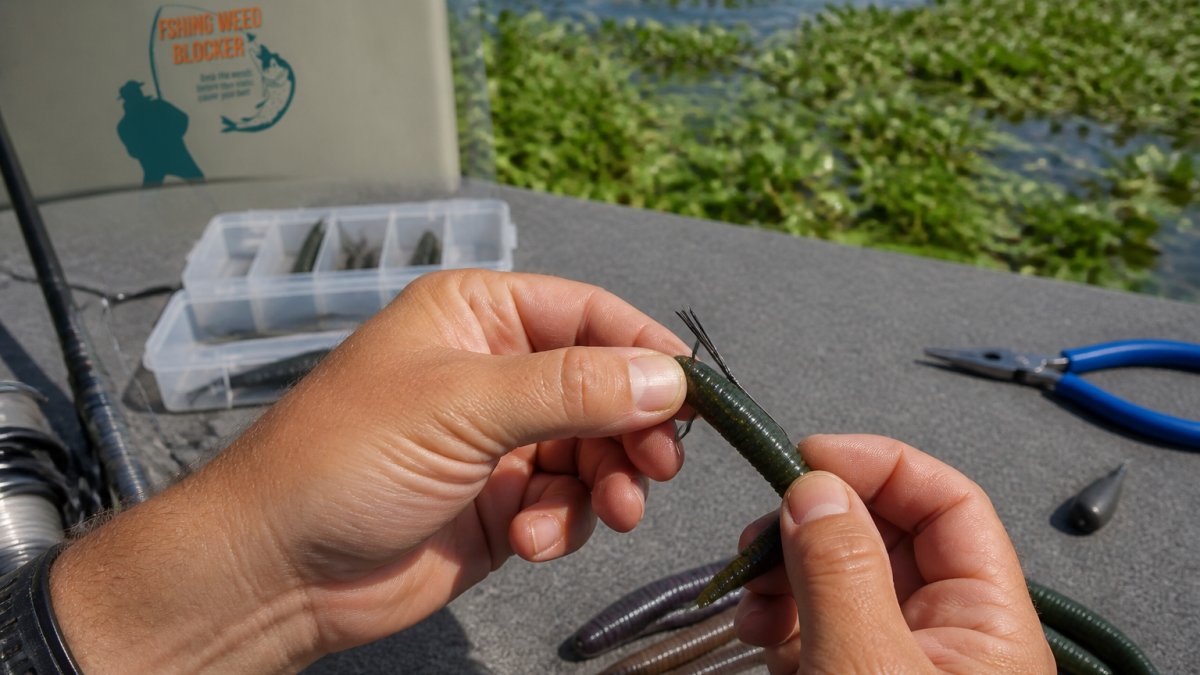
Cast past your target and bring the bait into the strike zone from the outside. Let it fall on a semi-tight line so you can feel the tick of a bite. Then work it with short hops or a slow, steady crawl.
- Pitch to the thickest cover first, then fan out
- Keep the rod tip up to steer the bait over snags
- Set the hook hard and fast to drive through the plastic
- Re-rig after every few fish; the plastic wears out
Hook penetration is the trade-off with any weed guard. Keep hooks sharp and replace them often.
Retrieval Speed and Action Adjustments
Retrieval speed is your main volume knob. Slow down in cold water and when fish are lethargic; speed up when they are chasing.
Ripping a lipless crankbait through grass triggers reaction strikes. A steady crawl with a swim jig works when fish are pressured. Vary your retrieve until you find what the fish want that day, then repeat it.
Line and Gear Pairing for Weedless Rigs
Gear pairing decides whether your weedless rig actually works. Heavy braid cuts through vegetation and gives you the power to haul fish out of cover.
- Braid, 30-65 lb: main line for punching and heavy grass
- Fluorocarbon leader: adds abrasion resistance in clear-ish water
- Heavy rod: fast action, enough backbone to set hooks in cover
- High-speed reel: picks up slack fast so you stay in contact
A soft, slow rod tip helps with treble-hook lures; a stiffer rod helps with single-hook Texas rigs. Match the rod to the lure, not the other way around.
Fishing Weed Blocker Benefits for Murky Water Anglers
Keeping your bait clear of debris is half the battle in stained water, and that is exactly the problem Fishing Weed Blocker was built to solve. The device grabs weeds before they can cover your lure or bait, so your presentation stays clean cast after cast.
- Engineered to cast like a rocket and move through the water with minimum drag
- Protects your lure from being covered in weeds
- Stacks neatly in your tackle box and built to last
- Sold in a convenient 4 pack
For trolling and bait fishing in weedy water, it is a straightforward add-on that keeps your bait working instead of fouling.
Common Mistakes to Avoid with Weedless Lures
Most missed fish in murky water trace back to a handful of fixable errors. Here are the ones we see most.
- Fishing too fast: low visibility means fish need time to find the bait
- Dull hooks: a weed guard plus a dull hook equals missed fish
- Wrong color: realistic colors vanish in dirty water
- Skipping maintenance: weeds and grit jam weed guards over time
Check your rig after every few casts. Clean the guard, retie worn knots, and swap frayed line before it costs you a fish.
Conclusion: Choosing the Right Weedless Lure
Picking the right weedless lure comes down to reading your water and matching the tool to the job. Dark, high-contrast colors and vibration-heavy baits win in low visibility; Texas rigs and search baits cover the water efficiently.
The variable most anglers overlook is keeping the bait clean. Fishing Weed Blocker grabs weeds before they cover your lure or bait, protects your presentation, and keeps you fishing instead of untangling. It casts like a rocket, moves with minimum drag, and stacks neatly in your tackle box.
Get started with Fishing Weed Blocker and keep your bait working in the weeds instead of snagging in them.
Frequently Asked Questions
What lures work best in murky water?
Lures that create vibration and displacement work best in murky water. Top choices include Texas-rigged soft plastics, buzzbaits, and lipless crankbaits. These lures help bass locate your presentation through their lateral line when visibility is low. Dark colors like black, blue, and junebug also stand out better in stained conditions.
What are the best weedless lures for bass in heavy cover?
For heavy cover, Texas-rigged soft plastics with a pegged weight, hollow-body frogs, and punch rigs are top performers. These lures feature hook points that tuck against the body, letting you cast into thick vegetation without snagging. Pair them with braided line for the power to pull bass out of cover.
Do weedless lures affect hookup ratios in heavy vegetation?
Weedless lures can reduce hookup ratios slightly compared to exposed-hook baits, but the trade-off is worth it in heavy cover. You gain access to fish that would otherwise be unreachable. To improve hooksets, use a firm rod, wait until you feel the fish's weight, and set the hook hard to drive the point through the plastic.
How does a Fishing Weed Blocker improve lure performance in weeds?
The Fishing Weed Blocker grabs weeds before they can cover your lure or bait, keeping your presentation clean during trolling or bait fishing. It is engineered to cast like a rocket and flow through the water with minimum drag. This means less time clearing debris and more time with your lure in the strike zone.