
Table of Contents
- Why Weedless Lures Matter for Beginners
- Understanding Weed Guards and Hook Point Design
- Best Weedless Lures for Bass and Other Species
- How to Rig Weedless Soft Plastics Correctly
- Using a Fishing Weed Blocker to Protect Your Presentation
- Selecting Lures by Water Clarity and Vegetation Density
- Rod, Line, and Gear Pairing for Weedless Fishing
- Common Mistakes to Avoid When Fishing Weedless Lures
- Frequently Asked Questions
Last Updated: October 1, 2026
Why Weedless Lures Matter for Beginners
Fishing in heavy cover and thick grass can be frustrating. Your lure gets tangled. Weeds cover your presentation. You lose time clearing debris instead of casting.
How to choose weedless lures for beginners solves this problem. Weedless lures let you fish where bass hide, in vegetation, under lily pads, and around submerged logs. You spend more time fishing, less time untangling.
At Fishing Weed Blocker, we understand that beginners often avoid weedy water because they think it's too difficult. The truth is simpler: the right lure design makes it easy. Weedless lures have protected hook points and weed guards that push vegetation away instead of collecting it.
The benefit is clear. You can fish snag-free in areas other anglers skip. More cover means more bass.
Understanding Weed Guards and Hook Point Design
A weed guard is a thin wire or fiber that sits in front of the hook point. It blocks weeds and debris from reaching the hook. When a bass bites, the guard bends back and the hook penetrates the fish's mouth.
The guard works because of how it's positioned. It covers the hook point during the cast and retrieve. When you set the hook hard, the guard moves aside and the point finds its target.
Hook point design matters just as much. An offset hook angles the point slightly away from the shank. This design helps the hook penetrate even with a weed guard in place. The angle gives you better hook sets in heavy cover.
Different materials affect performance:
- Wire guards are thin and light. They bend easily and don't slow your lure.
- Fiber guards are softer. They work well for topwater lures where you need a clean bite.
- Plastic guards are durable. They last through many casts in dense vegetation.
The best guard depends on your lure type and water conditions. Soft plastics need lighter guards.
Best Weedless Lures for Bass and Other Species
Soft Plastics and Offset Hooks
Soft plastics are the foundation of weedless fishing. A plastic worm rigged on an offset hook creates a snag-free presentation that bass can't resist.
Popular soft plastic options include:
- Straight worms (6-8 inches) for general bass fishing
- Creature baits with claws and appendages for extra action
- Swimbaits that mimic natural forage fish
- Crawfish imitations for bottom fishing in vegetation
Frogs and Topwater Weedless Options
Topwater weedless lures create commotion on the surface. Frogs are the best option for thick grass and weed mats.
Frogs work best when:
- You're fishing over dense weed mats
- The water is warm (summer and early fall)
- You want an explosive strike
- The bass are feeding near the surface
Spinnerbaits and Swimbaits
Spinnerbaits combine a metal blade with a soft plastic skirt. The blade spins and creates vibration. The skirt imitates a baitfish. A spinnerbait cuts through vegetation without getting tangled.
Swimbaits are best for:
- Clear water where bass can see details
- Larger bass that want a substantial meal
- Areas with moderate vegetation (not dense weed mats)
- Trolling along grass lines and drop-offs
How to Rig Weedless Soft Plastics Correctly
Texas Rig Setup
The Texas rig is the most popular way to rig soft plastics for weedless fishing. It's simple, effective, and works in any water condition.
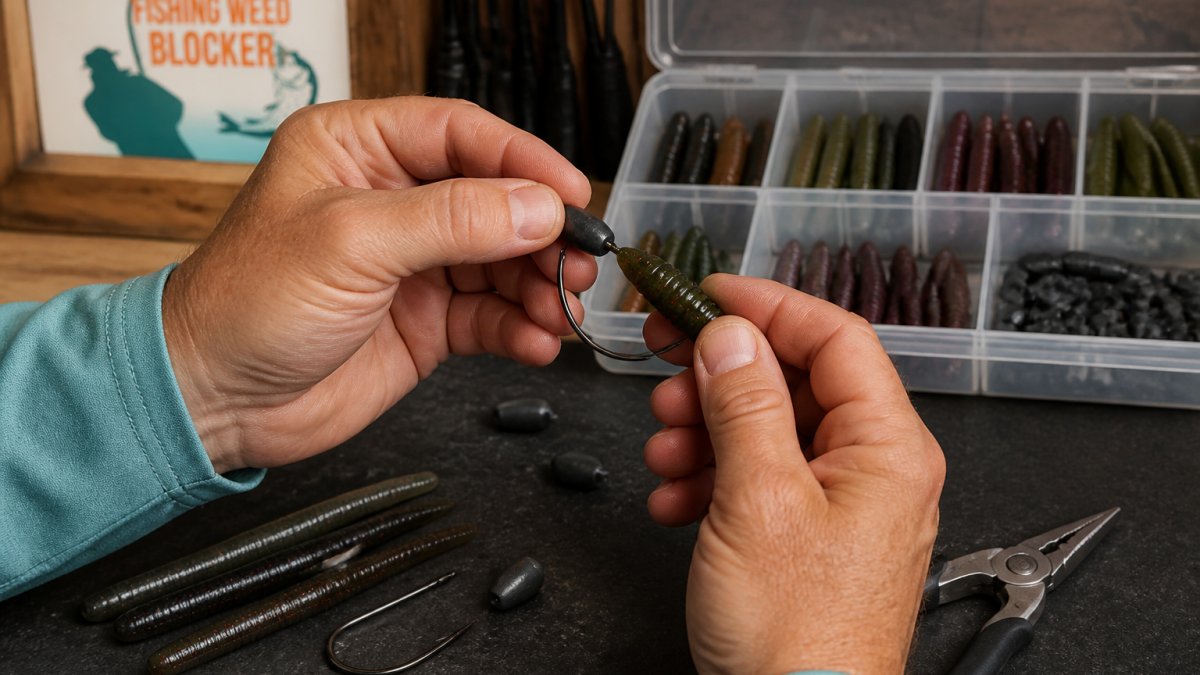
Here's how to set it up:
-
Slide the worm weight onto your line. Use a bullet weight (3/16 oz to 1/2 oz depending on water depth and cover density). Leave about 6 inches of line above the weight.
-
Tie the offset hook to the end of your line. Use a Palomar knot or improved clinch knot. Make sure the knot is tight.
-
Insert the hook point into the head of the soft plastic worm. Push the point about 1/2 inch into the plastic.
-
Rotate the worm 180 degrees. The hook point should come out of the worm's side, then re-enter the plastic about 1 inch down. This keeps the worm straight and snag-free.
-
Adjust the worm weight position. Slide it down until it sits 6-12 inches above the hook. In shallow water, use less distance. In deeper cover, use more.
Carolina Rig Setup
The Carolina rig is similar to the Texas rig but uses a longer leader between the weight and hook. This setup works well when you're fishing deeper water or want more separation between the weight and lure.
Steps to rig a Carolina setup:
-
Slide the worm weight onto your line. Use a larger weight than you would for a Texas rig (1/4 oz to 1 oz). The extra weight helps you reach deeper structure.
-
Tie a small barrel swivel to the end of the weight's line. This prevents the weight from sliding down.
-
Attach 12-24 inches of leader line to the swivel. Use a lighter line than your main line if you want to break free from snags easily.
-
Tie the offset hook to the end of the leader. Rig the soft plastic the same way as the Texas rig.
-
Cast and let the rig sink. The weight hits bottom first, then the plastic worm follows. This creates a natural presentation.
Using a Fishing Weed Blocker to Protect Your Presentation
A fishing weed blocker is a device that grabs weeds before they cover your lure. It works by sitting in front of your bait or lure, intercepting vegetation as you retrieve.
When to use a weed blocker:
- Trolling in shallow water where weeds are thick
- Bait fishing in areas with floating vegetation
- Casting near grass lines and lily pad edges
- Fishing in ponds with heavy aquatic plant growth
Selecting Lures by Water Clarity and Vegetation Density
Water clarity changes how bass see your lure. Vegetation density determines which lure designs work best.
In clear water with light vegetation:
- Use natural colors: green, brown, black
- Choose lures with fine details and realistic profiles
- Swimbaits and crawfish imitations work well
- Fish slower retrieves to let bass examine your lure
In murky water with heavy cover:
- Use bright or contrasting colors: chartreuse, white, orange
- Choose lures with vibration and noise: spinnerbaits, crankbaits
- Frogs and topwater lures trigger strikes through water clarity
- Fish faster retrieves to create commotion
In moderate clarity with moderate vegetation:
- Use medium colors: natural with a bright accent
- Soft plastics with weed guards work everywhere
- Adjust your retrieve speed based on bass activity
- Experiment with different presentations until you find what works
Rod, Line, and Gear Pairing for Weedless Fishing
Your rod, line, and reel must match your lure choice. The wrong combination reduces your hook-set power and lure control.
For soft plastics in heavy cover:
- Use a 7-foot medium-heavy rod
- Pair it with a 6.5:1 or 7:1 baitcasting reel
- Spool braided line (30-50 lb test) for better hook sets and sensitivity
- Braided line cuts through weeds and doesn't stretch
For topwater frogs:
- Use a 7.5-foot heavy rod
- Choose a 6.3:1 baitcasting reel for power
- Use braided line (50-65 lb test) to handle the strike
- The heavy setup gives you the power to set the hook in thick grass
For spinnerbaits and swimbaits:
- Use a 7-foot medium-heavy spinning rod
- Pair with a 2500-3000 size spinning reel
- Use monofilament or fluorocarbon (12-20 lb test)
- The lighter setup allows better lure action and casting distance
Common Mistakes to Avoid When Fishing Weedless Lures
Mistake 1: Using the wrong hook size. A hook that's too small won't penetrate thick bass jaws. A hook that's too large makes the lure unbalanced. Match your hook size to your soft plastic. For 6-inch worms, use 2/0 to 3/0 hooks. For larger baits, go up to 4/0 or 5/0.
Frequently Asked Questions
What makes weedless lures different from standard lures?
Weedless lures feature a weed guard, typically made of wire or plastic, that shields the hook point from catching vegetation and debris. The hook point sits slightly recessed or offset, allowing the lure to slide through thick grass and heavy cover without snagging. This design preserves your presentation and lets you fish strike zones where standard lures would constantly foul.
How do I rig weedless soft plastics so they actually work?
For a Texas rig, thread the line through a bullet weight, then tie it to an offset hook. Insert the hook point into the soft plastic's head and bury it inside the body so it's completely hidden. The buried hook point prevents snags while maintaining natural action. A Carolina rig uses a leader and swivel instead, giving the plastic more freedom to move. Both setups work in heavy cover when rigged correctly.
Will a fishing weed blocker slow down my lure or hurt my hook-up ratio?
A properly designed weed blocker, like the Fishing Weed Blocker, is engineered to grab weeds before they contact your lure, protecting your presentation without adding drag. It casts like a rocket and flows through the water with minimal resistance. Hook-up ratios depend more on your hook set and lure selection than on the blocker itself. Many anglers find they spend less time clearing weeds off their lure.
What's the best weedless lure for beginners fishing in heavy vegetation?
Soft plastics rigged Texas-style are the easiest for beginners because they're forgiving and effective in thick grass. Frogs are also beginner-friendly for topwater fishing over weed mats. Spinnerbaits work well in moderate cover and are less likely to foul than bare jigs. Start with a 3/8-ounce Texas rig in a natural color, then experiment with frogs or spinnerbaits as you gain confidence. Water clarity and cover density should guide your choice.