
Table of Contents
- Why Knot Choice Matters for Weedless Rigging
- The Knotless Knot for Weedless Rig: Step-by-Step
- Palomar Knot for Weedless Hooks: When It Works Best
- Best Knot for Braided Line to Hook in Heavy Cover
- How to Rig a Weedless Soft Plastic: Knots and Rigging Together
- Knot Orientation and Weedless Presentation
- When to Retie and How to Inspect Knots in the Weeds
- Frequently Asked Questions
Last Updated: October 13, 2026
Why Knot Choice Matters for Weedless Rigging
The best fishing knots for weedless rigging are the knots that stay tight, sit straight, and keep your hook point covered while you drag your bait through slop.
Here's the core problem. A knot that works fine in open water can fail the moment it hits grass. The tag end pokes out. The knot sits sideways.
Knot choice is the first fix, and it's free.
So what actually matters? Three things:
- Knot strength under a hard hookset
- Knot orientation so the hook rides point-up or point-down correctly
- Line type match because braid and monofilament behave very differently
Below, we break down the knots that hold up in heavy cover, show you how to tie each one, and explain how to rig them so your bait slides through weeds instead of collecting them.
The Knotless Knot for Weedless Rig: Step-by-Step
The knotless knot is the standard for hair rigs and weedless soft plastics because it lets you control exactly where the hook sits and which way it faces. It also creates a natural hinge that keeps your bait moving freely.
Most anglers tie it in under a minute once they've done it a few times.
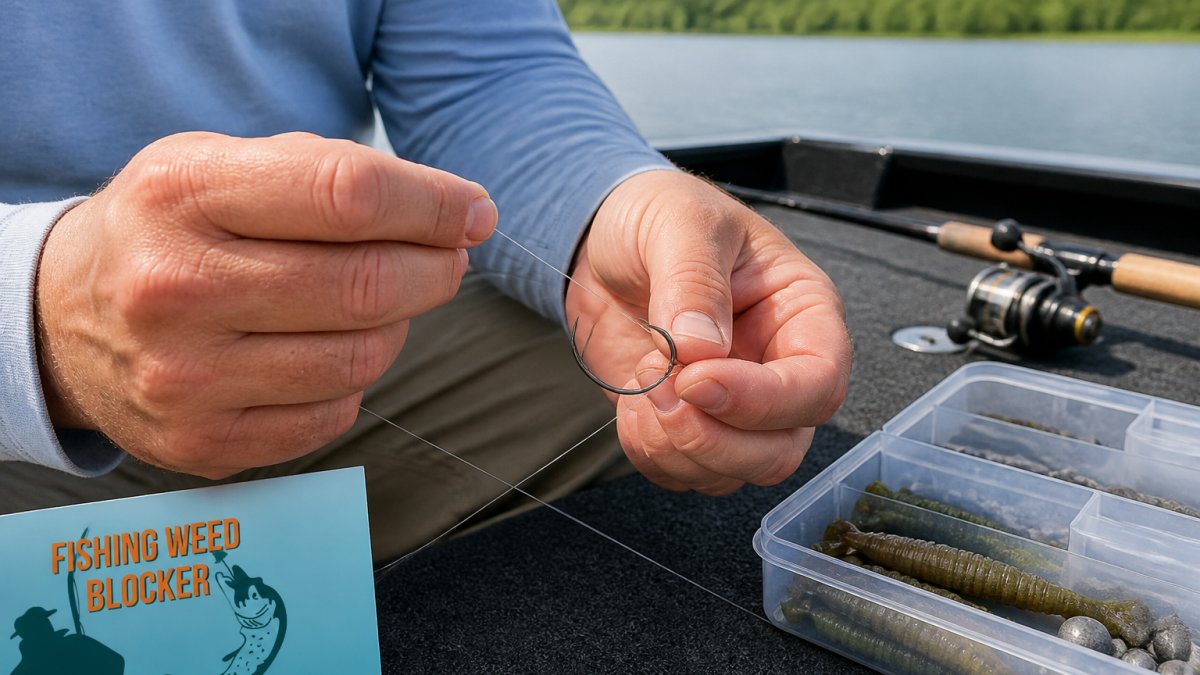
Tying the Knotless Knot: A Step-by-Step Walkthrough
- Thread your line through the hook eye and pull about 6 inches of tag end through
- Lay the tag end along the shank, pointing toward the bend
- Wrap the tag end around the shank and the main line 5 to 7 times, working back toward the eye
- Pass the tag end back through the hook eye from the same side you entered
- Wet the wraps and pull the main line steadily to cinch everything down
- Trim the tag end close, leaving about 1/8 inch
Expected result: A neat row of wraps along the shank with the hook hanging straight and the eye clear.
Palomar Knot for Weedless Hooks: When It Works Best
Where it falls short: the Palomar leaves a short tag end pointing up from the eye.
How to tie it:
- Double about 6 inches of line and pass the loop through the hook eye
- Tie a loose overhand knot with the doubled line
- Pass the loop over the hook and around the bend
- Pull the standing line to cinch the knot against the eye
- Trim the tag end flush
The Palomar shines with braid because braid doesn't stretch. A knot that grips well on slick braid is worth its weight in weeds.
For a deeper look at knot strength and line behavior, the Berkley line and knot guide covers how different lines respond under load.
Best Knot for Braided Line to Hook in Heavy Cover
For braid in heavy cover, the Palomar and the San Diego Jam are the two knots worth committing to memory. The FG knot is the best line-to-line connection when you're joining braid to a fluorocarbon leader, but for tying braid directly to a hook, the Palomar and San Diego Jam are the workhorses. Braid is slick and has almost no stretch, so knots that rely on friction alone can slip under a hard hookset.
Here's how the main options stack up for weedless work:
| Knot | Best For | Line Type | Ease | Notes for Weedless Rigs |
|---|---|---|---|---|
| Palomar | Braid to hook | Braid, mono, fluoro | Easy | Doubled line grips slick braid; short tag sits at the eye |
| San Diego Jam | Braid to hook | Braid, fluoro | Medium | Extra wraps add bite on heavy braid; tag runs down the shank |
| FG knot | Braid to leader | Braid to fluoro | Hard | Best braid-to-leader join; slim profile passes rod guides |
| Uni knot | All-purpose | Any | Easy | Good fallback; cinches down on mono and fluoro better than braid |
| Blood knot | Mono to mono | Mono, fluoro | Medium | Not for braid, braid cuts into itself and the knot fails |
| Albright | Line to leader | Mixed | Medium | Works when FG is impractical; bulkier through guides |
Match the Knot to Line Diameter, Not Just Line Type
Line type gets most of the attention, but diameter is what actually changes how a knot behaves. A Palomar tied in 10-pound braid and a Palomar tied in 65-pound braid are not the same knot in practice.
- Thin braid (10-20 lb test): The Palomar is ideal. The doubled line gives the knot enough bulk to grip without needing extra wraps. Fewer wraps also means less chance of the tag end standing up and catching grass.
- Mid braid (30-40 lb test): The San Diego Jam starts to earn its place. Five to seven wraps around the standing line create the friction surface that heavier, slicker braid needs.
- Heavy braid (50-80 lb test): Go San Diego Jam with six or seven wraps, or a Palomar tied carefully with a long enough loop to seat cleanly. Heavy braid is stiff and resists cinching, so wet it thoroughly and pull slowly.
A common mistake is using a Blood knot for braid-to-leader connections. Braid cuts into itself and the knot fails. Use the FG knot or an Albright instead.
Why This Matters More in Weeds Than Open Water
In open water, a knot that slips a little under load usually still lands the fish. In heavy cover, a slipping knot means the hook never seats, the bait comes back bare, and you've lost your shot at the one fish that was willing to eat through the slop. The margin for error shrinks because you're often pulling the fish through vegetation at the same time you're fighting it.
How to Rig a Weedless Soft Plastic: Knots and Rigging Together
Rigging a weedless soft plastic means pairing the right knot with the right hook placement so the point stays buried until you set the hook. The knot and the rig work as one system.
If your knot sits crooked, your bait rolls. If your bait rolls, it collects grass. It's that simple.
Rigging Steps for a Texas-Rigged Soft Plastic
- Slide a bullet weight onto your main line
- Tie on a wide-gap offset hook with a Palomar knot
- Insert the hook point into the nose of the plastic and push it through about 1/4 inch
- Rotate the hook and bring the point back to the plastic's body
- Push the point through so it sits just under the surface, skin-hooked
- Slide the weight down to the nose of the bait
Expected result: A bait that slides through cover with the hook point protected until you set the hook.
Even a perfect rig picks up some vegetation. That's where a weed blocker helps. Our device effectively grabs weeds before they can cover your lure or bait, protecting your presentation and maximizing your time on the water.
Knot Orientation and Weedless Presentation
Knot orientation decides whether your bait tracks straight or spins. A knot that pulls to one side makes the lure roll, and a rolling lure catches every strand of grass in its path. This is the part most knot tutorials skip, and it's the part that separates a bait that slides through slop from one that plows it.
How the Hook Eye Changes Everything
The hook eye is the pivot point. Where the line exits that eye determines the angle of pull, and the angle of pull determines how the bait sits in the water.
- Straight eye (inline): The line should exit directly in line with the shank. A Palomar tied cleanly on a straight-eye hook does this naturally. If the knot sits off to one side, the bait will roll on the retrieve.
- Offset eye (turned-up or turned-down): The line should exit at the same angle as the eye. A turned-up eye paired with a knot that exits straight down creates a torque that spins the bait. Match the knot's exit angle to the eye's angle and the bait tracks true.
- Wide-gap offset hooks (common in Texas rigs): These usually have a turned-up eye. The knot should exit upward, in line with the eye, so the hook hangs point-up or point-down as designed. A knot that exits sideways here is the single most common cause of a Texas rig that rolls.
The Line Exit Angle Test
After you tie on, hold the rod tip up and let the bait hang free. Look at where the line leaves the hook eye.
- If the line leaves the eye in line with the shank, the bait hangs straight. Good.
- If the line leaves the eye at an angle to the shank, the bait will hang off-axis. It will roll on the retrieve and collect grass.
- If the bait spins freely when you give it a gentle twirl, retie. A bait that spins at rest will spin in the water.
This test takes five seconds and catches most orientation problems before you make a cast.
Hook Point Orientation in Weeds
Weedless rigging depends on the hook point staying buried until you set the hook. How the point rides matters as much as how the knot sits.
- Point-up (skin-hooked through the top of the plastic): The point rides above the bait's body. This is the standard Texas rig orientation and it sheds grass well because the point is shielded by the plastic from below.
- Point-down (skin-hooked through the bottom): The point rides below the bait. This works in some finesse applications but collects more grass on the retrieve because the point is exposed to the vegetation below.
- The trade-off: Point-up protects the hook better but requires a slightly harder hookset to drive the point through the plastic. Point-down exposes the point more but hooks easier. For heavy cover, point-up is the safer default.
Why Orientation Is Not a Detail
A knot that sits straight keeps your bait tracking true. A bait that tracks true collects less grass. A bait that collects less grass stays in the strike zone longer. Every link in that chain starts with how the line leaves the hook eye. Get the orientation right and the rest of the weedless system, the hook point, the bait profile, the weight, works the way it was designed to.
When to Retie and How to Inspect Knots in the Weeds
Retie every time you feel a hard strike, drag through heavy grass, or notice fraying. Weeds are abrasive. They wear line and knots faster than open water.
Inspect these spots after every few casts:
- The knot itself, looking for loose wraps
- The tag end, checking for slippage
- The last 12 inches of line above the knot
A quick feel with your fingers catches most problems. Run the line through your hand. If it feels rough, cut and retie.
The U.S. Fish and Wildlife Service fishing resources offers more on responsible angling practices and gear care.
Frequently Asked Questions
What is the best knot for a weedless fishing hook?
The knotless knot is the top choice for weedless rigging because the tag end runs parallel to the shank, letting you thread a soft plastic straight and snag-free. The Palomar knot works well for single-hook setups with braid, and the Uni knot handles monofilament and fluorocarbon. Match the knot to your line type and hook style for the cleanest presentation in cover.
How do you tie a knotless knot for a weedless rig?
Thread your line through the hook eye, then wrap it 5 to 7 times around the shank above the eye. Pass the tag end back through the eye from the same side you entered, then moisten and cinch. Trim the tag close. The hook hangs straight, which keeps a Texas-rigged soft plastic tracking true through weeds.
Is a Palomar knot good for weedless fishing?
Yes, the Palomar knot works for weedless fishing when you use a single hook with braid or monofilament. It retains a high percentage of line strength and is simple to tie. The trade-off is the doubled line through the eye, which can limit how straight a soft plastic sits. For Texas rigs and punch rigs, the knotless knot usually gives a cleaner presentation.
How can you keep weeds from covering your fishing lure?
Start with a weedless knot and rigging setup: a knotless knot on a wide-gap hook with a Texas-rigged soft plastic keeps the hook point tucked. Pair that with a weed guard or a weed-blocking device that grabs vegetation before it reaches your bait. Fishing Weed Blocker effectively grabs weeds before they can cover your lure or bait, protecting your presentation and maximizing your time on the water.
Weeds will always find a way to your bait. The right knot slows them down, but a weed blocker stops them cold. Fishing Weed Blocker is a patented, award-winning device that grabs weeds before they cover your bait, keeping your hook free of debris whether you're trolling or bait fishing. It casts like a rocket, flows through the water with minimum drag, and stacks neatly in your tackle box. Get started with Fishing Weed Blocker and spend less time cleaning grass off your lure.