
Table of Contents
- Why Braided Line Works in Heavy Vegetation
- Braid Pound Test for Heavy Grass: Choosing the Right Strength
- 4-Strand vs 8-Strand Braided Line: Construction and Performance
- Braid vs Fluorocarbon for Bass Fishing in Thick Cover
- Best Braided Fishing Line for Bass: Selection Criteria
- Techniques That Maximize Braided Line in Heavy Cover
- Common Mistakes and Maintenance
- Frequently Asked Questions
Last Updated: October 12, 2026
Why Braided Line Works in Heavy Vegetation
The best braided line for heavy vegetation cuts through dense cover where other lines fail. The tight weave and low stretch give you the power to punch through grass, lily pads, and thick brush without losing your lure or bait to snags.
Here's what makes braid different: monofilament and fluorocarbon stretch under pressure, which means some of your hook-setting force gets absorbed. Braided line has virtually no stretch. When you set the hook in heavy cover, that energy transfers directly to the fish. Your presentation stays cleaner too.
The real advantage emerges when you're fishing techniques like flipping and pitching. You need immediate feedback. You need to feel the bottom, detect subtle bites, and react fast. Braid gives you all three. Its sensitivity is unmatched, you feel every piece of vegetation, every bump, every tentative strike.
Fewer trips to clear weeds from the lure. More time actually fishing. That's the practical payoff.
Braid Pound Test for Heavy Grass: Choosing the Right Strength
Pound test matters more than most anglers realize. It's not just about breaking strength, it's about diameter, casting distance, and how much abuse the line can take in thick cover.
40- to 50-Pound Test for Moderate Cover
If you're fishing shallow ponds with light to moderate vegetation, 40- to 50-pound test braid is your sweet spot. This range offers excellent sensitivity while maintaining enough diameter to handle occasional snags without breaking.
Forty-pound test is thin enough to cast well and won't create excessive drag through moderate weeds. Fifty-pound sits just above that threshold, slightly thicker, slightly more durable, but still manageable for most rods. Most anglers fishing grass beds and scattered vegetation choose this range because it balances power with finesse.
The trade-off is clear: go lighter and you gain casting distance but sacrifice durability in thick cover. Go heavier and you gain power but lose some of that critical sensitivity that makes braid special.
65-Pound Test and Beyond for Extreme Conditions
When you're flipping into dense mats, punching through standing timber, or fishing the thickest grass imaginable, 65-pound test and heavier braid becomes necessary. This is where braid truly separates from other line types.
Sixty-five-pound braid can handle repeated contact with sharp vegetation without fraying or losing strength. The thicker diameter means more abrasion resistance. You're not worried about the line breaking on a snag, you're focused on getting the fish out of cover before it wraps around a branch.
Heavy braid also gives you confidence to use heavier lures and rigs. A punch rig with a 3/4-ounce weight needs line that won't hesitate. Sixty-five-pound test delivers that without question. Beyond 65 pounds, you're entering specialized territory. Some anglers use 80-pound or even 100-pound test in extreme situations, but most recreational anglers find 65 pounds sufficient for virtually any freshwater scenario.
4-Strand vs 8-Strand Braided Line: Construction and Performance
The number of strands in braided line affects how it behaves in the water and how it handles abrasion.
Four-strand braid is the simpler construction. It's more affordable and casts slightly farther because it's rounder and smoother. However, four-strand has a tendency to fray at the knot if not tied carefully. It also creates a slightly stiffer feel in the water, some anglers notice this when casting light lures.
Eight-strand braid is more refined. The additional strands create a flatter profile and smoother surface. It handles knots better, frays less, and provides a more supple feel that many anglers prefer for sensitivity. Eight-strand also tends to absorb impact better when you're ripping through dense cover.
For heavy vegetation fishing, eight-strand generally outperforms four-strand because the flatter profile slides through weeds more cleanly and the improved knot strength matters when you're fighting fish in thick cover. If you're on a budget and fishing moderate cover, four-strand works fine. For serious heavy-cover anglers, eight-strand is worth the investment.
Braid vs Fluorocarbon for Bass Fishing in Thick Cover
This comparison matters because fluorocarbon has real advantages in clear water, but it struggles in heavy vegetation.
Fluorocarbon is nearly invisible underwater, a major advantage when bass can see your line. It's also incredibly abrasion-resistant and sinks, which helps with lure presentation in open water. But fluorocarbon stretches more than braid. In heavy cover, that stretch costs you power and sensitivity.
Fluorocarbon is also stiffer than braid, especially in heavier pound-tests. This stiffness makes it harder to cast light lures and creates more friction through vegetation. You'll spend more time clearing weeds and less time fishing.
Braid wins in heavy cover because of low stretch, superior sensitivity, and thin diameter. The one legitimate advantage fluorocarbon holds is visibility, if you're fishing crystal-clear water where bass can see your line clearly, fluorocarbon reduces refusals.
For most heavy-vegetation scenarios, braid is the clear choice. Fluorocarbon shines in specific situations, but heavy cover isn't one of them.
Best Braided Fishing Line for Bass: Selection Criteria
Choosing the right braid involves more than just picking a pound-test. Several factors determine whether a line will perform well in your specific situation.
Line Diameter and Casting Distance
Diameter directly affects casting distance. Thinner diameter means less air resistance and longer casts with the same rod and reel. However, thinner diameter usually means less abrasion resistance, which matters in heavy cover.
Most quality braids in the 40-65 pound range have diameters between 0.008 and 0.012 inches. A 50-pound braid from one manufacturer might be slightly thinner or thicker than the same pound-test from another brand. Check the manufacturer's specifications before buying.
If casting distance is critical and you're fishing moderate cover, prioritize thinner diameter. If you're in extreme heavy vegetation where abrasion is the main concern, accept a slightly thicker diameter for increased durability.
Abrasion Resistance and Durability
Abrasion resistance determines how long your line lasts when repeatedly dragging through sharp vegetation. Some braids are treated with special coatings to improve durability. Others rely on construction quality and material selection.
Higher-quality braids hold up better to abrasion. Budget braids fray quickly and lose strength faster. This matters because a line that frays after a few hours of heavy-cover fishing becomes unreliable. You lose confidence, which affects your fishing.
Inspect your line regularly when fishing heavy cover. If you see fraying or fuzzing, replace that section or respool entirely. Fresh line casts better and performs more reliably.
Knots, Leaders, and Connection Choices
Braided line requires proper knots. The Palomar knot works well, as does the improved clinch knot with an extra wrap. Many anglers prefer the Uni knot because it's reliable and holds consistently.
The real decision is whether to use a leader. Many heavy-cover anglers use a 12-18 inch fluorocarbon leader tied to braided main line. This setup gives you braid's power and sensitivity while reducing line visibility near the lure. The leader also protects your main line from the worst abrasion.
If you skip the leader, tie directly to the lure. This maximizes sensitivity but exposes your braid to more abrasion. In extremely heavy cover, a leader is worth the slight reduction in sensitivity.
| Connection Method | Best For | Pros | Cons |
|---|---|---|---|
| Direct tie to lure | Maximum sensitivity | Simpler setup, better feel | More abrasion on main line |
| Fluorocarbon leader | Balanced approach | Protects main line, reduces visibility | Slight sensitivity loss |
| Braided leader | Extreme cover | Maximum durability | Visible connection point |
Techniques That Maximize Braided Line in Heavy Cover
How you fish matters as much as what line you choose. Certain techniques are specifically designed to work with braided line's strengths.
Flipping and Pitching
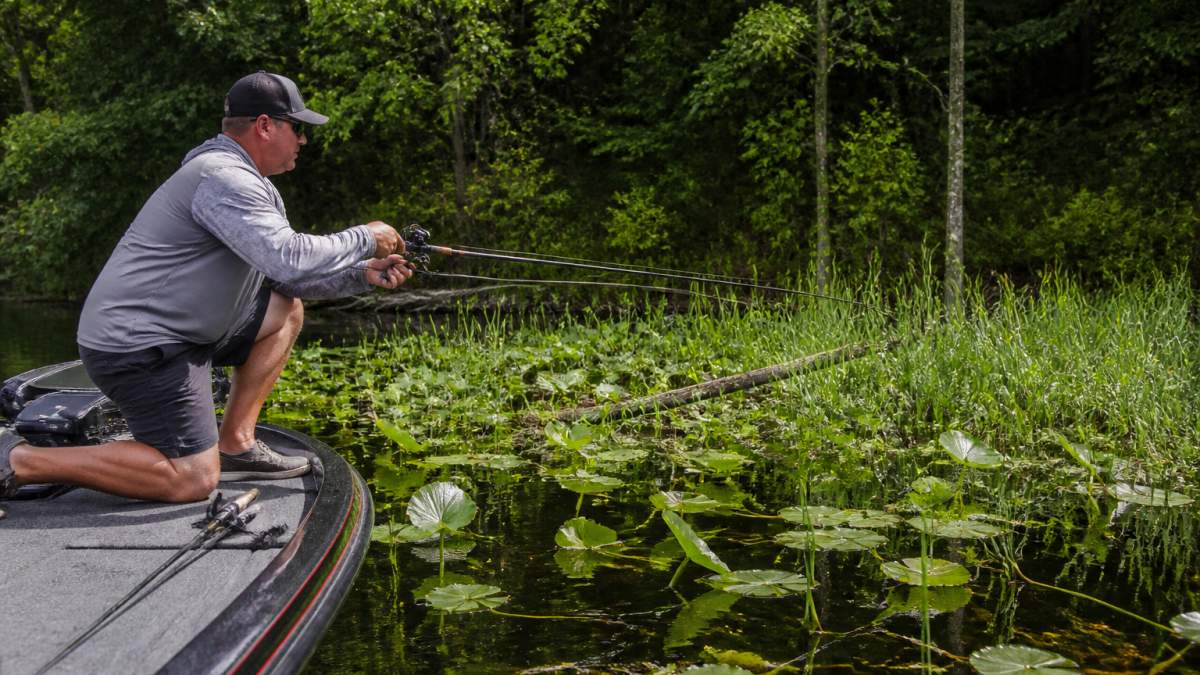
Flipping is short-distance, accurate casting into dense cover. You're not trying to cast far, you're trying to place the lure precisely in a small opening. Braided line excels here because it has no stretch. You can feel the bottom, detect strikes instantly, and set the hook with authority.
Pitching is similar but uses a longer cast. Both techniques rely on sensitivity and power, which braid provides in abundance. Your rod tip stays high, and you work the lure aggressively through the cover. Braid's low stretch means every movement of the rod translates directly to lure movement.
Most flipping and pitching is done with 65-pound braid or heavier. The power is non-negotiable when you're dragging a lure through dense vegetation and setting hooks hard.
Ripping Through Weeds
Ripping means aggressively jerking the lure through grass or weeds. The goal is to disturb the vegetation and trigger a reaction strike. This technique demands line that won't stretch and won't break under the stress of repeated hard jerks.
Fifty to 65-pound braid handles ripping beautifully. The no-stretch characteristic means your jerks are crisp and direct. You feel every piece of vegetation the lure contacts. When a bass strikes, you know it immediately.
Trolling and Bait Fishing
Trolling with braid allows you to detect bottom contact and vegetation more clearly than other lines. You feel the bottom composition and can adjust depth accordingly. When your lure hits weeds, you know instantly and can change course.
Bait fishing with braid offers similar advantages. You feel the bottom, detect bites quickly, and can set the hook with power. Many bait anglers prefer 40-50 pound braid for trolling and live-bait presentations because it provides sensitivity without excessive diameter.
Common Mistakes and Maintenance
Several mistakes can undermine even the best braided line choice.
Spooling too tightly is common. When braid is spooled under extreme tension, it compresses and can cut into itself.
Ignoring fraying is another costly mistake. Braid frays at the knot when tied improperly or when the knot itself is weak. Check your knots frequently.
Using the same line for weeks in heavy cover reduces performance. Braid takes abuse in thick vegetation.
Mixing line types can cause problems. If you're using a braided main line with a fluorocarbon leader, make sure the connection is solid.
Clean your reel and line regularly. Dirt and debris reduce performance. A quick rinse after fishing keeps everything functioning smoothly.
Choosing the right braided line for heavy vegetation means matching pound-test to your specific cover, understanding construction differences, and committing to proper setup and maintenance.
A quality weed-blocking device works alongside your braided line to keep your presentation clean and your frustration low.
Frequently Asked Questions
What pound-test braided line is best for fishing heavy vegetation?
For most heavy vegetation scenarios, 40- to 65-pound braided line is ideal. Use 40-50 lb braid for moderate grass and weeds, and step up to 65 lb or higher when punching through dense mats or standing timber. Heavier pound test provides the breaking strength needed to cut through vegetation and set the hook reliably without line breakage.
Is 4-strand or 8-strand braided line better for weeds?
8-strand braided line is generally better for heavy vegetation. It offers smoother casting, better knot strength, and more uniform diameter than 4-strand. However, 4-strand has a thinner profile for the same pound test, which can help with casting distance in open water. Choose 8-strand for thick cover fishing where durability and hook-setting power matter most.
Should you use a leader when fishing braided line in heavy vegetation?
A leader is optional in heavy vegetation but recommended in certain situations. Use a 12- to 24-inch fluorocarbon or monofilament leader if fish are line-shy or if you're fishing clear water near vegetation. Skip the leader when fishing murky water or when maximum cutting power through weeds is your priority. Leaders also reduce line twist and improve knot reliability.
Is braided line better than fluorocarbon in thick grass?
Yes, braided line outperforms fluorocarbon in thick grass for most applications. Braid has zero stretch, providing better hook-setting power and bite detection. It cuts through vegetation more effectively and resists abrasion from sharp weeds and stems. Fluorocarbon excels in clear water for visibility control but lacks the cutting power and sensitivity braid delivers in heavy cover situations.