
Table of Contents
- Why Line Choice Decides Your Weedless Fishing Success
- Braided vs. Monofilament vs. Fluorocarbon in Heavy Cover
- The Best Braided Line for Bass Fishing in Thick Vegetation
- Fluorocarbon vs. Monofilament for Cover: Which Leader Wins
- How to Prevent Weeds on Fishing Line Before They Cost You Fish
- Knots, Hooksets, and Rod Power for Weedless Rigs
- Line Maintenance, Memory, and Disposal
- Frequently Asked Questions
Last Updated: September 22, 2026
Why Line Choice Decides Your Weedless Fishing Success
Picking the wrong line is the fastest way to lose fish in heavy cover, and choosing the right line for weedless fishing comes down to three properties: low stretch for hooksets, high abrasion resistance for vegetation, and enough tensile strength to haul bass out of the slop. This guide breaks down exactly how braid, monofilament, and fluorocarbon behave in weeds, which knots hold up, and how to keep your lure presentation clean cast after cast.
Braided vs. Monofilament vs. Fluorocarbon in Heavy Cover
Braided line wins in heavy cover because it has near-zero stretch, the smallest diameter-to-strength ratio, and excellent abrasion resistance against stems and stalks. Monofilament and fluorocarbon each have a role, but neither matches braid for pulling fish out of vegetation.
| Line Type | Stretch | Sink Rate | Abrasion Resistance | Best For |
|---|---|---|---|---|
| Braid | Very low | Floats | High | Heavy cover, frogs, punching |
| Monofilament | High | Slow sink | Moderate | Topwater, light vegetation |
| Fluorocarbon | Low | Sinks fast | High | Leaders, clear water |
Why Braid Wins in Vegetation
Braid's advantage in weeds is not just strength, it is geometry. A tight-weave braid in the 50 to 65-pound class typically measures around 0.014 to 0.016 inches in diameter, roughly the same as a 12 to 15-pound monofilament. That thinner profile means less surface area dragging against milfoil, hydrilla, and coontail, so the line slices through stalks instead of sawing against them.
Monofilament: Shock Absorption at a Cost
Monofilament stretches, commonly in the 20 to 30 percent range under load depending on the formulation, which absorbs the shock of a close-range strike but dulls hooksets at distance. In heavy cover, that stretch is a liability: a 30-yard cast with mono means you are pulling slack out of the line before the hook moves. Mono also has more memory than braid, so it coils off the spool and creates loops that catch vegetation.
Fluorocarbon: Sinking and Low-Visibility
Fluorocarbon sinks faster than mono and has a refractive index close to water, which is why it dominates as a leader material in clear water. It also has less stretch than mono, so it transmits more of the hookset. The downside in weeds is stiffness, fluoro holds more memory than braid, and a stiff leader coils and kinks when it drags through stalks.
Matching Material to the Cover You Actually Fish
A practical rule most experienced anglers follow:
- Dense milfoil, hydrilla, or matted grass: straight braid, 50 to 65-pound test, no leader.
- Punching mats: straight braid, 65-pound or heavier, with a snell-hooked flipping hook.
- Sparse grass with clear water: braid main line with a fluorocarbon leader in the 15 to 20-pound class.
- Topwater over grass: monofilament or braid, depending on whether you want the line to float or sink.
- Murky water with heavy cover: straight braid, visibility is not the limiting factor, so the leader knot is just an extra failure point.
For a full breakdown of how each material behaves under load, the Berkley fishing line education guide covers stretch, diameter, and knot performance by formulation.
Braid: Low Stretch, High Sensitivity
Braid transmits every tick through the rod tip, which is why strike detection improves dramatically in thick vegetation. The trade-off is zero shock absorption. Set the hook hard and keep the rod loaded, because braid will not forgive a soft sweep.
Monofilament and Fluorocarbon: Stretch and Sink Rate
Monofilament stretches, which absorbs shock but dulls hooksets at distance. Fluorocarbon sinks faster and disappears underwater, making it the better choice for a leader in clear water. For a full breakdown, the Berkley fishing line education guide covers how each material behaves under load.
The Best Braided Line for Bass Fishing in Thick Vegetation
The best braided line for bass fishing in thick vegetation is a 50 to 65-pound test braid with a tight weave and a low diameter-to-strength ratio. That range gives you the tensile strength to drag a fish through stalks without sacrificing line capacity on the spool.
Diameter-to-Strength Ratio and Line Capacity
A thinner braid means more line capacity and less water resistance, so your lure tracks straighter through vegetation. Check your reel's rated capacity before you spool up. Overfilling causes wind knots; underfilling costs you casting distance.
Fluorocarbon vs. Monofilament for Cover: Which Leader Wins
Fluorocarbon wins as a leader in clear water because it sinks and has a refractive index close to water, while monofilament floats and stays visible. In murky water with dense weeds, the visibility advantage matters less, so monofilament's shock absorption becomes a fair trade.
How to Prevent Weeds on Fishing Line Before They Cost You Fish
Learning how to prevent weeds on fishing line starts with reducing the surface area that vegetation can grab. Every strand of milfoil that clings to your line adds drag, kills your lure presentation, and turns a clean retrieve into a fouled mess.
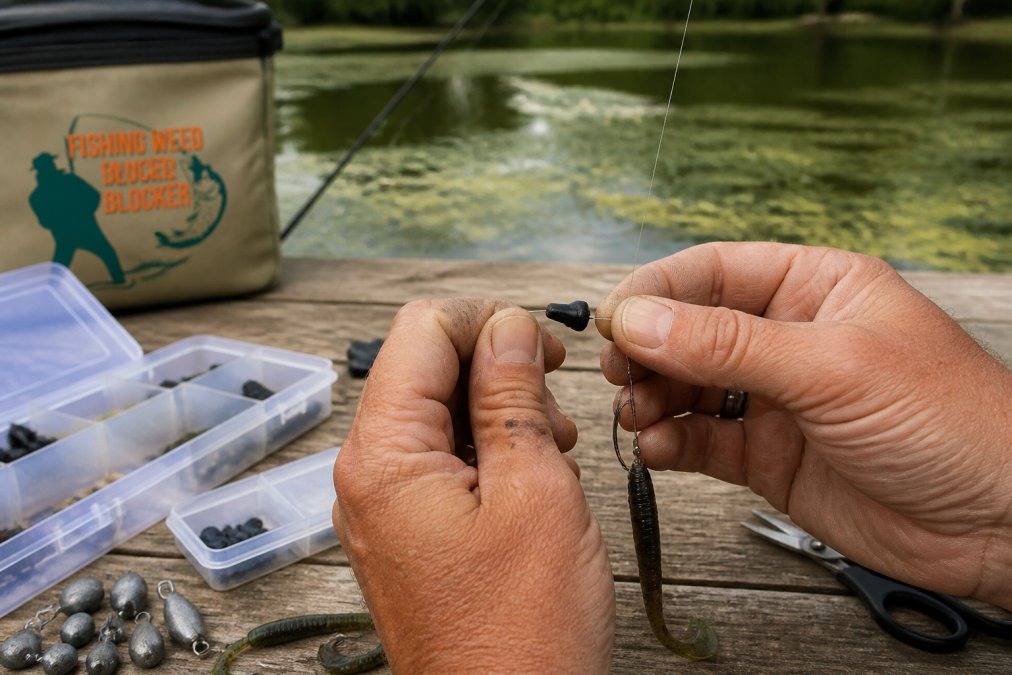
A few habits make a real difference:
- Keep your rod tip high on the retrieve to lift line clear of submerged stalks
- Switch to a Texas rig so the hook point stays buried in the plastic
- Check your line for clinging vegetation after every cast
- Add a weed-blocking device above your bait to grab debris before it reaches the lure
Knots, Hooksets, and Rod Power for Weedless Rigs
The Palomar knot is the strongest choice for braid in weedless setups because it retains knot integrity under heavy load and is simple to tie in low light. Pair it with a stout rod and a fast, hard hookset.
- Palomar knot: best for braid, high knot integrity
- Double uni: solid braid-to-leader connection
- Snell knot: locks the hook for punching setups
Line Maintenance, Memory, and Disposal
Line memory is the hidden killer of hookset efficiency in weedless fishing, and almost no guide addresses it directly. Coiled, stiff line creates slack between your rod tip and the lure, so a hookset loses force before it reaches the hook. In heavy cover, where you often have one shot at a fish before it buries itself, that lost force is the difference between a landed bass and a pulled hook.
How Line Memory Steals Your Hookset
When line comes off the spool in tight coils, it does not travel in a straight path to the lure. Instead, it forms a series of loops that must straighten before the hook can move. On a 20-yard cast, that straightening can absorb several inches of rod travel, and in a punching or flipping scenario where the fish is buried in matted vegetation, those inches are the entire hookset.
Maintenance Habits That Protect Hookset Efficiency
- Stretch your line before each trip. Hook the line to a fixed object, walk off 20 to 30 yards, and pull steadily to remove coils.
- Respool fluorocarbon and monofilament every few trips. Memory accumulates with UV exposure and temperature swings.
- Cut back braid regularly. Run your fingers up the first few feet after every few casts and cut any rough or frayed section.
- Store reels out of direct sun. UV degrades monofilament and fluorocarbon faster than most anglers realize.
- Check for nicks after every snag. A single rough spot in heavy cover is where the line will fail on the next hookset.
Line Color in Dense Weeds
Line color is a topic most guides skip, but it matters in a specific way for weedless fishing. When your line is physically touching vegetation, dragging across lily pads, sawing through milfoil, or resting on a grass mat, the fish is not seeing a line suspended in open water. It is seeing a line in contact with structure it already associates with cover.
Disposal and Environmental Responsibility
Dispose of used line responsibly. Most tackle shops and many municipal recycling programs accept monofilament for recycling, and leaving line on the bank harms wildlife. The NOAA marine debris program documents how discarded fishing line damages aquatic ecosystems. For broader guidance, the U.S. Fish and Wildlife Service publishes resources on responsible angling practices.
Frequently Asked Questions
Why is braided line preferred for weedless fishing?
Braid has almost no stretch, so when you drive a hook through a thick Texas rig, the energy goes into the hookset instead of stretching the line. It also has a smaller diameter at the same tensile strength, which cuts through vegetation with less friction and lets you fish heavier cover without losing line capacity on the spool.
Should I use a leader when fishing weedless rigs with braid?
A fluorocarbon leader helps in clear water or when bass are pressured. Tie 12 to 20 inches of fluorocarbon to your braid with an FG or Alberto knot. In murky water or dense mats, straight braid is fine because visibility matters less and the extra knot is one more failure point in heavy cover.
Does line visibility matter when fishing in thick weeds?
Less than most anglers think. In dense vegetation, bass rely on their lateral line to feel vibration and movement rather than sight. Line color psychology in weeds matters most at the edges and in open pockets, where a dark green or low-vis braid blends with the vegetation better than a bright one.
How does line diameter affect weedless lure performance?
Thinner line cuts through vegetation with less friction, so your lure tracks straighter and your hookset loses less energy to drag. A smaller diameter also increases line capacity and lets you cast farther. Go as heavy as the cover demands, but not heavier, because diameter-to-strength ratio is what decides how well a weedless rig moves through the slop.
Fishing heavy vegetation punishes every weak link in your setup, from line memory to a knot you tied in a hurry. Fishing Weed Blocker makes that fight easier with a patented device that grabs weeds before they reach your bait, a low-drag design that flows through the water, and a compact build that stacks neatly in your tackle box. Get started with Fishing Weed Blocker and keep your presentation clean cast after cast.