
Last Updated: October 23, 2026
Quick Summary
Fishing hook holders prevent hooks from tangling, snagging on tackle and clothing, and damaging leader material during transport and storage. The best systems combine rod-mounted keepers for active fishing with tackle box organizers or specialized snell holders that capture hook points and protect finished presentations.
- Rod-mounted hook keepers like the Hook Guardian ($14.99 single, $24.99 2-pack) use spring-loaded or magnetic mechanisms for instant rig access and snag prevention.
- Snell holders come in five types: spools, card holders, tubes, rig wallets, and foam blocks, each suited to different hook sizes and leader lengths.
- Stainless steel and rigid plastic holders resist corrosion and UV damage better than foam, which degrades in humidity and saltwater environments.
- Match the holder's hook channel to your hook size and leader length to prevent kinking and loose hooks that snag during transport.
- Most anglers need multiple holder types: a rod-mounted keeper for active fishing, a tackle box organizer for storage, and specialized holders for pre-rigged presentations.
Table of Contents
- Why Fishing Hook Holders Matter for Snag-Free Storage
- Rod-Mounted Hook Keepers: Instant Access and Snag Prevention
- Fishing Hook Holder Organizers: Tackle Box Storage Solutions
- Snell Holder and Fishing Rig Organizer Designs
- Tangle-Free Fishing Hook Storage: Materials and Design
- Choosing the Right Hook Holder: Key Criteria and Common Mistakes
- Frequently Asked Questions
Why Fishing Hook Holders Matter for Snag-Free Storage
Fishing hook holders solve a familiar problem: hooks tangling with each other, snagging on tackle, or catching on clothing and skin during transport.
The real cost isn't annoyance: tangled hooks damage leader material, dull hook points, and waste fishing time, especially when running multiple rigs.
A good fishing hook holder keeps bare hooks, snells, and rigged presentations organized and accessible.
Rod-Mounted Hook Keepers: Instant Access and Snag Prevention
Rod-mounted hook keepers clip onto your rod, keeping your active rig and backup hooks instantly accessible.
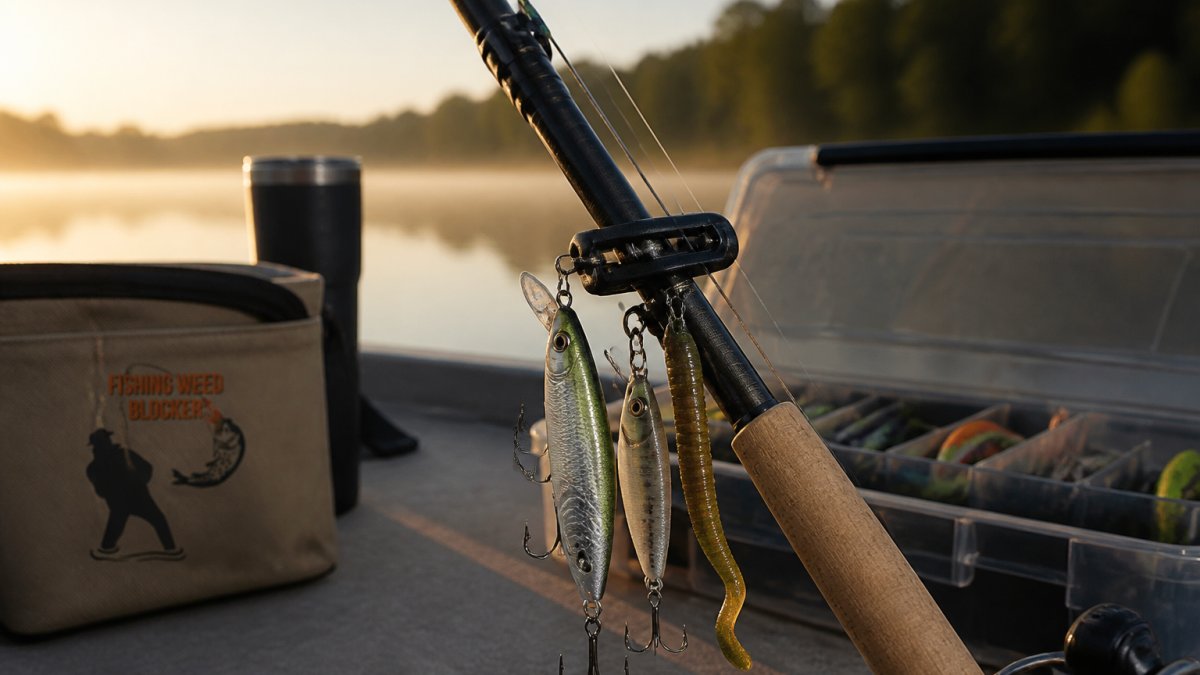
Match the clip size to your hook sizes: a clip built for large saltwater hooks won't secure small panfish jigs.
The Hook Guardian from Fishing Weed Blocker is a rod-mounted safety holder that keeps hooks and lures firmly in place to prevent snags and tangles.

One common mistake is mounting too many hooks on a single rod.
Fishing Hook Holder Organizers: Tackle Box Storage Solutions
Foam inserts are budget-friendly for modest collections, push the hook eye in and the foam holds it.
Compartment trays offer more flexibility: each section holds different hook sizes, styles, or finished rigs. Quality organizers use rigid, non-warping plastic with dividers that keep hooks separated during transport.
Consider your fishing style: multiple techniques (trolling, live bait, jigging) demand storage for different hook styles and sizes, so a single compartment system won't cut it.
Snell Holder and Fishing Rig Organizer Designs
A snell holder and fishing rig organizer serve anglers who rig their own presentations or buy pre-rigged snells. These need a different approach than loose hooks: leader material is delicate and easily kinked, and a loose hook point on a finished rig is the most likely thing to snag on everything else in your box.
Most buying guides list holder types without explaining which rigs fit which holder, or how each design restrains the hook point during transport. The comparison below closes that gap.
Snell Holder Types: Fit, Protection, and Snag Risk
| Holder Type | Best Rig Types | Hook-Size Fit | How It Restrains the Hook Point | Leader Protection | Snag Risk in Transport |
|---|---|---|---|---|---|
| Spool (center-post wind) | Single-hook snells, short leaders | Size 6 to 3/0 typical; large saltwater hooks overwhelm small spools | Hook eye or bend seats in a slot or clip on the spool flange | Good, even tension prevents kinks | Low if the hook is seated; moderate if the hook swings free |
| Card holder (flat card with slits) | Pre-tied snells, baitholder hooks | Size 8 to 2/0; larger hooks tear the card | Hook point pressed into a slit or foam strip | Fair, leader lies flat but can crease at the card edge | Moderate, cards stack and hooks can catch adjacent cards |
| Tube / sleeve | Long leaders, multi-hook rigs, walleye harnesses | Size 4 to 5/0 depending on tube diameter | Hook rides inside the tube; often a cap or foam plug at the end | Excellent, fully enclosed | Low, the tube is the snag barrier |
| Rig wallet (zippered binder with sleeves) | Multiple pre-tied rigs, bass flipping rigs | Size 1 to 5/0; oversized hooks puncture sleeves | Hook point captured in a dedicated sleeve or foam strip | Good, sleeves keep leaders separate | Low to moderate, depends on sleeve thickness |
| Foam block with pre-cut slots | Loose snelled hooks, short leaders | Size 10 to 1/0; large hooks compress foam | Hook point embedded in foam | Fair, foam can absorb water and degrade | Moderate, foam loses grip when wet |
Matching Holder to Rig: Practical Rules
Match the holder's hook channel to your hook size. A spool built for size 6 panfish snells won't seat a 4/0 bass hook, while a tube sized for 5/0 saltwater rigs lets a size 10 hook rattle loose. If you fish a wide range, use two holder sizes rather than forcing one to do both.
Match the leader length to the holder's capacity. A spool holds roughly 12 to 24 inches of leader comfortably; longer leaders need a tube or wallet. Winding a 36-inch leader onto a small spool kinks fluorocarbon and curls monofilament, so long-leader anglers should choose a rig wallet with individual sleeves.
Match the holder to how the rig will travel. A holder that lives in a tackle box drawer only needs to keep rigs separate; one that rides in a kayak crate, backpack, or truck bed needs a closure, a tube cap, wallet zipper, or spool case, because vibration works hooks loose from open holders.
Snag Protection by Design
The single most useful question to ask about any snell holder is: where does the hook point go, and what keeps it there?
- Slotted spools capture the hook by its bend or eye, leaving the point exposed but oriented inward toward the spool. This is adequate for storage in a compartment but not for loose transport.
- Foam-strip cards press the point into foam. This protects the point and prevents snags, but foam degrades, especially in humid boxes and hot vehicles, and eventually stops gripping.
- Enclosed tubes are the most snag-resistant design because the hook never leaves the tube. The trade-off is bulk: a tube for a 5/0 hook and 24-inch leader takes noticeably more box space than a card.
Capacity and Access Trade-offs
Capacity and quick access pull in opposite directions. A card holder stacking 20 snells is compact, but you must fan through cards to find a rig, exposing a hook point each time.
Hook Guardian | Fishing Hook & Lure Safety Holder | 2 Pack| Rod-Mounted Safe →
Panfish anglers (crappie, bluegill) need snell holders most: small hooks and light leaders tangle easily, and a kinked 4-pound leader is a lost fish. Bass and walleye anglers using multi-hook harnesses should choose tube organizers and rig wallets to prevent hook-to-hook tangles.
Tangle-Free Fishing Hook Storage: Materials and Design
Holder material determines how long it lasts, how well it protects hook points, and whether it survives a season in a boat, truck, or saltwater environment. The useful comparison is how each material handles corrosion, UV exposure, repeated flexing, and hook-point wear.
Material Performance: Corrosion, UV, and Wear
| Material | Corrosion Resistance | UV / Sun Exposure | Wear and Fatigue | Best Environment | Main Failure Mode |
|---|---|---|---|---|---|
| Rigid plastic (polypropylene, ABS) | High, unaffected by fresh or salt water | Moderate, colors fade and some plastics embrittle after prolonged direct sun | Good, resists repeated opening and flexing | Freshwater and saltwater | Cracking if dropped or left in extreme heat |
| Foam (open-cell and closed-cell) | Low to moderate, open-cell foam absorbs water and holds salt | Low, degrades and crumbles in sunlight | Poor, compresses and loses grip | Freshwater, sheltered storage | Loses holding power; crumbles |
| Stainless steel clips and springs | High, 300-series stainless resists rust in fresh water and light salt exposure | High, unaffected | Good, springs weaken only after many cycles | Freshwater and light saltwater | Spring fatigue; corrosion at dissimilar-metal contact |
| Coated metal (vinyl- or plastisol-coated) | Moderate, coating protects until it chips | Moderate, coating can degrade | Fair, coating wears at contact points | Freshwater | Coating chips expose bare metal |
| Corrosion-resistant coated wire | Moderate to high | High | Fair, bends and work-hardens | Freshwater and saltwater | Wire kinks and breaks at bends |
What the Material Choice Means in Practice
Saltwater is the hardest test. Stainless steel and rigid plastic hold up; plain steel clips and open-cell foam don't.
Repeated flexing wears springs and clips. Every open-and-close cycle weakens a spring slightly, so a keeper used dozens of times per trip loses tension faster than one used a few times.
Hook points wear holders, too. A sharp hook dragged repeatedly across the same plastic edge grooves it; once a slot is grooved, hooks seat loosely and snag protection degrades.
Design Criteria That Prevent Snags
The best tangle-free fishing hook storage combines rigid compartments to separate hooks, stainless or plastic clips to hold them, and smooth, closed surfaces that give a hook point nothing to catch on. Understanding durable weedless fishing hooks helps you choose hooks that complement your storage system's design. Look for these features:
- Closed compartments or lids. An open tray lets hooks shift and catch on adjacent gear; a lid contains them even if one works loose.
- Captured hook points. Restrain the point, not just the eye, slots, foam strips, or enclosed channels that cover the point separate snag-free from snag-prone.
- Smooth, rounded edges. Sharp mold lines and square corners catch hook points and abrade leader; run a finger along the inside edges before buying.
Matching Material to Use
A rod-mounted keeper that lives in the open should be plastic or stainless, not foam. A tackle-box organizer that stays closed can use foam inserts safely if kept dry. A snell holder for saltwater rigs should be plastic or coated metal, with stainless hardware wherever metal is exposed. The harsher the environment, the more the choice should lean toward rigid plastic and stainless.
Choosing the Right Hook Holder: Key Criteria and Common Mistakes
Hook size compatibility is the first filter. Learn about weedless hooks for crappie and how expert-recommended hook styles work with proper storage solutions.
Storage location determines the holder type.
Rig complexity affects your choice.
A common mistake is buying a one-size-fits-all organizer and expecting it to solve every storage problem.
Another mistake is choosing on price alone.
| Holder Type | Best For | Key Feature | Durability |
|---|---|---|---|
| Rod-mounted clip | Active fishing, quick access | Instant rig switching | High |
| Foam insert | Budget storage, small collections | Inexpensive, simple | Low-Medium |
| Compartment tray | Multiple hook sizes, organized storage | Modular, flexible | High |
| Snell holder | Pre-rigged presentations, leader protection | Prevents kinking | Medium-High |
| Tube organizer | Transport, maximum protection | Enclosed design | High |
The Hook Guardian stands out because it's designed specifically to prevent snags and tangles on your rod.
Snag-free hook storage isn't complicated, but it requires matching the right holder to how you actually fish.
Frequently Asked Questions
What is the difference between a fishing rod hook keeper and a hook holder?
A fishing rod hook keeper is a clip or device mounted directly on your rod that holds hooks and lures in place during transport and storage, preventing snags and tangles. A hook holder organizer, by contrast, is typically a standalone storage solution kept in your tackle box or bag. Rod keepers prioritize quick access and safety during fishing trips, while organizers focus on keeping multiple hooks, rigs, and leaders neatly separated and tangle-free when not in use.
How do you organize snelled hooks without tangling them?
Use a dedicated snell holder or fishing rig organizer that keeps leaders and snells separated with individual slots or compartments. Store snells horizontally or coiled loosely in their own sections rather than piled together. Avoid wrapping them tightly, and keep them away from other tackle that might catch on knots. Many anglers use foam or plastic organizers with designated rows for different hook sizes and leader lengths, making retrieval quick and preventing the friction that causes tangles.
Are hook keepers compatible with every fishing rod?
Most universal rod-mounted hook keepers are designed to fit standard fishing rods, but compatibility varies by clip design and rod diameter. Before purchasing, verify the keeper's specifications match your rod's grip material and thickness. Some keepers work better on cork or foam handles, while others grip composite or EVA foam. If you have specialty rods with unusual grip designs or very thin blanks, check product reviews or contact the manufacturer to confirm fit.
What should you look for in a fishing hook holder for snag-free storage?
Prioritize designs that separate hooks by size and type to prevent points from contacting other gear. Look for secure fastening mechanisms like clips or magnetic systems that keep hooks firmly in place during transport. Verify the holder accommodates your hook sizes, from small panfish hooks to larger saltwater patterns. Choose materials that won't corrode or degrade, and ensure the design allows quick, safe access without risk of the hook catching on your line, leader, or other tackle.
