
Table of Contents
- Why Weed Tangles Happen When Trolling
- How to Keep Weeds Off Your Fishing Line
- Weedless Lures for Trolling and Line Protection
- How to Prevent Fishing Line Tangles During Your Retrieve
- Using a Leader to Manage Weeds and Tangles
-
Planer Board Alternatives in Thick Weeds
- Inline Weights: Get Below the Weed Zone
- Staggered Depth Spreads: Cover the Column Without Hitting the Same Weeds
- Trolling Open Pockets and Weed Edges
- Diver Discs and Jet Divers: Depth Without Surface Contact
- Downriggers: The Cleanest Line Path in Heavy Weeds
- Weed Deflector Devices: A Mechanical Barrier Ahead of the Lure
- Choosing Between Alternatives: A Quick Decision Framework
- On-Water Troubleshooting Checklist
- Frequently Asked Questions
Last Updated: October 15, 2026
Why Weed Tangles Happen When Trolling
Weed tangles are one of the most frustrating problems anglers face, and learning how to prevent weed tangles trolling is essential.
Trolling means moving forward with lines trailing behind the boat, so weeds grab onto anything moving through them.
Most tangles stem from line positioning, speed, and tackle choice, fix these three factors and you'll spend far less time clearing weeds.
How to Keep Weeds Off Your Fishing Line
Keeping weeds off your fishing line requires strategic line placement and weed-resistant tackle.
Position Your Lines Away From the Boat and Rudder
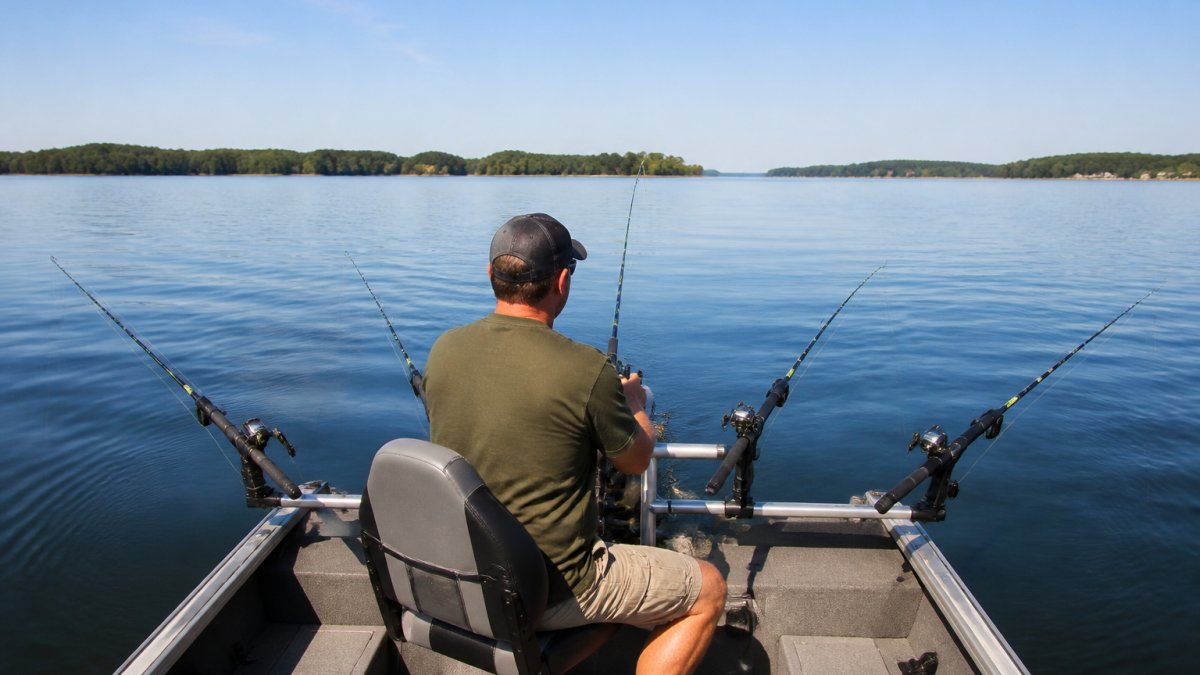
Your boat creates a wake, and the turbulent area directly behind it swirls weeds up and tangles lines more easily.
Move your lines to the sides of the boat instead, 15 to 25 feet out from the hull, away from the wake and rudder.
Stagger your line lengths too. If you're running three lines, use different distances:
- First line: 20 feet behind the boat
- Second line: 40 feet behind the boat
- Third line: 60 feet behind the boat
This separation creates a wider spread, so weeds struggle to tangle multiple lines at once.
Manage Line Angle and Distance
Line angle matters as much as distance: a line running too shallow plows through weed beds, while one angling downward cuts through vegetation more cleanly.
Let your lines out slowly so you can feel the bottom and sense weed zones.
Watch your line angle from rod tip to water: ideally 30 to 45 degrees downward. A nearly horizontal line snags more vegetation.
Weedless Lures for Trolling and Line Protection
Choosing the right lure makes a huge difference, some shed weeds naturally, others collect them like a magnet.
Weedless lures have these features:
- Thin, simplified bodies that slip through vegetation
- Upturned hooks that catch on weeds less often
- No treble hooks or dangly attachments
Spoons work well because their smooth, flat surfaces don't trap vegetation, and tight-wiggle crankbaits outperform wide-action baits.
In heavy vegetation, use bright colors like chartreuse or white, and match lure size to weed density, smaller lures move through thick vegetation more easily.
How to Prevent Fishing Line Tangles During Your Retrieve
Line tangles also happen during your retrieve, ruining your presentation.
Spooling and Line Maintenance
Start with quality line. Monofilament stretches and holds tangles, while braided line is stiffer, resists tangles better, and has less memory so it won't coil on your spool.
Spool tightly and evenly, loose spooling creates slack spots where tangles form. Use a line conditioner before spooling to reduce friction.
Checking and Clearing Weeds On the Water
Don't wait until weeds completely cover your line. Stop every 10 to 15 minutes, reel in, and pull off small strands starting to wrap, 30 seconds prevents major tangles.
Use a small treble hook to gently scrape stubborn weeds, don't pull hard or you'll damage the line.
Using a Leader to Manage Weeds and Tangles
A leader is the section of line between your main line and your lure. In weedy trolling, it changes how vegetation interacts with your presentation.
Why a Leader Reduces Weed Tangles
When a weed fragment contacts your line, it slides until it hits a stopping point, a knot, swivel, lure eye, or diameter change, where the tangle begins.
A heavier leader is stiffer and thicker than your main line, so weeds sliding down the thinner line stall at the junction rather than continuing to the lure, you clear one junction instead of picking vegetation out of 100 feet of line.
Choosing Leader Length by Weed Condition
Leader length is a trade-off: longer leaders give weeds more room to shed, but soften lure action and make netting fish harder.
- Light, scattered weeds: 12 to 18 inches. Short enough to keep lure action crisp, long enough to create a debris-collection point away from the hook.
- Moderate submerged vegetation: 24 to 36 inches. The added length lets floating fragments slide off before reaching the lure.
- Heavy weed beds or floating mats: 36 to 48 inches. The leader acts as a sacrificial zone, you clear weeds at the leader junction instead of at the hook.
Matching Leader Material to the Job
Material choice matters more in weeds than open water because stiffness determines whether vegetation slides off or wraps.
Fluorocarbon is the default for weedy trolling.
Monofilament leaders are cheaper but limper and stretchier.
Braided leaders are rare in trolling because braid has almost no stiffness and cuts through vegetation rather than shedding it.
Knots and Connection Points
Every knot is a weed magnet because it creates a bump in the line, so minimize knots between main line and lure.
The FG knot or Alberto knot produces the smallest profile when joining braid to a fluorocarbon leader; a bulky double uni catches vegetation.
At the lure end, use a Palomar knot or improved clinch knot tied directly to a snap or split ring.
Rigging for Different Weed Densities
A practical rigging progression as weeds worsen:
- Light weeds: 20-pound fluorocarbon leader, 18 inches, Palomar to a snap, snap to lure.
- Moderate weeds: 25-pound fluorocarbon leader, 30 inches, FG knot to braid main line.
- Heavy weeds: 30 to 40-pound fluorocarbon leader, 36 to 48 inches, no swivel, direct tie to a weedless lure.
- Matted surface weeds: 6 to 12-inch stiff fluorocarbon leader, direct tie, weedless lure with a single hook.
Weeds collecting at the leader-to-main-line junction means your leader is doing its job, clear it and keep trolling. Weeds collecting at the lure means your leader is too long or too limp.
When a Leader Hurts More Than It Helps
Leaders aren't universally beneficial. In three situations they can increase weed problems:
- Extremely clear water with spooky fish and light weeds: A heavy leader can reduce strikes. Match leader test to the lightest weight that still sheds weeds.
- Matted surface vegetation: Long leaders wrap around the mat instead of cutting through it. Go short and stiff.
- High-speed trolling: Above roughly 3.5 mph, a long limp leader can helicopter and twist. Shorten the leader or increase stiffness.
Planer Board Alternatives in Thick Weeds
Planer boards spread lines away from the boat, but they have a specific weakness in vegetation: the board runs near the surface, and in matted or floating weeds it can plow through a bed and drag a curtain of vegetation down the line to your lure. When boards collect more debris than they prevent, switch to one of these alternatives.
Inline Weights: Get Below the Weed Zone
An inline weight, a torpedo or keel weight threaded onto your line ahead of the leader, pulls your line deeper without a downrigger or diver.
When to use it: Submerged weed beds topping out 5 to 10 feet below the surface, or floating weeds concentrated in the top 2 feet.
Trade-off: Inline weights reduce lure action and make strikes harder to detect. Use a rod with a softer tip to compensate.
Staggered Depth Spreads: Cover the Column Without Hitting the Same Weeds
Instead of running all lines at the same depth, deliberately fish different depth bands.
When to use it: When you don't know where the weed tops are and want to find the cleanest depth band by trial.
Trade-off: You're deliberately fishing some lines in weeds. Expect to clear those lines periodically.
Trolling Open Pockets and Weed Edges
The most effective weed-tangle prevention is often route selection. Weed beds are rarely uniform.
When to use it: Always, as a first option. Route selection is free and requires no tackle change.
Trade-off: You may be fishing less productive water if the fish are buried in the weeds.
Diver Discs and Jet Divers: Depth Without Surface Contact
A diver disc or jet diver runs below the surface and pulls your line down and away from the boat.
Rigging: Attach the diver to your main line, then run a 3 to 6-foot leader to your lure.
When to use it: Floating weeds, windrows, and surface mats where a board would collect debris.
Trade-off: Divers add drag and require heavier rods.
Downriggers: The Cleanest Line Path in Heavy Weeds
A downrigger puts your line at a fixed depth below the boat with a short leader trailing the cannonball.
When to use it: Floating weeds, heavy surface mats, or any situation where you need precise depth control below a weed layer.
Trade-off: Downriggers require dedicated hardware, heavier rods, and more setup time. They are not practical for small boats or quick moves.
Weed Deflector Devices: A Mechanical Barrier Ahead of the Lure
A weed deflector or weed blocker is installed on the line ahead of the lure and physically intercepts vegetation before it reaches the hook.

Rigging: Install the device on your main line or leader 1 to 3 feet ahead of the lure.
When to use it: Any trolling situation where weeds reach the lure despite other precautions, particularly when you can't change depth or route.
Trade-off: Any device adds a potential failure point and can affect lure action.
Choosing Between Alternatives: A Quick Decision Framework
- Weeds are floating or suspended near the surface: Use a downrigger, diver disc, or inline weight to get below them. Avoid planer boards.
- Weeds are rooted and cover the full water column: Use route selection to find pockets and edges, then fish weedless lures with short, stiff leaders.
- Weeds are patchy and you want to cover water: Use staggered depth spreads and let the clean lines tell you where to focus.
On-Water Troubleshooting Checklist
When tangles happen, work through this checklist:
- Stop the boat and reel in all lines
- Inspect each line for weeds and debris
- Remove weeds by hand or with a small hook
Weed tangles can turn a productive day into hours of frustration, but most are preventable. Position your lines strategically, choose tackle that resists weeds, and check your setup frequently. If tangles still occur, tools like the Fishing Weed Blocker grab weeds before they cover your bait, keeping your presentation clear and your hook free of debris.
| Prevention Method | Best For | Difficulty |
|---|---|---|
| Line positioning | All conditions | Easy |
| Weedless lures | Heavy vegetation | Easy |
| Leaders | Moderate weeds | Medium |
| Fishing Weed Blocker | Trolling and bait fishing | Easy |
| Planer boards | Spreading lines wide | Medium |
Frequently Asked Questions
What causes fishing line to tangle while trolling?
Weed tangles during trolling happen when floating debris, branches, and aquatic plants wrap around your line or lure. Line positioned too close to the boat, rudder, or other lines creates natural snag points. Weeds collect faster in warm water and dense vegetation. Using monofilament line, which has more memory and stretch, increases tangle risk compared to stiffer line. Improper spooling and line twist from reel friction also contribute to tangles forming on the water.
How often should I check my lure for weeds when trolling?
Check your lure every 5 to 10 minutes when trolling through vegetation, or more frequently if you notice resistance or feel the lure dragging. If you're in thick weeds, inspect every few minutes. A quick visual scan from the boat tells you if weeds have started collecting. The faster you spot and clear weeds, the better your lure presentation stays intact. Regular checks also let you catch weed buildup before it becomes a major tangle problem.
Can a weed-catching device help keep bait clear while trolling?
Yes. A weed-catching device like the Fishing Weed Blocker grabs weeds and debris before they reach your lure or bait. The device is designed to glide through the water smoothly, picking up weeds along the way and keeping your hook free of debris. It's engineered to cast like a rocket and flow through the water with minimal drag, so it doesn't slow down your retrieve or affect how your lure moves. Many anglers add one to their tackle box specifically for trolling in vegetation-heavy areas.
What's the best way to prevent fishing line tangles when I'm trolling?
Position your lines away from the boat, rudder, and each other. Space them at least 2 to 3 feet apart on the sides of the boat. Use a leader made of stiffer monofilament or nylon to resist tangles. Check your line regularly for twists and ensure it's spooled correctly on your reel without memory. Use weedless lures or add a weed blocker to catch debris before it reaches your bait. Troll at a steady speed and avoid sharp turns that cause line slack and tangling.