
Last Updated: October 29, 2026
Quick Summary
Bass anglers should carry needle-nose pliers, hardened line snips, terminal tackle, spare line, a rubber-mesh landing net, weed control gear, and safety equipment like a fitted life jacket and navigation tools. Start with the tools you touch every cast, then add weed control and safety gear as your budget allows.
- Needle-nose pliers top the tackle box list for removing hooks and crimping barbs.
- Pack more hooks, split rings, swivels, and weights than you think you need.
- Rubber-mesh landing nets are gentler on bass and snag treble hooks less than nylon.
- Tether every tool on a kayak, because dropped pliers are gone for good.
- Inspect life jackets each season and replace any vest that no longer fits securely.
Table of Contents
- Why the Right Accessories Matter for Bass Anglers
- Must-Have Bass Fishing Tackle Box Items That Earn Their Space
- How to Prevent Weeds on Fishing Lures in Heavy Cover
- Essential Bass Boat Accessories for Safety and Navigation
- Landing Nets, Fish Handling, and Hook Safety on Deck
- Accessory Kits by Setup: Shore, Kayak, and Boat
- Prioritizing Your Gear by Budget and Season
- Build Your Weed-Free Bass Setup
- Frequently Asked Questions
Why the Right Accessories Matter for Bass Anglers
The difference between a frustrating day on the water and a productive one usually comes down to preparation. Bass anglers who carry the right tools spend more time fishing and less time untangling, retying, and cursing the weeds. This guide covers accessories that may earn a spot in your boat, kayak, or bank bag.
Bass fishing accessories are the tools and gear that support your lure presentation, protect your line, and keep you safe on the water. They are not the rod and reel. They are everything else that makes those two work.
Below, we discuss accessories for different fishing setups.
Must-Have Bass Fishing Tackle Box Items That Earn Their Space
A tackle box should be a working tool, not a storage unit for things you forgot you owned. The best bass fishing tackle box items are the ones you reach for every trip.
Pliers, Snips, and Line Tools
Needle-nose pliers top the list. You need them to remove hooks, crimp barbs, and hold a fish steady. Pair them with a quality line scissor or scissor snips for clean cuts on braided line and fluorocarbon.
A common mistake is buying cheap snips that dull after a few trips. Spend a little more on hardened blades. Also carry a small file for sharpening hooks, and a screwdriver for tightening reel screws and trolling motor mounts.
Terminal Tackle and Spare Line
Extra hooks, split rings, swivels, and weights are the small parts that end a trip when you run out. Pack more than you think you need.
Spare line matters just as much. A backlash or a frayed section can cost you twenty minutes of re-spooling on the water. Keep a spare spool of your main line and a backup of your braided line. A line conditioner helps keep both supple and reduces memory, especially in cold weather.
Storage sleeves and small divided boxes keep hooks organized and tangle-free. If you want snag-free hook storage options, see our guide to the best fishing hook holders for snag-free storage.
How to Prevent Weeds on Fishing Lures in Heavy Cover
Learning how to prevent weeds on fishing lures comes down to one idea: keep the hook clear long enough for a bass to strike. Heavy cover holds fish, but it also grabs everything you throw.
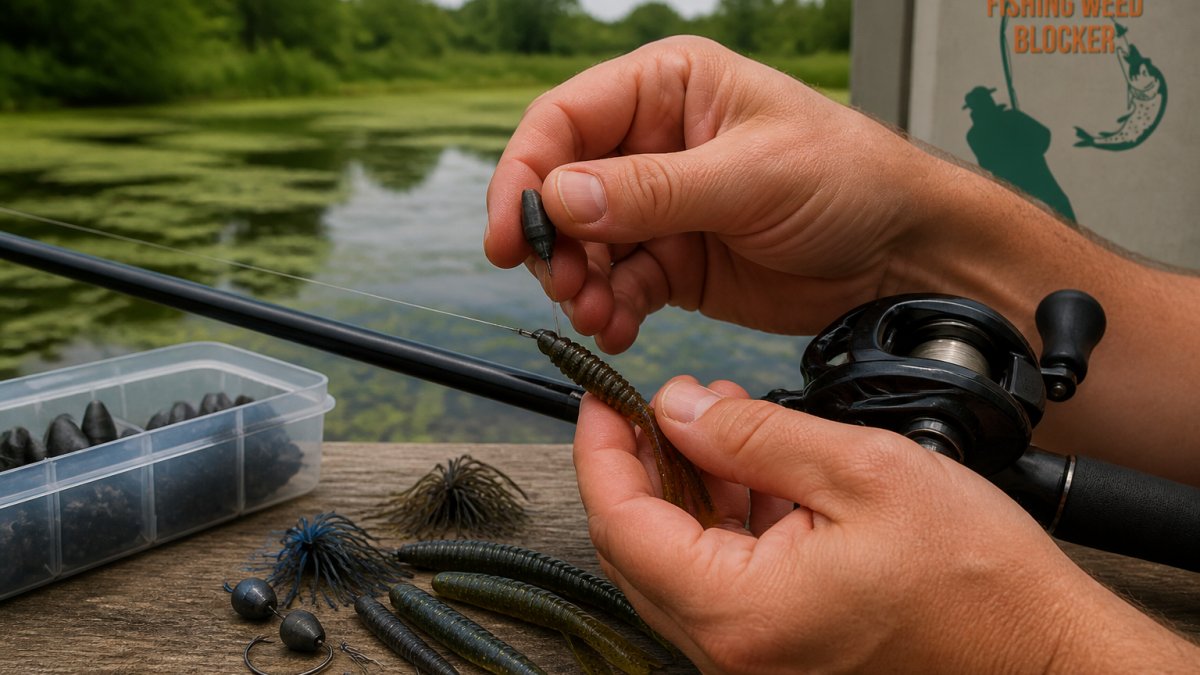
Methods fall into a few categories:
- Weedless rigging: Texas rigs and offset hooks tuck the point into the plastic.
- Weed guards: Wire or plastic guards deflect vegetation away from the hook.
- Weed blockers: A device mounted above the lure that grabs weeds before they reach the bait.
- Line management: Keeping your line tight and your retrieve steady stops slack from collecting debris.
The Fishing Weed Blocker is a patented, award-winning device designed for trolling and bait fishing. It grabs weeds before they cover your bait and keeps the hook free of debris. It is designed to cast like a rocket and flow through the water with minimum drag. It stacks neatly in your tackle box.
For a deeper look at proven techniques, read our full guide on how to keep weeds off fishing lures. If you want the physical device that solves it, you can see the Fishing Weed Blocker and add it to your setup.

Essential Bass Boat Accessories for Safety and Navigation
Safety gear is not optional, and it is not the place to save money. Essential bass boat accessories start with a properly fitted life jacket for every person aboard. Check the fit before you launch, not after.
Life Jacket Fit and Legal Requirements
A life jacket only works if it stays on (Life Jacket Wear / Wearing your Life Jacket).
Navigation and Mapping Tools
A GPS unit or a phone-based mapping app helps you find structure, mark waypoints, and stay off the rocks. Two practical rules: download offline maps before you leave cell coverage, and keep a charged backup battery in the boat. A dedicated chartplotter with side-imaging is the premium option; a phone in a waterproof case with offline maps is the budget option. Either way, mark your launch point as a waypoint so you can find your way back in fog or after dark.
Hook Guardian | Fishing Hook & Lure Safety Holder | 2 Pack| Rod-Mounted Safe →
Emergency Preparedness Checklist
Consider keeping emergency gear in a dry bag:
- First-aid kit with antiseptic, bandages, and hook-removal supplies
- Charged phone in a waterproof case, plus a backup battery
- Whistle or air horn (required sound-producing device on most boats)
- Throwable flotation device within reach of the helm
- Spare prop, prop wrench, and a basic tool kit
- Rain gear and an extra layer, even in summer
- Sunscreen and a wide-brim hat
Maintenance and Replacement Intervals
Safety gear degrades quietly. Inspect life jackets at the start of each season for torn fabric, faded labels, or stiff straps, and replace any vest that no longer fits or fastens securely. Check inflatable PFD cartridges on the schedule printed on the label, most manufacturers call for annual inspection and replacement after any inflation. Replace first-aid supplies that have expired, and test your whistle, horn, and navigation lights before your first trip of the year. A five-minute seasonal check is cheaper than a failed component on the water.
Landing Nets, Fish Handling, and Hook Safety on Deck
A rubber-mesh landing net protects both the fish and your lure. Rubber mesh is gentler on bass and less likely to snag treble hooks than nylon. Choose a net with a handle long enough for your boat height.
Choosing the Right Net
Net sizing is where most anglers guess. A hoop in the 20- to 24-inch range handles most bass, while a 24- to 28-inch hoop gives more margin for big fish and treble-hooked lures. Handle length should match your deck: a short handle is fine on a kayak, but a boat angler reaching over the gunwale needs a handle long enough to land a fish without leaning out. Collapsible or telescoping handles save space but add flex, check that the lock holds under load before you trust it with a good fish. Rubber or rubber-coated mesh is the standard recommendation because it reduces hook tangles and supports the fish's body rather than slicing through fins.
Fish Handling That Protects the Fish
Wet your hands before touching a bass, support the belly, and keep the fish out of the air briefly. Never hold a bass vertically by the jaw alone, support the body with a second hand. If you are practicing catch-and-release, keep the fish in the net in the water while you ready your camera or pliers, and return it promptly. In warm summer water, minimize handling time; in cold water, keep the fish from flopping on a dry deck.
Hook Removal Sequence
Use pliers to back the hook out, never your fingers. The safe sequence: secure the fish, locate the hook, push down on the eye or bend to disengage the barb, then back the point out the way it came in. For deeply hooked fish, cut the line close to the hook and release the fish rather than digging, the hook will work loose over time. Keep a hook cutter within reach for emergencies.
Care and Replacement
Rinse and dry your net after each trip, especially after saltwater or muddy water, and inspect the mesh for tears before you store it. Replace a net when the mesh frays or the handle lock weakens, a net that fails at the boat is worse than no net. Store pliers and cutters dry and oil the pivot occasionally; replace cutters when they crush rather than cut braid. A small maintenance routine keeps handling tools ready when a good fish shows up.

Accessory Kits by Setup: Shore, Kayak, and Boat
Your setup should shape your kit. A bank angler carrying a boat-sized box is just hauling weight.
| Setup | Core Accessories | Keep It Light By |
|---|---|---|
| Shore | Pliers, snips, small terminal box, weed blocker, one spare spool | One small bag, no hard box |
| Kayak | Leash for tools, waterproof box, net, safety whistle, spare line | Everything tethered or clipped |
| Boat | Full tool kit, spare prop, GPS, life jackets, landing net | Organized storage, labeled boxes |
Bank fishing has its own demands. If you fish small ponds from shore, our bank fishing gear guide for small ponds breaks down a tackle setup built for that access.
Kayak anglers should tether every tool. Dropping pliers over the side is a lesson you only need once.
Prioritizing Your Gear by Budget and Season
Start with the tools you touch every cast, then add as your budget allows. Pliers, snips, and terminal tackle come first. Weed control and safety gear come next.
A simple priority order:
- Pliers and snips
- Terminal tackle and spare line
- Weed control for your water
- Safety gear
- Navigation and mapping
- Spare parts and repair tools
Build Your Weed-Free Bass Setup
The accessories that matter most are the ones that keep your lure in the strike zone. Weed control sits at the top of that list for anyone fishing cover.
Fishing Weed Blocker builds tools for exactly that problem. Our patented weed blocker grabs weeds before they cover your bait, keeps the hook free of debris, and casts and retrieves with minimal drag. The Hook Guardian keeps hooks secure on the rod to prevent snags and injuries. Both stack neatly in a tackle box and are built to last.
See the Fishing Weed Blocker for details.
Frequently Asked Questions
What are the most essential accessories for bass anglers?
Start with tools you will touch every trip: needle-nose pliers, line scissors or scissor snips, a spare spool of line, extra hooks and terminal tackle, and a landing net. From there, add a weed blocker if you fish vegetation, a life jacket for boat days, and a hook holder to keep lures secured between casts. A small kit can keep frequently used items together.
How do I keep weeds off my lure while bass fishing?
The Fishing Weed Blocker ($15.97) is designed to grab weeds before they cover your lure. It is designed for trolling and bait fishing.
Are specialized fishing accessories worth the investment?
A $15.97 Fishing Weed Blocker is designed to grab weeds before they cover your bait. The $24.99 Hook Guardian 2-pack keeps hooks and lures firmly in place on your rod and helps protect kids and pets from accidental injuries caused by exposed hooks during transport or storage.
What should I keep in my bass fishing tackle box for quick access?
Keep the items you reach for most on top: needle-nose pliers, line scissors, extra hooks, spare line, and a few terminal tackle pieces. The test is simple: if you have to dig for it while a fish is on, it belongs in a different spot.
