

Quick Summary
Store weedless topwater lures dry, separated, and in compartments sized to each lure's shape. Keep hooks away from the weed guard, since a hook point pressed against it can bend the guard and leave it unable to deflect weeds. Rinse and dry lures after every trip before closing the box.
- Dry every lure fully before packing, since trapped moisture quickly rusts hooks and ruins paint.
- Give each lure its own slot, sized to its length, so bulky baits do not press on soft ones.
- Store hook points away from the weed guard to prevent the guard from bending or notching.
- Keep soft plastic lures in their own sealed compartment, away from painted hard baits.
- Inspect hooks, paint, and box seals monthly during the season and before long storage.
Table of Contents
- Why Weedless Topwater Lures Need Special Storage
- Dry Your Weedless Topwater Lures Before Storing Them
- Choose a Fishing Lure Storage Box That Fits Your Lures
- How to Keep Fishing Lures From Tangling
- How to Store Soft Plastic Lures Without Damaging Them
- How to Store Fishing Tackle in the Offseason
- Set Up Your Storage Routine Before Next Season
- Frequently Asked Questions
How to Safely Store Weedless Topwater Lures
Last Updated: October 31, 2026
Why Weedless Topwater Lures Need Special Storage
Weedless topwater lures are built to fish where the weeds are thickest. That is their whole job.
A lure that looked fine after a day on the water can come out of the box tangled, scratched, or rusty by the next season.
Weedless topwater lures are surface lures designed with guards or weed-deflecting features that let them move through cover without snagging.
Here is what makes them tricky to store:
- Exposed or semi-exposed hooks can tangle with other lures
- Soft plastic and rubber bodies can deform under pressure
- Paint and finish can chip when lures knock together
- Moisture left on the lure can lead to rust
Good storage solves all four problems. It keeps each lure separate, dry, and easy to find.
Dry Your Weedless Topwater Lures Before Storing Them
Never store a wet lure. Water trapped in a tackle box is one of the fastest ways to rust hooks and ruin paint. For more on why debris clings to lures, read proven methods to keep weeds off fishing lures.
Follow these steps after every trip:
- Rinse off salt, mud, and plant matter with fresh water.
- Pat each lure dry with a clean towel.
- Let lures air dry for several hours in a shaded spot.
- Check hook points and split rings for moisture before you pack them.
Watch out: Do not dry lures in direct sun for long periods. Heat can warm the plastic and soften the finish.
A common mistake is closing the box while lures are still damp. Even a little moisture can cause rust spots to grow over a few weeks.
Choose a Fishing Lure Storage Box That Fits Your Lures
The right box makes a big difference, but "get a tackle box" is not useful advice for weedless topwater baits. These lures have wide bodies, long-shank hooks, and weed guards that bend if they are crushed. The box has to fit the lure, not the other way around.
Look for these features when you shop:
- Individual compartments sized to the lure, not just "small" and "large"
- Flat-bottom compartments so hollow bodies do not roll and deform
- Lids that seal tightly enough to keep splash and humidity out
- Movable dividers so you can resize a slot when you change lure styles
- Clear lids so you can see hook position before you open the box
Match compartment size to weedless topwater style
Most anglers sort by color. Sort by shape first, then color. Here is a practical sizing guide based on common weedless topwater styles:
| Lure style | Typical body length | Compartment to look for | What to protect |
|---|---|---|---|
| Hollow-body frog | 2.5-4 in | 4-5 in long, 1.5-2 in deep, flat bottom | Hollow body collapsing; legs sticking to neighbors |
| Buzzbait | 3-5 in plus blade | 5-6 in long, 2 in deep, wide enough for the blade | Blade bending; skirt matting |
| Weedless popper | 2.5-3.5 in | 4 in long, 1.5 in deep | Paint on the cup face; treble hook points |
| Weedless walker | 3-5 in | 5 in long, 1.5 in deep | Joint hardware; rear hook |
| Soft-plastic toad or swimbait | 3-5 in | Sealed compartment or bag inside a slot | Plasticizers leaching; body flattening |
A common pattern is to dedicate one shallow tray to frogs and toads, one deeper tray to buzzbaits and walkers, and a small utility box to spare hooks, skirts, and split rings. That keeps the bulky baits from pressing on the soft ones.
Portable versus bulk storage
A single 3600-size utility box (about 11 x 7 x 2 in) holds roughly six to ten weedless topwater baits when each gets its own slot. That is a good day-trip size. For bulk storage at home, use a larger tray system and keep the day box as a shuttle, load it from the bulk tray the night before a trip instead of carrying everything.
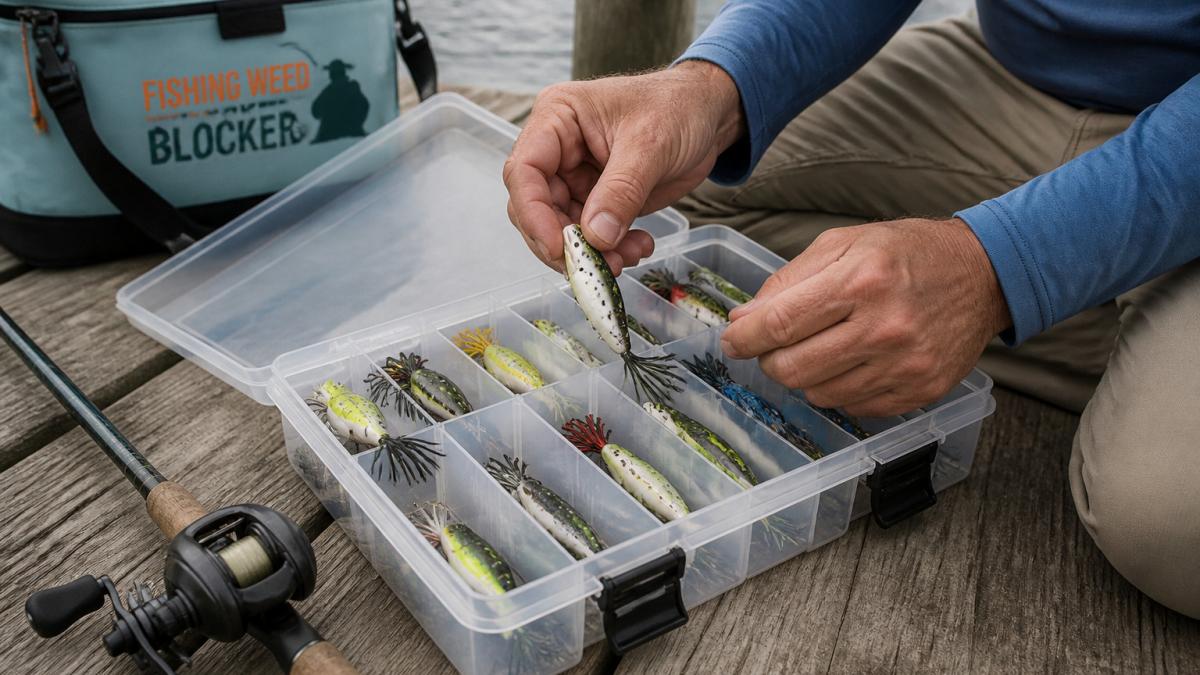
Angler's hands sorting weedless topwater lures into individual compartments of a clear tackle box on a wooden dock.
Check the lid before you buy
Close the empty box and shake it. Compare the best fishing hook holders for snag-free storage to see which designs keep hooks from catching on compartment walls. A lid that rattles will let lures shift and hooks knock together in transit. Look for a box with a positive latch and a gasket line, not just a snap tab.
Once the box is chosen, the Hook Guardian from Fishing Weed Blocker can help keep a hooked lure secured on the rod between trips. See https://fishingweedblocker.store for details.

How to Keep Fishing Lures From Tangling
Tangles waste time and can damage hooks, but weedless topwater baits tangle differently than crankbaits or jigs. A simple holder can keep hooks secure so they stay put on the rod. The weed guard itself is often the culprit: it catches on a neighboring hook point, bends, and then no longer deflects vegetation. Protecting the guard matters as much as separating the hooks.
Hook Guardian | Fishing Hook & Lure Safety Holder | 2 Pack| Rod-Mounted Safe →
Here is a method built around the hardware these lures actually have:
- Store each lure in its own slot or compartment. No exceptions for frogs or buzzbaits, their wide profiles touch neighbors even in a divided box.
- Point hooks away from other lures and away from the guard. A hook point resting against a weed guard will bend it over time.
- Use hook keepers or protective caps on exposed trebles. A small piece of split tubing over each point is enough.
- Keep heavy lures separate from soft ones. A buzzbait head pressing on a hollow-body frog will dent it.
- Do not coil line around the lure. Leader or line wrapped around a weed guard pulls it out of shape.
Protect the weed guard, not just the hook
A weed guard is usually a stiff mono loop, a wire loop, or a molded plastic fin. Each fails in a different way:
- Mono-loop guards take a set if bent and stay bent. Store them with the loop facing up, never pressed against a compartment wall.
- Wire guards can kink. Keep them from crossing under other lures.
- Molded plastic fins crack at the base. Avoid stacking weight on top of the bait.
A simple check before closing the box: run a finger along the guard. If it does not spring back straight, the storage position is wrong.
Material compatibility and corrosion
Weedless topwater baits mix materials that do not always get along. Soft plastic bodies contain plasticizers that can soften or cloud hard plastic boxes and can react with painted finishes on neighboring hard baits. Keep soft plastics in their own sealed compartment or bag, not loose against painted poppers.
Moisture is the other issue. Salt residue and lake water left on hooks, split rings, and buzzbait blades start rust quickly in a closed box. A few grains of salt in a compartment will pit a hook point within a season.
Use the Hook Guardian for rigged rods
Many tangles happen before the lure reaches the box, on a rigged rod in the truck or boat. The Hook Guardian from Fishing Weed Blocker is a rod-mounted safety holder that helps keep hooks and lures firmly in place on your rod to prevent snags and tangles. It is available at https://fishingweedblocker.store. Pair it with a compartment box and you cover both the transport and the storage sides of the tangle problem.
How to Store Soft Plastic Lures Without Damaging Them
Soft plastics are the easiest lures to ruin in storage. Heat, pressure, and oil can all change their shape and feel.
Keep soft plastics:
- Out of direct sunlight and hot cars
- In their own compartments, not piled together
- Away from dirty or oily gear
- Sealed in a bag or box to keep dust off
Watch out: Do not stack heavy tackle on top of soft plastics. The weight can flatten them and change how they swim.
How to Store Fishing Tackle in the Offseason
Long storage periods need extra care. Before you put tackle away for the winter, check every lure. Look for rust, cracked paint, and loose hooks.
Then:
- Replace any rusty hooks or split rings.
- Wipe down metal parts with a dry cloth.
- Store the box somewhere cool and dry, not in a garage or shed with wide temperature swings.
- Add a fresh moisture absorber to each box.
Many anglers find that a quick inspection in the fall saves a lot of trouble in the spring.
Set Up Your Storage Routine Before Next Season
A simple routine keeps your gear ready when the season starts. Try this:
- After each trip: Rinse, dry, and sort lures back into their compartments.
- Monthly during the season: Check hooks, paint, and box seals.
- Before storage: Clean, inspect, and replace damaged hooks.
- Before next season: Restock lures, check the box, and confirm your gear is in good order.
Here is a quick reference for the most common storage tasks:
| Task | When to Do It | Why It Matters |
|---|---|---|
| Rinse and dry lures | After every trip | Prevents rust and mildew |
| Check hooks | Monthly | Catches loose or rusty hooks early |
| Inspect paint and plastic | Before storage | Spots damage before it spreads |
| Replace moisture absorbers | Each offseason | Keeps boxes dry |
| Sort by lure type | When restocking | Saves time on the water |
Storing weedless topwater lures well takes only a few minutes of care each time. Keep them dry, keep them separate, and check them often. Your lures will last longer, and you will spend less time untangling hooks when you need them most. For a simple way to keep hooks secure on your rod, check out the Hook Guardian at https://fishingweedblocker.store.
Frequently Asked Questions
How should you store weedless topwater lures?
Dry each lure fully, then keep it in its own compartment so hooks and weed guards do not catch on neighboring lures. Use a tackle box with dividers or a utility box with foam inserts. Keep the box out of direct sun and heat, because heat can warp soft components and fade painted finishes. Check the hooks and weed guard for bends or wear before each trip so you can replace anything that no longer holds its shape.
Should topwater lures be stored in separate compartments?
Yes. Topwater lures often have treble hooks and weed guards that snag other lures and scratch painted finishes when packed together. Individual compartments keep each lure in place and make it easier to see what you have. A simple divider system costs little compared with replacing a lure whose finish was damaged by contact with hooks. Keep larger topwater baits in their own slots and smaller ones in smaller compartments.
How do you keep hooks from damaging other lures?
Keep hooks secured before you pack a lure. Tuck treble hooks into the lure body or place a hook cover over them, and set each lure so its hooks face the foam or the divider wall rather than another lure. Avoid stacking lures on top of one another in loose storage. A Hook Guardian can also help keep hooks and lures firmly in place on your rod to prevent snags and tangles.
Should you dry lures before putting them away?
Yes. Moisture trapped in a tackle box can cause hooks to rust and paint to bubble or peel. After a trip, wipe each lure with a dry cloth and let it air dry for several hours before sealing it in a box. Store the box in a cool, dry place, and consider adding a moisture-absorbing packet to the box if you fish in humid conditions.
