

Last Updated: October 27, 2026
Quick Summary
Keep fishing lures organized on your rod by securing each hook point into a built-in keeper or a rod-mounted clip, leaving 6 to 12 inches of slack line at the keeper, and never hanging a lure from the rod tip. Cover exposed hooks and store lures in a divided compartment box.
- Set the hook point fully into the keeper so no barb is exposed.
- Leave roughly 6 to 12 inches of slack line between the reel and the keeper.
- Never let a lure hang from the rod tip by its line alone.
- Use a rod-mounted clip or holder on rods that have no built-in keeper.
- Cover hooks during transport to protect the rod and passengers.
Table of Contents
- Why Lures Tangle and Snag When They Ride on the Rod
- What You Need Before You Start
- How to Secure a Lure to a Fishing Rod Step by Step
- How to Prevent Fishing Hooks From Tangling
- How to Store Fishing Lures Between Trips
- Transporting a Rod With a Lure Attached Safely
- Setting Up Your Rod Before the Next Trip
- Frequently Asked Questions
Why Lures Tangle and Snag When They Ride on the Rod
Lures that stay tied to a rod between casts tend to tangle. The treble hooks catch on guides, line wraps around the blade, and a lure swings loose during a walk to the next spot. Keeping fishing lures organized can help address these issues.
The fix starts with knowing where the trouble comes from. Hooks drag across the rod blank, lures knock against each other in a bag, and loose line picks up weeds in shallow water. Each of these is a small problem. Together, they cost time and patience.
Fishing Weed Blocker provides a patented device designed to grab weeds before they cover your lure or bait while trolling or bait fishing.
What You Need Before You Start
Gather a few simple items before you secure anything to the rod:
- A rod with a hook keeper, or a rod-mounted clip designed for lures
- Your lure, with the line tied and trimmed
- A dry, flat spot to work, such as a dock or tailgate
- Needle-nose pliers for tightening or loosening the hook
Check your line and knots first. A weak knot will fail under pressure no matter how well the lure is secured.
How to Secure a Lure to a Fishing Rod Step by Step
Securing a lure to the rod is not one procedure, it depends on the hook type, whether the rod has a keeper, and how the rod will be carried. The steps below cover a general sequence and hook-specific variations.
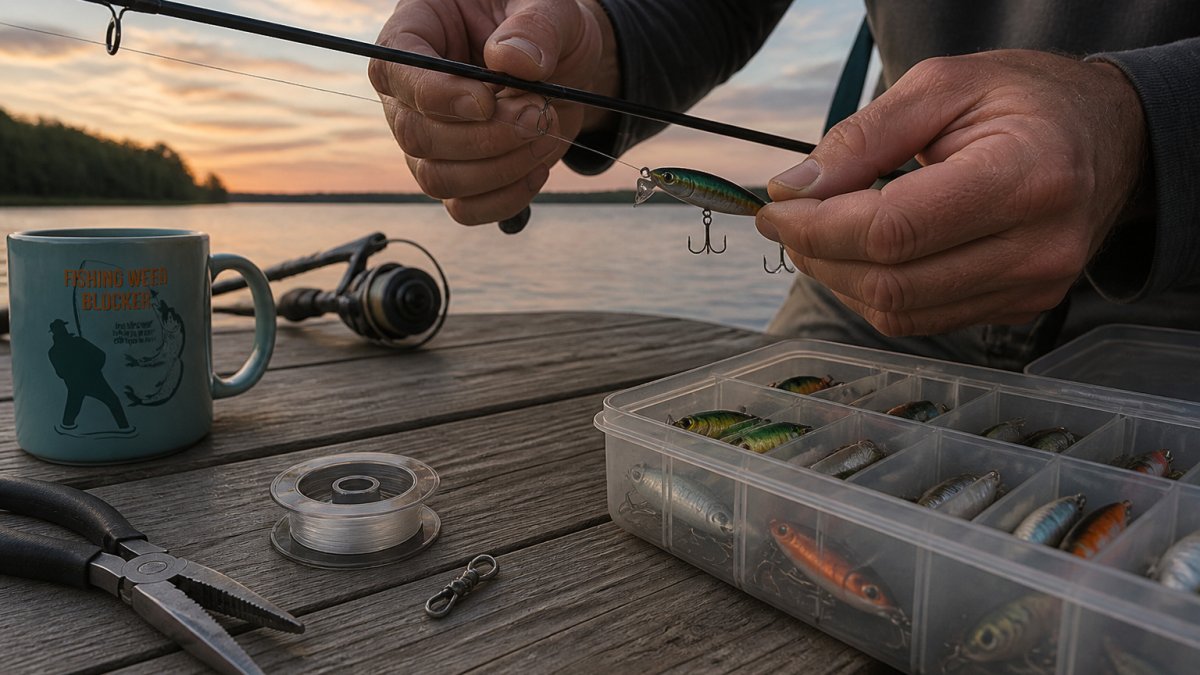
The General Sequence
- Reel the lure up until the hook sits a few inches below the rod tip, close enough to reach, far enough that the lure's weight is not loading the tip.
- Decide where the hook will attach: a built-in keeper, a rod-mounted clip, or a removable retainer. Never attach a hook directly to a guide ring or the blank itself.
- Set the hook point into the keeper or clip so the point is fully captured and no barb is exposed. Find a rod-mounted hook holder designed for safe, snag-free attachment.
- Leave a short loop of slack line between the reel and the keeper, roughly 6 to 12 inches on most setups, so the rod can flex without the line going tight against the hook.
- Gently tug the lure away from the rod to confirm the keeper holds. If it pulls free, reposition or switch keepers.
- Confirm the line still runs cleanly through every guide and is not wrapped around the blank.
Treble-Hook Lures (Crankbaits, Topwaters, Jerkbaits)
Treble-hook lures are the hardest to secure because two of the three points are always exposed. The reliable pattern is to hook one treble into the keeper and let the body of the lure rest against the rod, with the rear treble either hooked to the same keeper or captured by a second retainer near the butt. Do not hook a treble through a guide ring, the point will scar the ring and abrade line on the next cast. If the rod has no keeper, a rod-mounted clip that captures the hook shank rather than the point is the safer choice, because it holds even when the fish has bent a point.

Single-Hook Lures (Jigs, Swimbaits, Soft Plastics on Jigheads)
Single hooks are easier: the point goes into the keeper and the jig head rests against the blank. The trade-off is weight. A heavy jig hanging from a keeper near the handle puts a slow bend in the rod over time, so on rods stored vertically, hook the jig near the butt rather than the tip. For soft plastics rigged weedless, the hook point is already buried in the plastic, hook the plastic itself into the keeper, not the hook, so the bait does not tear free in transit.
Hookless Rigs and Baits Without Exposed Points
Carolina rigs, drop-shot rigs, and weedless soft plastics with the point buried in the body can be secured by hooking the weight or the bait into the keeper. This is the lowest-risk configuration, but check that the weight is not resting on a guide, a sliding sinker will bang against the ring every time the rod moves.
Rods Without a Built-In Keeper
If the rod has no keeper, you have three practical options, each with a trade-off: Shop an add-on rod-mounted clip that secures the lure.
- Rod-mounted clip or holder, most secure, reusable, and works on any blank diameter; the trade-off is a small add-on cost and a few seconds to install.
- Removable hook keeper (adhesive or strap-on), low profile and cheap, but adhesive versions can peel in heat or wet conditions and should be checked before each trip.
- Rubber band or tape over the hook point, a temporary field fix only; it does not survive rough travel and should not be trusted for a full day on the water.
Checking the Setup Before the First Cast
Before you cast, run three checks: the hook point is fully captured, the line has slack at the keeper, and the line runs straight through every guide. A lure that passes all three will not snag on the walk to the next spot, will not scar a guide, and will not load the rod tip.
The right method depends on the hook type and whether the rod has a keeper, as summarised below.
Hook Guardian | Fishing Hook & Lure Safety Holder | 2 Pack| Rod-Mounted Safe →
| Setup | Best method | Key note |
|---|---|---|
| Built-in keeper | Hook point set into keeper | Fully capture the point |
| Rod without keeper | Rod-mounted clip or holder | Most secure and reusable |
| Removable keeper | Adhesive or strap-on keeper | Check before each trip |
| Temporary fix | Rubber band or tape over point | Not for a full day on water |
| Slack at keeper | 6 to 12 inches of line | Lets the rod flex |
How to Prevent Fishing Hooks From Tangling
Keeping fishing lures organized by size or lure type also helps you find the right one quickly and avoid digging through a tangled pile. Explore eight ways to organize hooks and lures on fishing rods.
How to Store Fishing Lures Between Trips
Good storage keeps lures ready to use and protects your gear. Store lures in a compartment box or tackle bag with dividers. Keep hooks in their own slots so they do not snag soft plastics or spinnerbaits.
Dry lures before packing them. Moisture can rust hooks and damage paint. Once dry, lay lures flat and avoid stacking heavy items on top.
Many anglers also keep a few rod-mounted clips in their tackle box. That way, a clip is always ready when you rig up at the next spot. Compare the best fishing hook holders for snag-free storage.
Transporting a Rod With a Lure Attached Safely
Transport is where rod-mounted lures do the most damage, to upholstery, to passengers, and to the rod itself. The risks change with the carrier, so the guidance should too.
In a Vehicle
Lay rods flat in the bed, trunk, or across the back seat with the lure secured and the hook covered. The two failure modes are the lure swinging into a seat or door frame, and a passenger brushing an exposed hook. A rod-mounted clip plus a hook cover handles both. If rods must stand upright, put them in the corner behind a seat where nothing can fall against them, and never let a lure hang free near a window or door.
In a Boat
On the water, rods usually ride in a rod locker or upright in holders. In a locker, the lure should be secured to the rod and the rod separated from others so hooks cannot cross. In upright holders, the lure must be secured to the rod, not left dangling, because boat movement will swing it into the console, another rod, or a passenger. Lockers with tube inserts are the safest option because each rod is isolated.
In a Rod Tube or Case
A rod tube is the highest-risk carrier for a lure because the tube is narrow and the rod can slide. Secure the lure to the rod with a clip, cover the hook, and slide the rod in butt-first so the tip is not leading. Never force a rod with an exposed hook into a tube, the hook will catch on the tube mouth and either bend or tear free.
Hook Covers and Why They Matter in Transit
A hook cover, a small cap, a piece of split tubing, or a commercial hook bonnet, does two things a keeper cannot: it contains the point if the keeper fails, and it protects fabric and skin from a hook that works loose. For treble-hook lures, a bonnet over each treble is the most reliable pattern. For single hooks, a short length of split tubing over the point is enough.
A Quick Pre-Transport Checklist
- Hook secured to the rod via keeper or clip
- Hook point covered
- Line slack at the keeper, not tight
- Rod isolated from other rods
- Tip not leading into a tube or locker
Setting Up Your Rod Before the Next Trip
A few minutes of prep means you spend less time untangling and more time fishing. Once your rods are set, you are ready to head out.
Frequently Asked Questions
How do you keep a fishing lure from swinging on a rod?
Hook the lure into the rod's hook keeper or a rod guide, with the point set into the cork or foam so it cannot swing. On rods without a keeper, a rubber band or a rod-mounted safety clip holds the lure in place. Check that the hook point is covered or secured before you walk, since a swinging lure can catch clothing, fingers or the line itself. Re-check the hookset after each cast.
Where should you hook a lure when carrying a fishing rod?
Set the hook into the built-in hook keeper near the handle, or into the first rod guide closest to the reel, and keep the line slightly taut. Avoid hooking the lure into the rod blank itself, where it can scratch the finish or weaken the wrap. If you carry the rod over the shoulder, point the tip away from your body and keep the lure low to reduce the chance of a hook catching on brush or gear.
How do you keep treble hooks from snagging line or clothing?
Tuck the trebles into the hook keeper or wrap them with a small rubber sleeve or piece of tape over the points. Keeping the hooks pinned against the rod reduces tangles with the line and keeps the points from grabbing fabric. Always remove the lure from the rod before you store it, and check the hooks for sharpness and damage each time you re-rig.
How do you organize spare lures while fishing?
Keep your most-used lures in a small compartment box or a soft plastic wallet with resealable pages, and sort them by type, such as spinnerbaits, chatterbaits and soft plastics. Carry only what you expect to use on that outing. Store hooks and weights in their own small containers so they do not spill into the lure section. Reorganizing at home after each trip keeps the system working.
