

Table of Contents
- Why Murky Water Changes Everything About Your Setup
- The Best Fly Colors for Murky Water (and When to Use Each)
- Flies for Muddy Water: Profile, Flash, and Movement
- Adding Weight and Adjusting Tippet, Leader, and Fly Line
- Fly Fishing After Rain: Reading High Water and Spring Runoff
- Weedless Fly Fishing Gear That Keeps Your Fly Working
- Presentation, Retrieve, and Strike Detection in Low Visibility
- Conclusion
- Frequently Asked Questions
Last Updated: October 17, 2026
Why Murky Water Changes Everything About Your Setup
Muddy water is not a small problem you can cast your way around. It is a completely different fishing environment, and fly fishing gear for murky water often fails when you simply carry over a clear-water setup.
Fish feed by sight. When water turns brown, their strike zone shrinks fast.
That single change drives every gear decision below. Color, flash, profile, weight, leader strength, and even where you stand all flow from one question: can the fish see this?
Below, we break down exactly how to rebuild your setup for dirty water, from fly color to strike detection.
The Best Fly Colors for Murky Water (and When to Use Each)
The best fly colors for murky water are black, chartreuse, white, and hot orange. These colors hold their shape against a brown background better than natural tones. Olive, brown, and tan flies disappear in muddy water, no matter how well they are tied.
Think about contrast, not realism. A brown nymph on a brown river is camouflage. A black streamer with a chartreuse head is a target.
When to use each:
- Black: The safest default. Black creates a hard silhouette in almost any water color.
- Chartreuse: Best in stained green water and low light. It reads as a bright flash.
- White: Strong in muddy water with some sun. It mimics the flash of a baitfish belly.
Bright vs. Dark: A Simple Visibility Rule
Use dark flies in bright light and bright flies in low light. That sounds backwards, but it works. In full sun, a dark fly casts a strong silhouette. In flat, cloudy light, a bright fly gives fish something to lock onto.
Flies for Muddy Water: Profile, Flash, and Movement
Flies for muddy water need three things: a big profile, some flash, and movement. Fish cannot examine details in low visibility, so they respond to size and motion instead. A small, subtle fly is wasted effort in dirty water.
Patterns that earn their place in a murky-water box:
- Woolly Bugger: The workhorse. Big profile, marabou tail that pulses, and it pushes water. Fish feel it before they see it.
- Streamers: Articulated patterns with flash in the wing. Strip them with a steady retrieve to create a visible wake.
- Stonefly nymphs: Bulky and dark. Good when fish are holding near the bottom in high flows.
Streamers, Nymphs, and Weighted Patterns That Get Seen
Match the fly to the depth. Streamers cover water and trigger aggressive fish. Nymphs work when fish are pinned to the bottom and not chasing. Weighted patterns let you reach both without changing your whole rig.
Adding Weight and Adjusting Tippet, Leader, and Fly Line
Added weight is how you reach fish in high, fast water. Fly fishing gear for murky water usually needs more of it, since the current runs harder and fish move deeper and tighter to cover. If your fly is not getting down, nothing else matters. But weight alone is not a setup, you need the line, leader, and tippet to work together so the fly stays in the strike zone long enough to be found.
Weight options, from least to most:
- Beadhead flies for a small boost
- Split shot above the knot for quick adjustments
- Tungsten nymphs for fast, deep runs
Match Line Density, Leader Length, and Fly Depth to Conditions
Most anglers adjust one variable and leave the rest alone. In dirty water, the whole system has to line up. Use this as a starting framework and adjust from there:
- Lightly stained, moderate flow: Floating line, 9-foot tapered leader to 3X or 4X tippet, beadhead nymph or unweighted streamer. Add one small split shot if the fly is not ticking bottom within a few casts.
- Muddy, steady flow: Floating line with a sinking polyleader or a clear intermediate sink-tip, 7.5-foot leader to 2X or 3X tippet, tungsten nymph or weighted streamer. Shorten the leader so the fly turns over and gets down faster.
- High, fast runoff: Full sinking line or a heavy sink-tip (type 3 or faster), short 4- to 6-foot leader to 1X or 0X tippet, large weighted streamer. The short, stout leader keeps the fly tracking straight in heavy current and gives you leverage to turn a fish away from structure.
A common pattern among guides is to shorten the leader as flows increase. Long, fine leaders that turn over delicately in clear water collapse in heavy current and keep the fly too high. In dirty water, a shorter, heavier leader is a feature, not a compromise.
Tippet and Leader Strength
Go up in tippet size. Dirty water hides heavier line, and a stronger tippet lets you turn fish away from structure. Step up your leader strength too, since fish in high water often run for cover the moment they feel the hook. A 3X tippet that feels right in clear water is often a 2X or 1X tippet in runoff.
Fly Line Choice
Your fly line choice matters as well. A sink-tip or full sinking line keeps your fly in the zone longer when the current is pushing hard. Floating lines still work for shallow flats and slower edges. If you only own one line, a floating line plus a set of sinking polyleaders gives you the most flexibility for the least money, you can change density in seconds without a spare spool.
Fly Fishing After Rain: Reading High Water and Spring Runoff
Fly fishing after rain is a timing game. High water and spring runoff push fish to the edges, where the current breaks and food collects. Read the water before you read your fly box.
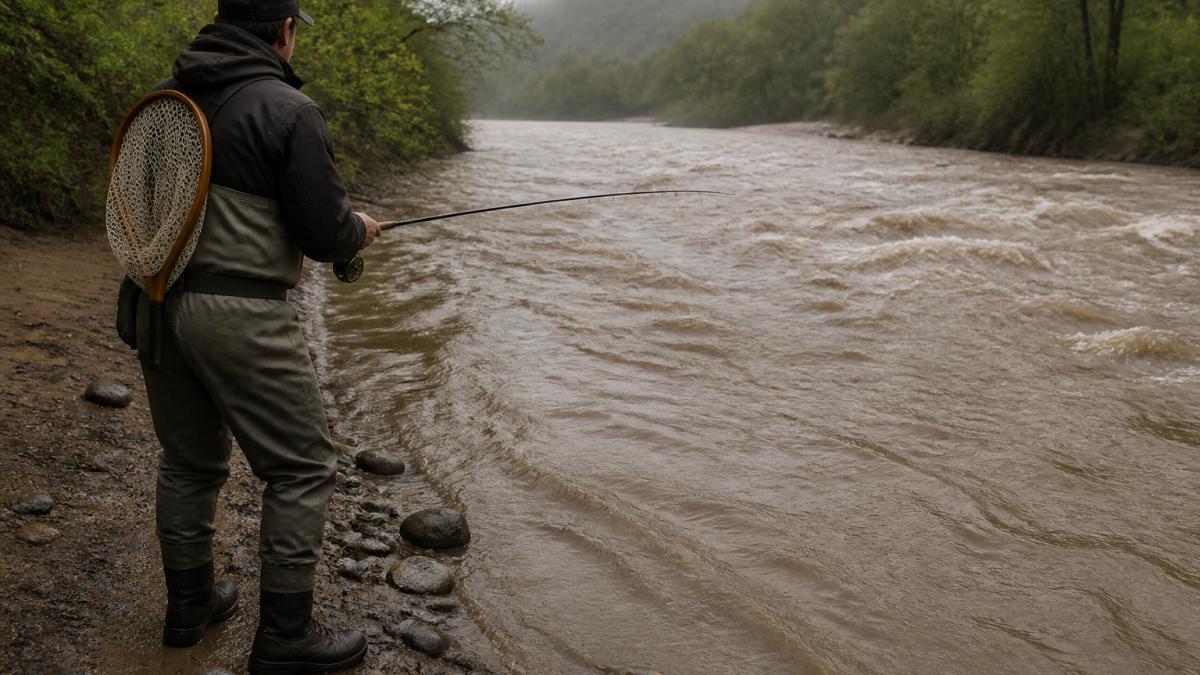
Where to look in high water:
- Soft seams along the bank where fast water meets slow
- Back eddies behind rocks and fallen trees
- The inside of bends where current slows
Safety comes first during runoff. Banks get soft, currents get strong, and a wading belt is not optional. Fish with a partner when flows are up, and skip the crossings you would normally make without thinking.
Weedless Fly Fishing Gear That Keeps Your Fly Working
Weedless fly fishing gear solves a problem dirty water makes worse. High water carries debris, and murky water often comes with vegetation knocked loose by the current. A fly covered in weeds is a fly fish cannot see and will not eat.
This is where our own product earns its place. The Fishing Weed Blocker is a patented, award-winning device that grabs weeds before they reach your bait or fly.
Presentation, Retrieve, and Strike Detection in Low Visibility
Presentation in low-visibility water comes down to slow, steady movement and a fly fish can track. A fast, erratic retrieve gives fish nothing to follow. A steady retrieve creates a wake and a silhouette they can close in on. But the right retrieve depends on the water in front of you, so treat the list below as a decision framework rather than a single rule.
A Condition-Based Presentation Chart
Use water color, light, and flow to pick your retrieve and fly depth. This is the part most murky-water advice skips.
- Lightly stained, bright sun: Medium strip with short pauses. Fish are still willing to chase, and the sun gives them enough contrast to track a moving fly. Keep the fly mid-column.
- Lightly stained, flat light: Slow strip, longer pauses. Contrast drops, so give fish time to close in. Dark fly, steady retrieve.
- Muddy, bright sun: Slow, steady strip with a visible wake. Dark fly with a strong silhouette, fished shallow to mid. The wake is your best visibility tool.
Adjust Your Presentation Like This
- Slow down your strip and let the fly swing
- Add a pause to let the fly settle in the strike zone
- Fish closer to cover than you would in clear water
Species and Water-Type Adjustments
Trout in rivers respond to a swung streamer and a dead-drifted nymph on a tight line. Bass in stillwater respond to a steady, wake-producing retrieve along weed edges and drop-offs. In stillwater, the wind line and any color change in the water are your best clues, fish stack along them. In rivers, the soft seam is the equivalent. Match your retrieve to how the fish feeds: trout often hold and wait, bass often chase.
Strike Detection When Fish Cannot See Well
Strike detection gets harder too. Fish cannot see as well, so they take longer to commit. Set the hook on feel, not sight. Watch your line where it enters the water, and keep a light finger on the line to feel the take. Many anglers miss fish in muddy water simply because they were watching for a visual strike that never came.
Three concrete habits improve detection:
- Keep a tight line. Slack line hides takes. Strip-set with the line under tension rather than lifting the rod tip.
- Watch the line, not the fly. In dirty water you will rarely see the fly. The line jump, the stop, or the tick is the strike.
- Use a strike indicator for nymphs. Even in murky water, an indicator gives you a visual cue when the fly stops or hesitates. Set it shallow so the fly stays in the strike zone.
Conclusion
Murky water punishes a clear-water setup. The anglers who keep catching fish after rain are the ones who change color, size, weight, and line strength to match the conditions.
Fishing Weed Blocker was built for exactly this kind of fishing. Our patented, award-winning device grabs weeds before they cover your bait, keeps your hook free of debris, and flows through the water with minimal drag.
Frequently Asked Questions
Does fly fishing work in murky water?
Yes, but you have to adjust. Fish still feed in murky water; they just cannot see as far. Choose flies with strong profiles, flash, or bright colors, add weight to reach fish holding deeper, and step up to heavier tippet so you can pull fish out of fast current. Focus on edges, seams, and slower pockets where fish conserve energy. Strike detection gets harder, so watch your line and use a visible indicator or tight-line approach.
What colors work best for fly fishing in murky water?
For muddy water, bright and high-contrast colors show up best: chartreuse, orange, hot pink, white, and black. Dark flies create a strong silhouette against a bright sky, while flashy materials like gold or silver tinsel reflect light. Carry a mix of bright and dark patterns so you can switch based on light conditions and water clarity. The best fly color for murky water is the one you can see and fish still find.
Should you use a heavier leader or tippet in murky water?
Go heavier than you would in clear water. Murky water hides your line, so fish are less leader-shy, and you often need to turn over bigger, weighted flies. A shorter, heavier leader and tippet in the 2X to 0X range helps you cast bulky streamers, control depth, and land fish in strong current. It also reduces break-offs when fish run in high water.
How do you keep flies from snagging on weeds in murky water?
Use weedless fly patterns and gear designed to shed vegetation. Weed guards on hooks, mono loops, and devices that grab weeds before they cover your fly all help. Fish flies with the hook point protected, retrieve steadily so the fly rides above the weeds, and target the edges of weed beds rather than the thickest cover. Checking your fly after every cast saves time and keeps your presentation clean.