
Table of Contents
- How Weedless Rigs Change the Way You Set the Hook
- Weed Guards vs. Exposed Hooks: Hookup Ratio Trade-Offs
- Weedless Hook Set Techniques That Actually Work
- Best Rod Action for Weedless Hooks and Heavy Cover
- How to Clear Weeds Quickly So Your Hook Stays Ready
- Line Type and Hook Gap: What Most Anglers Overlook
- Common Mistakes That Cost You Hookups
- Frequently Asked Questions
Last Updated: September 17, 2026
How Weedless Rigs Change the Way You Set the Hook
Yes, weedless fishing affects hook set. A weed guard sits between your hook point and the fish's mouth, absorbing part of your force. You still get solid hookups, but you must set harder and sharper than with an open hook.
Why Hook Point Exposure Is the Real Issue
Hook point exposure is the biggest variable in weedless hook sets. A fully buried point travels farther and pushes through more material before it bites.
Three things change when you bury the point:
- The guard flexes before the point reaches flesh
- The soft plastic collapses and absorbs energy
- The hook has to rotate and clear the body of the lure
Weed Guards vs. Exposed Hooks: Hookup Ratio Trade-Offs
Exposed hooks win on hookup ratio. Weed guards win on time in the strike zone. You cannot max out both.
Here is how the main options stack up:
| Setup | Hookup Ratio | Snag Resistance | Best For |
|---|---|---|---|
| Exposed hook | Highest | Lowest | Open water, sparse cover |
| Wire weed guard | Moderate to high | High | Skirted jigs, heavy cover |
| Fiber weed guard | Moderate | Moderate to high | Flipping, pitching |
| Texas-rigged plastic | Moderate | High | Soft plastics in grass |
| Wacky rig | Moderate to high | Low to moderate | Weightless plastics, open grass |
Weedless Hook Set Techniques That Actually Work
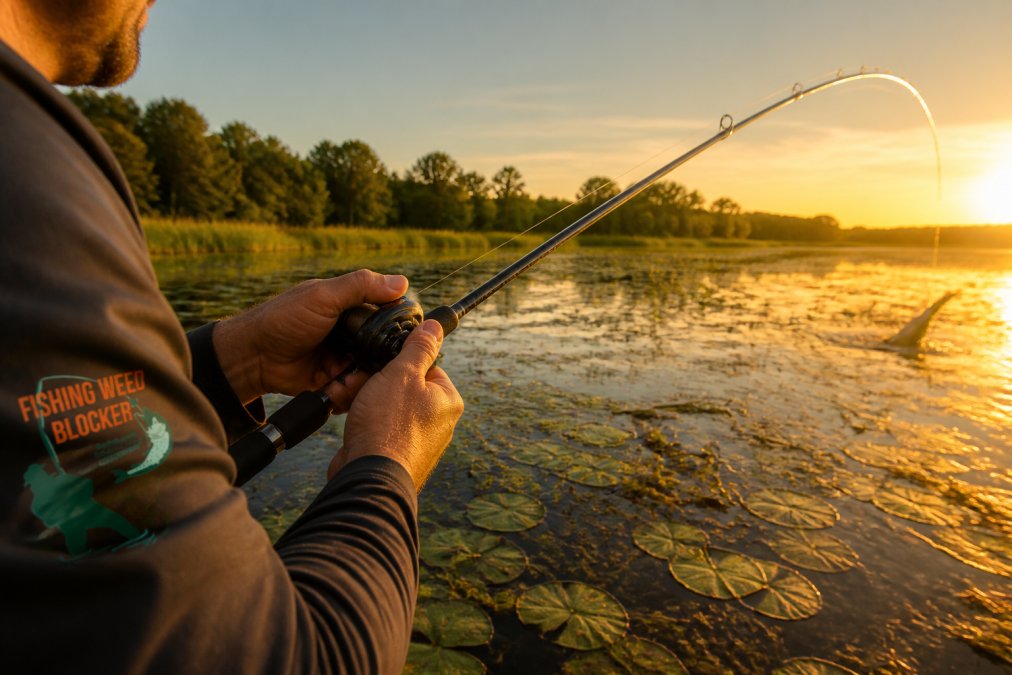
Set the hook hard, fast, and upward. Weedless hook sets need more force and a sharper snap than open-hook sets. A slow sweep will not drive the point through a guard and thick plastic.
Use this sequence:
- Reel down first. Take up slack until you feel the fish's weight.
- Snap, do not sweep. Drive the rod up and back in one sharp motion.
- Keep the rod loaded. Do not stop halfway. Follow through.
- Reel to confirm. If you feel weight, keep the line tight and reel.
How Much Force a Weedless Hook Set Needs
A weedless hook set needs more force than an open-hook set, but "more" is not "as hard as you can." You want a sharp, controlled snap that loads the rod and drives the point through.
The right amount depends on three things:
- Guard stiffness (wire needs more than fiber)
- Plastic thickness (thick baits need more)
- Hook gap (a wide gap needs less force to bite)
Best Rod Action for Weedless Hooks and Heavy Cover
A fast or extra-fast action rod with real backbone is the best choice for weedless hooks: the stiff lower section drives the hook while the fast tip loads quickly and keeps the set tight. Here is why rod power matters more with a weed guard than an open hook.
The Mechanism: Where Rod Power Meets Guard Resistance
A weed guard is a spring. The hook point must overcome a resistance threshold, fixed by the guard's stiffness, not by how hard you swing, before it touches flesh. Your rod controls how much of your swing reaches the hook instead of being absorbed by the blank.
- A moderate-action blank bends deep into the mid-section on the set. That bend stores energy in the rod rather than transferring it to the hook point, so the guard flexes but the point may not clear it.
- A fast or extra-fast blank keeps the bend in the upper third. The lower section stays rigid, so more of your hand speed converts into forward hook travel.
- Power (the blank's resistance to bending) sets the ceiling on how much force you can deliver without the rod folding. A medium-power rod in heavy grass runs out of backbone before the guard runs out of resistance.
Matching Power and Action to Cover
Use these pairings as a starting point, then adjust to guard stiffness and plastic bulk:
- Heavy power, fast action (roughly 7'0"-7'6"): Punching mats, thick hydrilla, skirted jigs with stiff wire guards. Built for 50-65 lb braid. The backbone drives the point through a stiff guard and a bulky trailer.
- Medium-heavy power, fast action (roughly 6'10"-7'3"): The all-around pick for Texas rigs, creature baits, and most soft plastics in moderate grass. Pairs well with 30-50 lb braid or 15-20 lb fluorocarbon.
- Medium power, moderate action (roughly 6'6"-7'0"): Fine for light cover, weightless plastics, and open-water wacky rigs. Weak in heavy grass because the blank folds before the guard flexes.
- Medium-light power, moderate action: Open water only. Do not fish this in cover with a weedless rig and expect consistent penetration.
A Quick Field Test for Rod Backbone
Before committing a rod to a weedless setup, load it against a fixed object at roughly your planned drag setting. If the blank bends past the mid-point before you feel real resistance, it lacks the backbone to drive a stiff guard. If the bend stays in the upper third and the tip recovers fast, it will transfer your set cleanly.
How to Clear Weeds Quickly So Your Hook Stays Ready
Clear weeds fast by snapping the rod tip and ripping the bait free, then checking the hook point before your next cast. A fouled bait is a missed fish waiting to happen.
- Snap the tip. A sharp twitch often frees the bait.
- Rip if needed. If it holds, pull hard to break it loose.
- Reel in and check. Look at the hook point every time.
- Clear the guard. Pull any strands off the wire or fiber.
- Recast. A clean bait hooks more fish.
Line Type and Hook Gap: What Most Anglers Overlook
Line type changes how much force reaches the hook. Braid has almost no stretch, so more of your set transfers straight to the point; monofilament and fluorocarbon stretch, softening the set. Here is how stretch and hook gap geometry compound the loss.
Stretch as Energy Loss
Think of your hook set as a pulse of energy traveling from your hand to the hook point. Every inch of stretchy line absorbs part of that pulse before it arrives.
- Braid stretches roughly 1-3% under load. Nearly all of your set reaches the hook. This is why braid is the default for punching mats and fishing stiff wire guards.
- Fluorocarbon stretches roughly 10-20% depending on brand and diameter. It still transfers a solid set, and its abrasion resistance is a real advantage around wood and rock.
- Monofilament stretches roughly 20-30%. In open water that forgiveness protects light line and small hooks. In heavy cover it can absorb enough of an already-reduced weedless set that the guard flexes but the point never bites.
Hook Gap Geometry: Why Wide-Gap Hooks Win Weedless
Hook gap is the distance between the hook point and the shank. With an open hook, gap matters less because nothing blocks the point; with a weedless rig, gap determines how far the point travels to clear the plastic and reach flesh.
- A wide-gap hook gives the point a shorter, cleaner path out of the bait. Less plastic to push through means less force lost before penetration.
- A narrow-gap hook on a bulky bait can leave the point buried even after a solid set. The plastic collapses around the shank and traps the point.
- Offset shanks (common on Texas-rig hooks) rotate the point upward on the set, which helps it clear the bait body faster than a straight shank.
Matching Line and Hook to the Guard
Use this as a starting framework:
- Stiff wire guard, heavy cover: Braid (40-65 lb) plus a wide-gap offset hook. Maximum force transfer, shortest point travel.
- Fiber guard, moderate cover: Braid or fluorocarbon (15-20 lb) plus a standard wide-gap hook. Fiber flexes easier, so you can trade some force transfer for abrasion resistance.
- Buried plastic, open water: Fluorocarbon or monofilament plus a wide-gap hook. Stretch is less of a problem when the guard is soft and the bait is thin.
Common Mistakes That Cost You Hookups
The same few mistakes show up again and again. Fix them and your hookup ratio climbs.
- Sweeping instead of snapping. The guard flexes but the point never bites.
- Skipping the reel-down. Slack line wastes your set.
- Fishing a soft rod in heavy cover. No backbone, no penetration.
- Ignoring the hook point. A fouled point cannot hook anything.
- Using a narrow-gap hook on a fat bait. The point stays buried.
- Setting too early. Wait until you feel the fish's weight.
Frequently Asked Questions
Do weedless hooks actually reduce your hookup ratio?
Yes, in most cases. A weed guard sits between the hook point and the fish's mouth, so the point must push through the guard before it can penetrate. That extra step lowers hookup efficiency compared to a bare exposed hook. The trade-off is worth it in heavy cover, where an exposed hook would snag on every cast. Matching your hook set force to the guard type and keeping the point sharp keeps the loss small.
How much pressure is needed for a weedless hook set?
More than a standard set, but not a violent one. Wire guards need a firm, sweeping sweep to compress the wire and drive the point home. Fiber or bristle guards collapse more easily, so a moderate snap works. The key is keeping steady line tension through the whole motion. A limp, half-hearted set lets the guard spring back before the point ever touches the fish.
What is the best rod action for setting a weedless hook?
A fast or extra-fast action rod with medium-heavy to heavy power works best. The stiff backbone transfers your hook set force straight into the hook instead of flexing away. A moderate or slow action rod bends too much, which softens the set and gives the weed guard time to rebound. Pair that fast rod with braided line for the most direct energy transfer.
How do you clear weeds quickly when fishing heavy cover?
Strip the bait clean after every cast, not just when you feel a strike. Grab the line above the lure and pull the weeds off in one downward motion so you do not disturb your knot. Check the hook point for trapped vegetation before the next cast. A weed-grabbing device mounted ahead of your bait also catches debris on the way in, so your lure arrives at the boat cleaner and you spend less time picking it apart.