

Quick Summary
The safest approach is a pet safe weed killer chosen by reading the label, not by trusting words like natural or eco-friendly. Pick the lowest concentration that works, spot treat rather than spraying broadly, and keep pets off the area until it is fully dry and the label's re-entry period has passed.
- No weed killer is automatically safe; "natural" describes ingredients, not guaranteed non-toxicity.
- Check the active ingredient, percentage, signal word, and back-panel re-entry instructions before buying.
- Spot treatment limits the area that must dry before pets can return.
- Keep pets off until the spray is dry, adding time on cool, humid, or shaded days.
- Contact a veterinarian or pet poison control if a pet walks through wet spray and then grooms or eats treated grass.
Table of Contents
- What Makes a Weed Killer Pet Safe
- Ingredient-by-Ingredient Safety Guide
- Homemade Vinegar Weed Killer: Recipe and Limits
- Step-by-Step Application for Lawns, Driveways and Sidewalks
- How Long to Keep Pets Off the Lawn After Weed Killer
- Weed Control Limits and Prevention for a Pet-Friendly Yard
- Choosing Your Pet-Safe Weed Control Plan
- Frequently Asked Questions
Pet owners searching for an eco friendly weed killer for a yard that is pet safe weed killer territory want to know which products are safe, how to apply them, and when pets can return.
The core point: no weed killer is automatically safe for pets. "Natural" and "eco-friendly" labels describe ingredients or environmental profile, not a guarantee against toxicity.
Several ingredient categories recur in pet-safe yard discussions: vinegar-based sprays, corn gluten meal, and ready-to-use horticultural acetic acid products.
What Makes a Weed Killer Pet Safe
A weed killer is pet-friendly when its labeled ingredients, application method, and drying time reduce the chance of meaningful exposure for dogs and cats. The label is the primary source of truth, since the same ingredient can be formulated at very different strengths.
Four factors matter most:
- Active ingredients: Check every ingredient listed, not just the marketing claims on the front.
- Concentration: Stronger solutions cause more irritation and need more caution around pets.
- Application method: Spot treatment reduces the area that needs to dry before pets return.
A product labeled "pet-safe" is still not risk-free if a pet licks wet foliage or drinks standing spray. Keep pets away while spraying and until the area is dry.
Ingredient-by-Ingredient Safety Guide
Most roundups list ingredients and slap a "pet-safe" or "not pet-safe" label on each, hiding what actually matters: how a pet could be exposed, how much exposure matters, and what the label says to do. The table below adds those layers. It is a general orientation, not a substitute for the product label or advice from your veterinarian or a poison control service.
| Ingredient | How it works | Main pet exposure routes | What the label usually tells you | Realistic effectiveness |
|---|---|---|---|---|
| Horticultural vinegar (acetic acid, typically 20%-30% in labeled products) | Contact burn of above-ground tissue | Skin and paw contact with wet foliage; eye contact; ingestion of sprayed leaves | Keep pets off until dry; avoid contact with wet spray; wear gloves and eye protection | Burns top growth fast; deep-rooted perennials often regrow |
| Household white vinegar (about 5% acetic acid) | Weak contact burn | Same routes, but lower concentration | No standardized pet re-entry statement on food-grade vinegar | Only reliable on very young seedlings; repeated passes needed |
| Corn gluten meal | Pre-emergent that suppresses root formation in germinating seeds | Ingestion of granules or treated soil; paw contact | Keep pets off until watered in and dry per label | Works on germinating seeds, not established weeds |
| Soap-based fatty acid salts | Contact disruption of cell membranes | Skin and eye contact with wet spray; ingestion | Keep pets off until dry; rinse exposed skin | Repeat applications usually needed; poor on mature weeds |
| Iron-based (FeHEDTA) herbicides | Contact burn plus iron overload in treated tissue | Ingestion of sprayed foliage; skin contact | Some labels carry specific pet re-entry language; read carefully | Effective on many broadleaf weeds; can stain hardscapes |
| Glyphosate | Systemic, moves to roots | Ingestion of treated foliage; skin contact with wet spray | Label states re-entry interval; often until dry | Effective on many weeds, but not a "natural" option |
Exposure routes matter more than the ingredient name
A pet's risk depends on how it meets the product, not just what the product contains.
- Ingestion is the route most likely to cause more than mild stomach upset. Dogs chew sprayed grass, lick paws after walking through a treated area, or eat dropped granules. A small lick of dried, diluted residue is a very different exposure from a mouthful of wet, concentrated spray.
- Skin contact is common on paws, bellies, and muzzles. Wet foliage transfers product to fur, and grooming moves it toward the mouth. This is why "keep pets off until dry" appears on so many labels, drying reduces transfer, it does not eliminate residue.
- Inhalation matters most during mixing and spraying, when fine droplets hang in the air. Keep pets out until the air clears, not just until the ground looks dry.
Read the label like an editor, not a shopper
Front-of-bottle claims such as "natural," "organic," or "eco-friendly" are marketing terms, not safety standards. The back panel is where the enforceable information lives. Look for four things before you buy:
- Active ingredient and percentage. The same ingredient at 5% and 30% behaves very differently.
- Signal word. "Caution," "Warning," and "Danger" reflect the EPA's acute toxicity and irritation categories, and they are a faster read than the marketing copy.
- Precautionary statements. These cover pets, children, skin, eyes, and environmental hazards.
- Re-entry and watering instructions. These tell you when pets can return and whether rain or irrigation changes the plan.
What "natural" does and does not mean
Natural ingredients can still cause harm. Horticultural-strength acetic acid is corrosive enough to carry a "Danger" signal word on some labels. Maintaining a healthy home environment requires similar vigilance regarding the ingredients found in pet-safe cleaning products.
The practical takeaway: choose the lowest-concentration product that will do the job, apply it as a spot treatment rather than a broadcast spray, and treat the label's pet instructions as the minimum, not the maximum, precaution.
Homemade Vinegar Weed Killer: Recipe and Limits
Many people make a homemade spray from household vinegar and dish soap, commonly one gallon of white vinegar with a tablespoon or two of dish soap, sprayed on a dry, sunny day.
The limits matter:
- Vinegar usually scorches leaves but does not reliably kill deep roots, especially perennials like dandelions.
- Repeat applications are often needed, and results vary with weather and weed age.
- Vinegar can harm desirable plants and turf on contact, so spray carefully.
Watch out: horticultural vinegar is far more acidic than kitchen vinegar. Do not substitute it without reading the label, and do not mix concentrates unless the directions say to.
Step-by-Step Application for Lawns, Driveways and Sidewalks
Good technique affects both results and safety. Follow these steps for any product you choose:
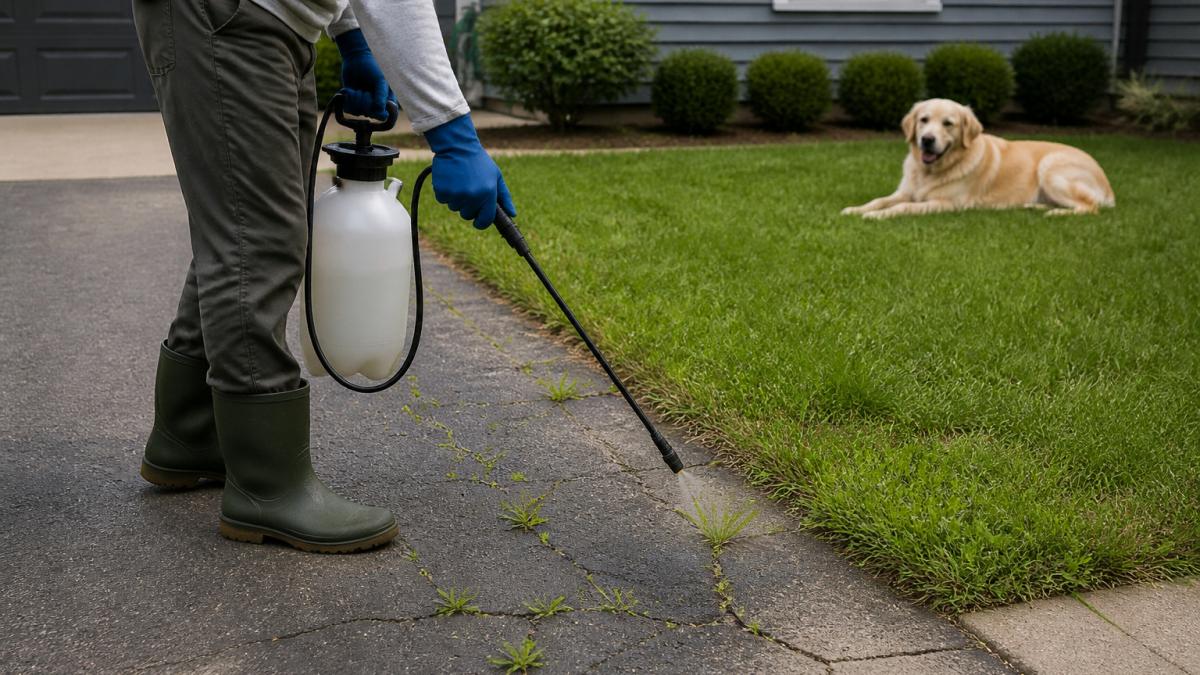
- Read the full label, including pet, child, and re-entry directions.
- Apply on a calm, dry day with no rain expected for the labeled period.
- Remove pets and children from the area and close the gate or door.
- Set your sprayer to a coarse, low-pressure spray to reduce drift.
- Spray target weed leaves until wet but not dripping.
- Avoid desirable plants and water sources.
- Wait for the area to dry completely before pets return.
Driveways and sidewalks need extra care because runoff can carry product into gutters and storm drains. Spot treat cracks instead of soaking the surface.
Spot Treating Dandelions, Clover and Crabgrass
Spot treatment limits the area that must dry before pets return, one of the simplest ways to make a pet safe weed killer plan work in practice. For dandelions and clover, apply directly to leaves and crown. Crabgrass is best controlled before it germinates, often with a pre-emergent applied in early spring; once emerged, most contact sprays work poorly, so plan for timing.
How Long to Keep Pets Off the Lawn After Weed Killer
There is no single safe waiting period, and any article that gives you one number is guessing. Re-entry time depends on the product's form, the label's instructions, the weather, and your pet's habits. The practical skill is combining those factors into a decision for your yard.
Start with the label, then adjust
The label is the floor, not the ceiling. It states the minimum re-entry interval the manufacturer supports. Meet that minimum, then layer on the conditions below.
| Product form | Typical label language | Practical adjustment |
|---|---|---|
| Ready-to-use contact spray (vinegar, soap, iron-based) | Keep pets off until spray has dried | Add time on cool, humid, or overcast days when drying is slow |
| Concentrate you mix yourself | Follow re-entry directions for the mixed solution | Keep pets out during mixing and spraying, not just after |
| Granular pre-emergent (corn gluten meal) | Keep pets off until watered in and dry | Granules are attractive to dogs; sweep or water in promptly |
| Systemic herbicide | Label states a specific interval | Do not shorten it because the surface looks dry |
Four factors that should stretch the wait
- Drying time. "Dry to the touch" is the minimum. On a cool, humid morning, a spray that looks dry at noon may still be tacky in shaded turf. Walk the treated area in shoes and check shaded spots before releasing pets.
- Weather. Rain before the label's rainfast window can redistribute product onto untreated ground and into puddles. If it rains sooner than the label allows, keep pets off longer and check the label for reapplication guidance. Wind during application spreads drift onto adjacent grass your pet uses.
- Pet behavior. A dog that grazes, digs, or chews grass has higher exposure risk than one that trots across the lawn to the door. Puppies, senior pets, and pets with liver or kidney conditions warrant a longer margin. Cats that roam garden beds need the same consideration.
- Where the product landed. Spot-treated cracks dry faster than a broadcast-sprayed lawn, but runoff can carry product to the edge of the grass where pets walk. Treat the runoff path as part of the treated area.
A simple decision sequence
- Before spraying: Read the label's re-entry statement and note the rainfast window. Move water bowls, toys, and pet beds off the treated area.
- During spraying: Keep pets indoors and close pet doors. Spray when the forecast shows no rain inside the label's window.
- After spraying: Wait for the label's stated period and for the surface to be fully dry, including shaded and low spots. Water only if the label permits it.
If exposure happens anyway
Contact your veterinarian or a pet poison control service right away if a pet walks through wet spray and then grooms, eats treated grass, or shows drooling, vomiting, diarrhea, lethargy, or skin and eye irritation. Bring the product label or EPA registration number, it tells the professional exactly what was applied. Do not induce vomiting unless a veterinary professional instructs you to.
Weed Control Limits and Prevention for a Pet-Friendly Yard
No product eliminates weeds permanently. Many common weeds, especially deep-rooted perennials, return after treatment. Realistic expectations help you choose the right approach.
Prevention is what keeps yard maintenance manageable:
- Mow at a higher setting to shade out weed seeds.
- Keep lawns thick through proper watering and fertilizing.
- Pull weeds after rain, when roots release more easily.
Treating weeds in the same spots each year is also a useful habit. Track which areas recur, because those spots often reveal soil or drainage problems that herbicides alone cannot fix.
Choosing Your Pet-Safe Weed Control Plan
Start with your goal. For a few young weeds in a small area, spot treatment with a labeled horticultural product or careful hand-pulling may be enough.
Consider these questions before you buy:
- Which weeds are you targeting, and are they annual or perennial?
- How much area do you need to cover?
- Can you keep pets fully off the area for the labeled drying period?
Choose the simplest option that meets your needs, apply it exactly as labeled, and keep your pets safe. For yard weed control, rely on product labels and local extension guidance rather than general claims.
Frequently Asked Questions
What is the safest weed killer to use around pets?
No weed killer is completely risk-free, so the safest choice is a product whose label lists pet-safe ingredients and directions for use around animals. Read the active ingredients, follow label rates exactly, and keep pets off treated areas until the spray has dried. Ready-to-use sprays formulated for home lawns are often easier to apply precisely than concentrates, which reduces overspray onto grass, paths and water bowls. Always store products out of reach of pets and check the label for any warnings before buying.
Does vinegar kill weeds, and is it safe for pets?
Household vinegar at about 5 percent acetic acid can burn the tops of young broadleaf weeds, but it rarely kills deep roots, so repeat applications are usually needed. Concentrated horticultural vinegar is stronger and can irritate skin and eyes, so wear gloves and eye protection. Keep pets away while spraying and until the leaves have dried, and avoid spraying near water sources or garden plants you want to keep.
How long should pets stay off a lawn after weed killer is applied?
Follow the drying time and re-entry directions printed on the specific product label, since these vary by formulation. As a general practice, keep dogs and cats off treated grass until the spray has fully dried, which often takes several hours, and rinse paws if they walk on treated areas. If a pet ingests product or shows vomiting, drooling or lethargy, contact a veterinarian or the ASPCA Animal Poison Control Center right away.
What are pet-safe alternatives to chemical weed killers?
Options include hand pulling, a stiff weeding tool for taproots, boiling water on cracks in paving, and corn gluten meal applied as a pre-emergent to limit seeds sprouting. Mulch in beds and dense turf also reduces weed germination. Pair these methods with a healthy, thick lawn, which crowds out weeds over time. Combine approaches for the best results, since no single natural method controls every weed species.
