
Table of Contents
- Llungen Lures vs Weed Blockers: What's the Real Difference?
- Feature Comparison: Weedless Rigging Options at a Glance
- Best Weedless Lures for Bass in Heavy Cover
- How to Prevent Weeds on Fishing Line
- Trolling in Heavy Weeds: Setup and Tactics
- Weed Blockers vs Built-In Guards: Hook Set and Snag-Free Performance
- Frequently Asked Questions
Last Updated: September 16, 2026
Llungen Lures vs Weed Blockers: What's the Real Difference?
If you fish heavy vegetation, you've probably asked whether it's better to buy lures with built-in weed protection or add a device that grabs weeds before they reach your bait. The short answer: weed blockers are add-on devices that intercept vegetation before it fouls your presentation, while built-in guards are molded or wired directly into a lure.
Built-In Weed Guards on Llungen Lures
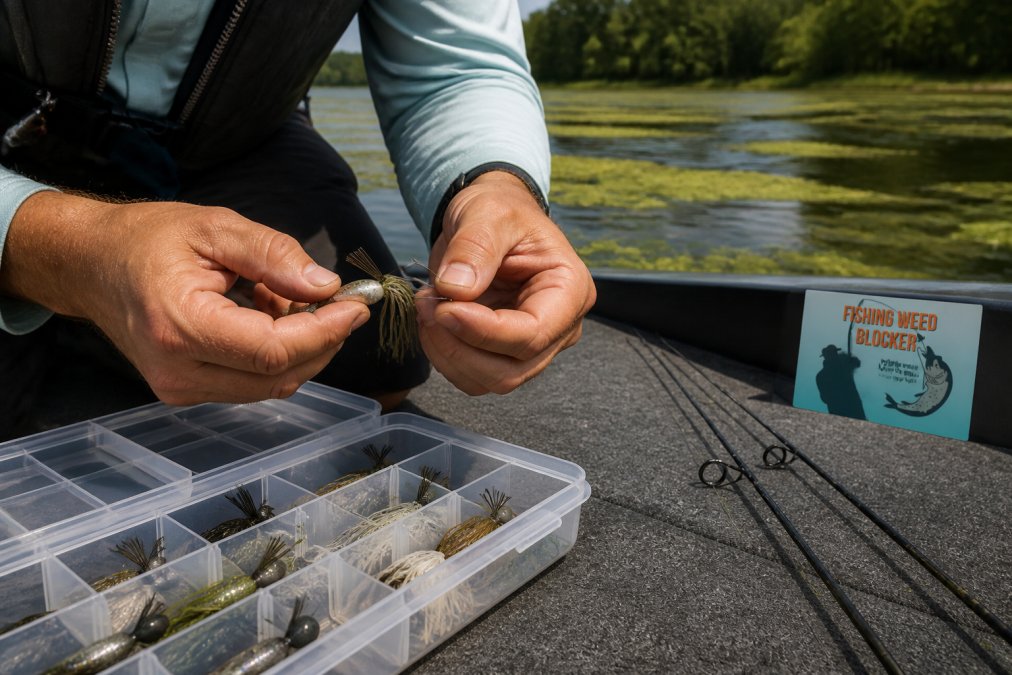
Llungen Lures builds wire and fiber guards directly into the bait, so the hook point sits behind a protective loop. The advantage is simplicity: nothing extra to attach, nothing to lose, and the lure is ready the moment you tie it on. The trade-off is commitment. A built-in guard is tuned for one lure, one weight, and one type of cover.
Add-On Weed Blockers Explained
An add-on weed blocker is a separate piece of terminal tackle that mounts ahead of your bait and deflects or collects vegetation before it wraps the hook. Fishing Weed Blocker sells a patented version in a convenient 4 pack, designed for trolling and bait fishing, that grabs weeds before they cover your bait. The device is engineered to cast like a rocket and move through the water with minimal drag, and it stacks flat in a tackle box.

Feature Comparison: Weedless Rigging Options at a Glance
| Feature | Built-In Guard (Llungen) | Add-On Weed Blocker |
|---|---|---|
| Attachment | Molded into lure | Mounts on line or bait |
| Works with live bait | No | Yes |
| Swaps between lures | No | Yes |
| Best for | Casting soft plastics | Trolling and bait fishing |
| Fouling protection | Hook point only | Whole presentation |
The table makes the split obvious. Built-in guards protect the hook point. Add-on devices protect the entire bait, which matters most when you're dragging through vegetation for long stretches rather than making quick casts.
Best Weedless Lures for Bass in Heavy Cover
The best weedless lures for bass in heavy cover are soft plastics rigged Texas-style, hollow-body topwater frogs, and buzzbaits. Each keeps the hook point shielded while still allowing a clean hook set when a fish commits.
Topwater and Buzzbaits
Hollow-body frogs and prop baits shine over lily pads because they ride on the surface where bass ambush from below. Buzzbaits add noise and commotion, and their upward-facing hook stays clear of most grass. The catch is hook set timing: wait until you feel weight before driving the hook home.
Soft Plastics and Texas-Rig Options
A Texas-rigged worm or creature bait keeps the hook point buried in the plastic, which is why it's the workhorse for punching through mats. Wacky-rigging works in lighter cover but exposes the hook, so pair it with a blocker if you're fishing around pads. For a full breakdown of rigging technique, see the Bassmaster rigging guides library, which covers Texas and wacky setups in detail.
How to Prevent Weeds on Fishing Line
Keeping weeds off your line comes down to three habits: keep the line tight, clear it after every cast, and use hardware that intercepts vegetation before it reaches your bait.
- Check the last two feet of line after every retrieve and strip off any clinging grass
- Keep a slight bow out of your line so vegetation slides off rather than wrapping
- Run a weed blocker ahead of your bait so debris collects there instead of on your hook
- Switch to braid in heavy cover; its slick surface sheds grass better than monofilament
Trolling in Heavy Weeds: Setup and Tactics
Trolling in heavy weeds rewards a setup that keeps baits above the canopy and clears debris continuously. The goal is to tick the tops of the grass without burying your bait in the stems, and that comes down to four variables you can control: line length, speed, depth, and how you handle the vegetation that collects on the way in.
Line Length and Speed
Run your lines shorter than you would in open water. In open water, a common pattern is 100 to 150 feet of line behind the boat; over a weed canopy, most practitioners cut that to roughly 40 to 60 feet so the bait stays high and you can feel a fouled lure before it drags through the whole flat. Keep speed steady rather than surging.
Depth Control
Match your running depth to the top of the weeds, not the bottom. If you can see your bait ticking the surface, you're in the strike zone. If it disappears, you're too deep and you'll spend the day clearing grass. Adjust with weight, not speed, whenever you can, adding speed to lift a bait usually just makes it skip and spin.
Water Clarity Changes the Equation
This is the part most trolling guides skip. Weed-blocking hardware changes how your bait reads in the water, and the effect depends on clarity:
- Stained or off-color water: A blocker that sits ahead of the bait adds bulk and shadow, which can actually help, bass and pike key on silhouette and vibration more than fine detail in low visibility. Run brighter, higher-contrast baits and let the blocker's profile do some of the attracting.
- Clear water: The same bulk can spook fish that get a long look at the presentation. In clear water, favor a low-profile blocker, run it further ahead of the bait, and lean on natural colors. Light penetration is deeper, so fish see the hardware and the bait as separate objects, which is exactly what you don't want.
Species-Specific Trolling Needs
Heavy-duty trolling for musky and pike is not the same game as trolling for bass.
- Musky and pike: These fish hit hard and run big baits. You need hardware that survives a strike without folding, and you need it positioned so it doesn't interfere with a large hook set. Heavy line, stout rods, and a blocker that stays put under load matter more than finesse.
- Bass: Bass trolling over grass is usually a finesse game, smaller profiles, lighter line, and a blocker that adds minimal drag so the bait still has action. A device tuned for musky will kill a bass bait's movement.
Weed Blockers vs Built-In Guards: Hook Set and Snag-Free Performance
Hook set efficiency is where the two approaches diverge most, and the difference comes down to geometry, how far the protection sits from the hook point.
How Each One Works on the Set
A built-in guard keeps the hook point shielded until a fish bites, then collapses or flexes on the set. The wire or fiber loop is tuned to a specific resistance: enough to shed grass, light enough to fold when a fish loads the rod. That tuning is the catch. A guard stiff enough for heavy pads can be too stiff for a light-biting bass, and a guard soft enough for finesse can fold on the cast and foul.
Snag-Free Performance by Scenario
Snag-free performance favors the add-on device in trolling and bait fishing, where your bait is in the water for long periods and collects debris continuously. Built-in guards favor casting, where the lure is moving fast and the hook point is the only thing that needs protecting. Neither is universally better. Match the tool to how the bait spends its time.
The Maintenance Angle Nobody Talks About
Here's what the ranking guides leave out: weed guards degrade, and how fast depends on where you fish.
- Wire guards can fatigue and take a set after repeated bending. A guard that's been folded hundreds of times stops springing back, and a guard that won't spring back is a guard that stays fouled.
- Plastic and fiber guards are more vulnerable to heat and UV. A tackle box left on a boat deck in summer sun, or stored in a hot garage, will soften and warp them over a season.
- Saltwater exposure accelerates corrosion on wire and degrades some plastics faster than freshwater use. If you fish brackish or coastal grass, inspect guards more often.
Cost-Per-Fish Thinking
Specialized weed-blocking hardware costs money, and the honest question is whether it earns its keep. The math isn't about the sticker price, it's about how many casts you actually get in the strike zone.
[Take Me Fishing's guide to weedless rigging(/blogs/news/benefits-of-weedless-fishing-setups) | takemefishing.org]
Frequently Asked Questions
What is the best lure for fishing in heavy weeds?
Weedless soft plastics rigged Texas-style, hollow-body frogs, and buzzbaits with built-in guards work well in heavy cover. Add-on weed blockers like the Fishing Weed Blocker ($15.97) grab vegetation before it covers your bait, keeping your presentation snag-free. For trolling in heavy weeds, pair a weed blocker with a shallow-running crankbait or spoon. Match your lure profile to the cover density and target species.
Do weed guards on lures affect hook-up ratios?
Yes, built-in weed guards can reduce hook-up ratios because the guard sits between the hook point and the fish's mouth. Add-on weed blockers that intercept vegetation ahead of the lure leave the hook point exposed, so hook set efficiency stays higher. The trade-off is that any weed guard requires a firm, sweeping hook set to compress the guard and drive the point home. Practice your hook set in open water before fishing heavy cover.
How do weed blockers differ from built-in weed guards?
Built-in weed guards are molded or wired directly onto the lure and deflect vegetation at the hook. Add-on weed blockers like the Fishing Weed Blocker mount ahead of the lure or bait and grab weeds before they reach the hook point, providing mechanical interception. This keeps your lure profile natural and your hook point clear. Weed blockers work with trolling and bait fishing setups, while built-in guards are lure-specific.
Can you use weed blockers with any type of lure?
Weed blockers work best with trolling and bait fishing setups, according to the manufacturer. They attach ahead of the lure or bait and intercept vegetation before it fouls your presentation. For casting soft plastics or topwater, built-in weed guards or Texas-rigging may be more practical. If you troll crankbaits, spoons, or live bait in weedy lakes, a weed blocker keeps your line and lure clear without altering lure action.