

Last Updated: October 25, 2026
Quick Summary
To oxygenate bait water effectively, run a properly sized air pump with a clean fine-bubble diffuser placed near the tank bottom, and aim for roughly 5 to 7 ppm dissolved oxygen. Keep water cool, stock lightly, and test oxygen after setup, under full load, and during the hottest part of the day.
- A clogged diffuser is the most common silent failure, so clean or swap it regularly.
- Oxygen demand scales with fish mass, not fish count, so weigh a sample before filling.
- A handheld dissolved oxygen meter costs roughly $150 to $400; a colorimetric kit costs under $40.
- Keep the tank out of direct sun and add sealed ice packs when the water climbs.
- Do a partial water change of about a quarter to a third when water looks cloudy or oxygen drops.
Table of Contents
- Why Dissolved Oxygen Decides Whether Your Baitfish Survive
- Setting Up a Bait Tank Aeration System That Actually Works
- Safe Dissolved Oxygen Targets and How to Measure Them
- How Baitfish Water Temperature Changes Oxygen Demand
- Stocking Density: How Many Baitfish Your Tank Can Support
- When and How to Do a Bait Tank Water Change
- How to Keep Live Bait Alive Through Transport and Power Failures
- Troubleshooting a Bait Tank That Is Losing Fish
- Frequently Asked Questions
Why Dissolved Oxygen Decides Whether Your Baitfish Survive
Dissolved oxygen is the oxygen gas held in your bait water, and knowing how to oxygenate bait water is the single biggest factor in whether baitfish survive a day on the water.
Baitfish breathe oxygen dissolved in water, not from the air, so keep that supply steady from the bait shop to the last cast.
Dead bait does not swim or trigger strikes.
Below, we break down how to oxygenate bait water effectively, from picking a pump to handling a power failure.
Setting Up a Bait Tank Aeration System That Actually Works
A bait tank aeration system is a pump, an air line, and a diffuser that pushes air into the water so it can absorb oxygen. Get these three parts right and most bait survival problems disappear.
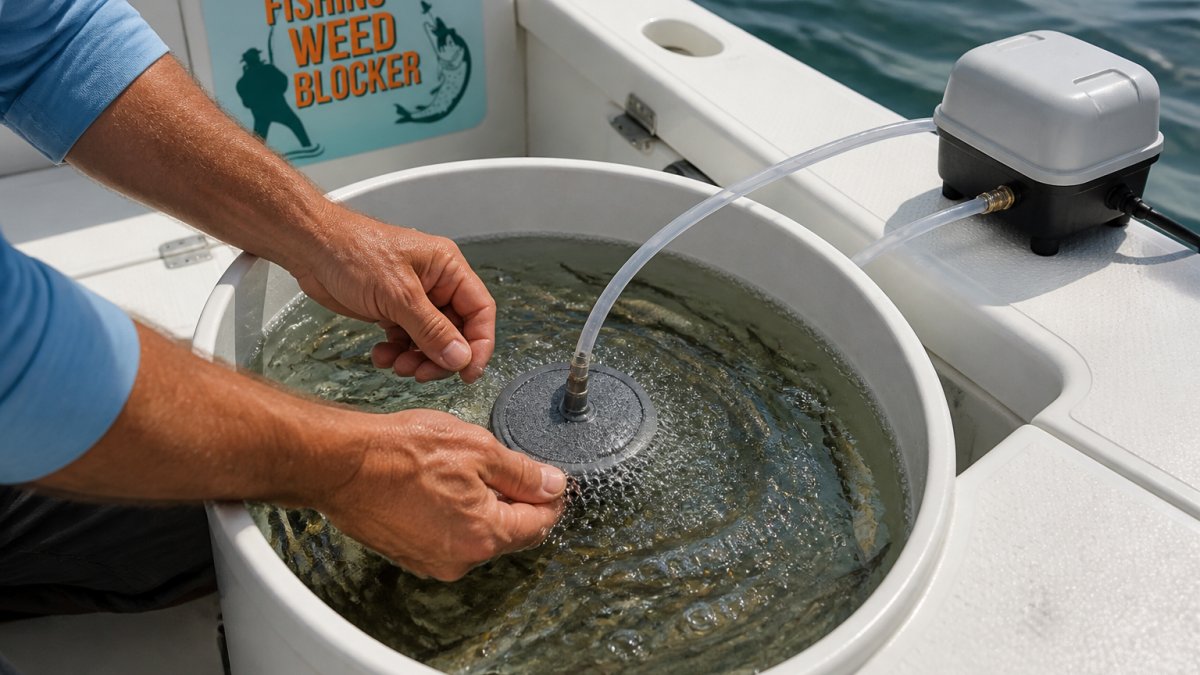
Start with a pump rated for your tank size. Then run a short, kink-free air hose to the diffuser; a kinked hose cuts airflow and quietly starves your bait.
Choosing and Positioning the Diffuser
A diffuser is the stone or disc that turns pumped air into fine bubbles.
Place the diffuser near the bottom so rising air mixes the whole water column, but keep it off the direct floor so debris does not clog the pores.
Watch out: a clogged diffuser is the most common silent failure. Airflow drops, bubbles get coarse, and oxygen falls without any obvious sign. Clean or swap it regularly.
Creating Circular Water Flow
Water circulation matters as much as the air pump. A gentle circular motion keeps oxygenated water mixing through the tank instead of sitting in layers.
Angle the diffuser or a small pump so flow pushes water around the tank walls. Baitfish orient into that current, which reduces stress, and the flow sweeps waste toward a filter or overflow instead of letting it settle.
Safe Dissolved Oxygen Targets and How to Measure Them
A safe dissolved oxygen target for most baitfish is roughly 5 to 7 parts per million (ppm), with anything under about 3 ppm dangerous. The number that matters depends on species, water temperature, and fish per gallon.
Species-Specific Oxygen Demand
Not all baitfish breathe at the same rate. Treat these as working ranges:
- Fathead minnows and shiners are the most tolerant of the common baitfish. They handle lower oxygen and wider temperature swings better than most, which is why they dominate bait-shop shelves. Aim for 5 ppm or better.
- Golden shiners are slightly less tolerant than fatheads and stress faster in warm, crowded tanks. Keep them at 6 ppm or above when the water is over 70°F.
- Suckers and chubs are cool-water fish with higher oxygen demand. They need 6 to 8 ppm and fall apart quickly above 70°F. In summer, plan on more aeration and less bait per gallon.
If you do not know your species, assume it is on the sensitive end and stock lighter.
Stocking Density and Oxygen Math
Oxygen demand scales with fish mass, not fish count. A practical rule is roughly 1 pound of baitfish per 3 to 5 gallons in a well-aerated tank at moderate temperatures, and 1 pound per 6 to 10 gallons in warm water or with weaker aeration.
To use that rule, you need a rough weight: a 3-inch fathead is about 1/50 of a pound and a 5-inch shiner about 1/15. Weigh a sample on a kitchen scale and do the math against your tank volume before you fill it.
How to Measure Dissolved Oxygen
You have two practical options:
- Handheld dissolved oxygen meter. A polarographic or galvanic probe gives a reading in seconds; expect roughly $150 to $400 for a field-grade unit. Calibrate it before the season and keep the probe membrane wet. Check the tank at the ramp, mid-day, and before the drive home.
- Colorimetric test kit. A drop-count or ampoule kit costs under $40 and takes a few minutes per test. It is accurate enough for bait-tank work if you follow the timing exactly, but slower and hard to use in a moving boat.
Either way, test at three moments: right after setup, after a few hours under full bait load, and on the hottest part of the day. A tank that reads 6 ppm at 8 a.m. can read 3 ppm by 2 p.m. on a sunny deck.
Reading the Warning Signs Without a Meter
If you do not own a meter, watch the bait. Gulping at the surface, crowding the aerator outlet, losing color, or hanging listless near the bottom all signal low oxygen. When you see them, increase airflow, do a partial water change, and cut the bait load before you lose the tank.
How Baitfish Water Temperature Changes Oxygen Demand
Baitfish water temperature controls how fast bait burns oxygen. Warm water holds less oxygen and speeds up metabolism at the same time, which is why summer bait tanks fail.
Cool water holds more oxygen and slows metabolism, so baitfish need less per hour. Keep the tank out of direct sun and add sealed ice packs when the water climbs.
A few practical rules:
- Store the tank in shade, never on hot pavement.
- Insulate the tank or wrap it in a towel.
- Add cool water during water changes, not warm.
The goal is a steady, cool temperature; calm, cool bait uses less oxygen and lasts longer.
Stocking Density: How Many Baitfish Your Tank Can Support
Stocking density is the number of baitfish per gallon, and it is the limit most anglers ignore.
No single number fits every tank; it depends on fish size, water temperature, and aeration strength. Bigger bait and warmer water both mean fewer fish per gallon.
Use this as a working guide:
| Tank Situation | Stocking Approach | Why |
|---|---|---|
| Small tank, warm day | Light load, few bait | Low oxygen, high demand |
| Small tank, cool water | Moderate load | Oxygen holds better |
| Large tank, strong aeration | Heavier load | More water and airflow |
| Transport container | Light load only | No room for error |
A common mistake is filling a tank to the top because it looks lively; that tank will be gasping by afternoon.
When and How to Do a Bait Tank Water Change
A bait tank water change swaps part of the old water for fresh to reset oxygen and clear waste.
Here is the routine we recommend:
- Mix fresh water that matches the tank temperature.
- Remove about a quarter to a third of the old water.
- Replace it slowly so bait does not shock.
- Check oxygen and temperature after the change.
Fresh water brings in oxygen and dilutes waste like ammonia. But a full change all at once can shock bait. Partial, frequent changes beat one big swap.
For a deeper look at keeping bait clean between changes, see our guide on how to keep bait clean.
How to Keep Live Bait Alive Through Transport and Power Failures
Keeping live bait alive during transport comes down to backup oxygen, temperature control, and a tested plan. Pumps fail, batteries die, and vehicles get hot, so plan for all three before you leave the driveway.
Transport Setup That Holds Oxygen
A transport container is not the same as a home bait tank. It is smaller, it sloshes, and it sits in a vehicle that can heat up fast. Set it up like this:
- Size the container to the load. A 5-gallon bucket with a lid is fine for a light load of minnows on a short trip. For a full day or a bigger load, use a 20- to 30-gallon cooler-style bait container with an insulated lid.
- Run a battery-powered air pump with a fine-bubble diffuser weighted to the bottom. A typical D-cell or rechargeable air pump runs 12 to 30 hours on a set of batteries depending on the model and airflow setting. Carry a spare set.
- Keep the diffuser off the floor by an inch or two so debris does not clog it, and angle it to create a slow circular flow.
- Fill only two-thirds to three-quarters full so the water has room to slosh without splashing out, and so the air pump is not fighting an overfull, sealed container.
- Shade the container. Direct sun on a dark bucket can push water temperature up 10°F or more in an hour. Wrap it in a towel or keep it in the cab's shaded footwell, not the bed of a truck.
- Do not feed bait during transport. Feeding raises waste and oxygen demand. Fast them until they are back in a stable tank.
Power-Failure Procedure for a Boat Livewell
A livewell that loses circulation in a hot boat can kill bait in under an hour. When the main pump dies, work in this order:
- Switch to a portable aerator immediately. Clip a battery-powered air pump to the livewell and drop the diffuser in. Do not wait to diagnose the main pump first.
- Open the livewell lid if it is safe to do so. Fresh air exchange helps, and it lets you watch the bait for gasping.
- Reduce the load. If you have a second container, split the bait. Halving the density roughly halves the oxygen demand per gallon.
- Add cool water if you have it. A partial water change with water within a couple of degrees of the tank temperature buys time. Avoid a big temperature shock.
- Check the bait, not the gauge. Gasping at the surface means act now. Calm, colored bait means you have a few minutes to troubleshoot.
Runtime and Backup Math
Plan your backup around hours, not hope. A small battery air pump on low output might run 20 hours; on high output, closer to 10. If your trip is 8 hours plus drive time, carry two sets of batteries or a rechargeable pack with a known charge. For overnight trips, a second pump or a small inverter tied to a deep-cycle battery is the safer plan.
For more on preventing bait fouling while trolling, read our guide on preventing bait fouling.
Troubleshooting a Bait Tank That Is Losing Fish
When bait starts dying, work from the most likely cause to the least. Most losses trace to oxygen, temperature, or overcrowding, in that order.
Run this checklist:
- Check airflow at the diffuser. Is it strong and fine?
- Test dissolved oxygen. Is it above 5 ppm?
- Check water temperature. Is it too warm?
If oxygen is low, increase airflow and do a partial water change.
One more thing worth knowing: pure oxygen systems exist for serious bait haulers, but they carry risk.
Keeping weeds off your bait and lure is the other half of a productive day.
Frequently Asked Questions
How can you tell if bait water has enough oxygen?
Watch the fish before you trust the equipment. Bait that is gulping at the surface, hanging near the top, or losing color is short on oxygen. A dissolved oxygen meter removes the guesswork: aim to keep bait water above roughly 5 mg/L, with 6 to 8 mg/L a safer working range. Ripples at the surface and a steady stream of fine bubbles from the diffuser are good signs, but they do not confirm the actual oxygen level, so a meter is the only reliable check.
Can baitfish survive in a tank without an air pump overnight?
Sometimes, but it is a gamble that depends on tank volume, water temperature, and how many fish are in the tank. A small, crowded tank in warm water can crash within hours. If you have no pump, use the largest container you can, keep it in the coolest shaded spot, and change part of the water periodically. For overnight storage, a battery-powered aerator with a fine-bubble diffuser is the safer choice and costs far less than replacing a tank of dead bait.
Does cooler water help keep baitfish alive longer?
Yes. Cooler water holds more dissolved oxygen and slows baitfish metabolism, so the fish consume less oxygen and produce less waste. That is why baitfish water temperature matters as much as aeration. Keep the tank out of direct sun, avoid adding warm water during changes, and make temperature shifts gradual. Sudden swings stress bait, so cool the water slowly rather than dumping ice directly into the tank.
How often should you change bait tank water?
Plan on replacing roughly a quarter to a third of the water daily, and more often if the water turns cloudy, smells strongly, or bait starts acting sluggish. A bait tank water change removes ammonia and waste that aeration cannot fix. Use dechlorinated fresh water at a similar temperature to the tank, add it slowly, and never swap the whole volume at once, because a full change shocks baitfish and can kill them faster than dirty water.
