
Table of Contents
- What Determines How Long a Lure Weed Protector Last
- How to Clear Weeds Quickly Without Damaging Your Protector
- How to Prevent Bait Fouling and Extend Protector Life
- Signs Your Lure Weed Protector Needs Replacing
- Environmental Factors That Shorten Protector Lifespan
- Maintenance Tips to Get More Seasons Out of Your Protector
- Conclusion: When to Replace and What to Expect
- Frequently Asked Questions
Last Updated: September 14, 2026
What Determines How Long a Lure Weed Protector Last
Most anglers assume a lure weed protector lasts forever because it looks like a simple piece of plastic. That assumption costs you fish. A well-built protector typically holds up for two to four seasons of regular use, but the exact lifespan depends on how you fish, where you fish, and how you store the device between trips (pubmed.ncbi.nlm.nih.gov). Material quality sets the ceiling, and fishing conditions decide how fast you hit it.
A lure weed protector is a device that shields your lure or bait from weeds by intercepting vegetation before it wraps around your presentation. It works passively, which means it has no moving parts to fail, but it does have surfaces that wear.
Material and Construction Quality
Protectors made from UV-stabilized polypropylene or high-density polyethylene resist sun damage and repeated flexing far better than cheap, unstabilized plastic. Thicker walls and reinforced attachment points add seasons to the lifespan. A common mistake is buying on price alone, then watching the attachment loop crack in the second season. The American Sportfishing Association industry resources notes that gear durability remains a top purchase factor for recreational anglers.
How Often You Fish Weedy Water
Heavy vegetation is abrasive. Every pass through milfoil, hydrilla, or lily pads drags plant matter and grit across the protector's surface. Anglers who fish weedy water weekly will wear out a protector faster than someone who hits a weedy lake twice a month. More contact means more fraying, and fraying is the first stage of failure.
How to Clear Weeds Quickly Without Damaging Your Protector
The fastest way to clear weeds is to snap the rod tip sharply once, then reel in the slack before the vegetation reattaches. Yanking continuously loads the line and the protector unevenly, which is how attachment points crack. A short, firm pop sheds most vegetation in one motion.
Here's a sequence that protects your gear:
- Stop your retrieve and let the lure settle for a second.
- Snap the rod tip up sharply, once.
- Reel two or three quick turns to take up slack.
- Repeat once if weeds remain.
- Inspect the protector before your next cast.
This approach works whether you're trolling or bait fishing, and it keeps your presentation intact instead of dragging a salad back to the boat.
How to Prevent Bait Fouling and Extend Protector Life
Bait fouling happens when soft plastics, dough baits, or live bait slide up the line and wrap around the protector's arms. The fix is rigging discipline, not more hardware. Seat your bait firmly, check it after every few casts, and trim tags that catch vegetation.
A few habits that add seasons to any protector:
- Re-seat soft plastics after every strike or snag.
- Use a bait stop or small bobber stop above the bait.
- Avoid overloading the hook, which makes baits slide.
- Swap frayed line, since rough line shreds protectors faster than smooth line.
Signs Your Lure Weed Protector Needs Replacing
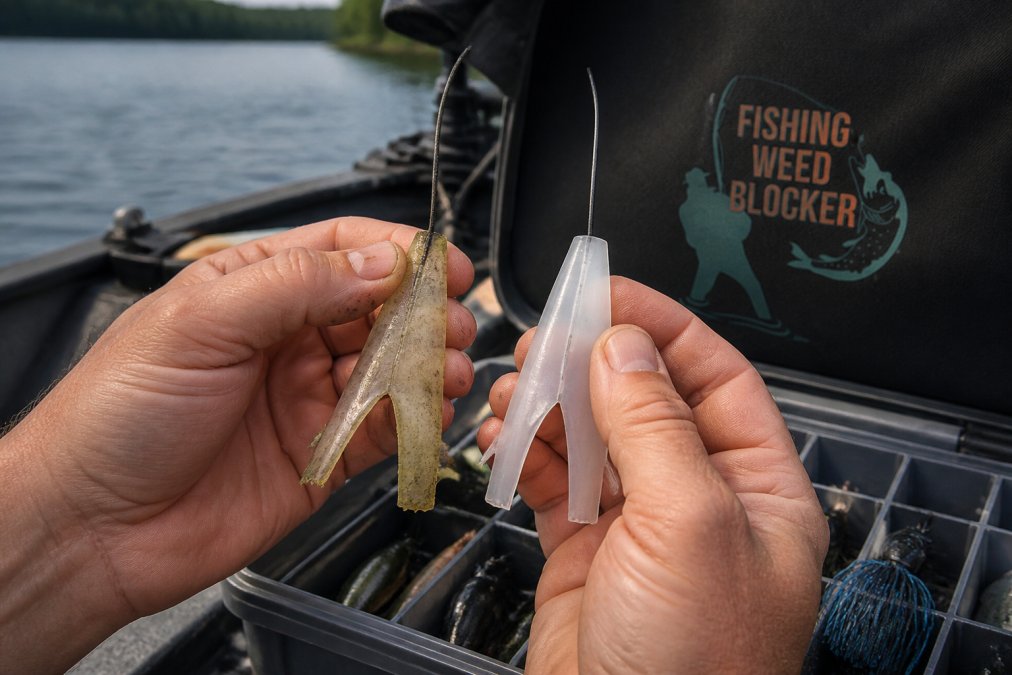
Replace your protector as soon as you see deep cracks, missing chunks, or attachment points that flex loosely. These are structural failures, not cosmetic ones, and they cause the device to foul your line instead of clearing weeds. A protector that has lost its shape, bent arms, a warped body, an attachment loop that no longer sits flush, is also done, because it no longer deflects vegetation cleanly.
Fraying, Cracking, and Loss of Shape
Fraying along the edges is the earliest warning sign. Next comes whitening or crazing, which signals UV degradation, followed by cracking at stress points. Loss of shape matters too: a protector that has bent out of alignment no longer deflects weeds cleanly. Any of these means it's time to retire the device. Our device is built to hold its shape through repeated casts, which is why it stacks cleanly in a tackle box without warping.
The Part Nobody Warns You About: Removal After Years of Use
Here's the gap most guides skip. A protector that's been fished hard for several seasons doesn't just wear out, it becomes harder to remove cleanly from the line, the tackle box, and any storage it's been pressed against. Degraded plastic gets tacky, sheds micro-particles, and can leave residue on line, hooks, and soft plastics. If a protector has been stored compressed under heavy tackle, warped arms can snag line on removal and cost you a cast or a fish. Compromised gear integrity often signals that your terminal tackle is no longer reliable enough to pair with durable braided line when navigating the thickest vegetation.
The practical rule: retire a protector the moment it shows structural failure, not when it finally breaks. Waiting until it fails mid-trip means you're removing a compromised device on the water, often in low light, often with cold hands. That's when line gets nicked and tackle gets lost.
Disposal: What to Do With a Dead Protector
Synthetic protectors are plastic, and they don't belong in a lake, a riverbank, or a loose trash bag headed for a landfill where they'll persist for decades. A few responsible options:
- Check local recycling rules first. Many municipal programs accept rigid polypropylene and HDPE, but small fishing accessories often fall below the size threshold for automated sorting. Call or check your county's waste authority before assuming curbside pickup works.
- Use retailer take-back programs. Some sporting goods retailers and tackle shops run gear recycling or trade-in events. Availability varies by store, so ask before you toss.
- Store dead protectors in a dedicated container until you can dispose of them properly. Don't leave them in a boat, a truck bed, or on a dock where they can blow into the water.
- Cut or break down large pieces so they don't jam sorting equipment if your program does accept them.
When to Replace vs. When to Repair
There's no meaningful repair for a cracked or crazed protector. Glues and tapes don't hold up to water, UV, and repeated flexing, and a patched surface defeats the whole point of a smooth, weed-shedding profile. The only sensible call is replacement, and keeping a spare in the tackle box so a failure mid-trip doesn't end your day. Rotating between two protectors also spreads UV and abrasion exposure, which stretches the useful life of both.
Environmental Factors That Shorten Protector Lifespan
Sun exposure does more damage than any weed bed, and it's not close. Ultraviolet light attacks the polymer chains that give a protector its stiffness and shape memory. Once those chains scission, the plastic stops springing back, starts to chalk and whiten, and eventually crazes into a network of hairline cracks. UV-stabilized polypropylene and high-density polyethylene resist this for a while because they're blended with hindered amine light stabilizers and UV absorbers, but those additives are consumable. Every hour in direct sun spends a little of that protection, and once it's gone, degradation accelerates sharply.
A protector left on a boat deck through a full summer of fishing days will typically show whitening and edge crazing within a single season. The same protector kept in a shaded tackle box between trips often looks nearly new after two. That gap is the single biggest controllable variable in how long the device lasts.
How Climate and Region Change the Clock
Longevity isn't one number, it's a range that shifts with where you fish. Most practitioners find the pattern breaks down roughly like this:
- Desert and high-altitude sun (low humidity, intense UV, big day-night temperature swings): the fastest wear. Expect the low end of the range, often two seasons or fewer for a protector that lives in the open. Thermal cycling also works the attachment points loose.
- Humid southern reservoirs and coastal brackish water: UV is lower than the desert but constant moisture, mineral deposits, and salt accelerate surface abrasion and can pit the plastic. Salt residue left on the surface acts like a mild abrasive on every retrieve.
- Northern and high-latitude fisheries with a hard winter: the fishing season is shorter, so total UV exposure is lower, but freeze-thaw cycles and cold-weather brittleness crack stressed plastic. A protector stored in an unheated garage over winter is more likely to crack on the first cold-weather cast of spring.
- Year-round warm-water fisheries: no off-season means continuous UV and abrasion exposure. This is where rotating between two protectors pays off most.
The takeaway is that a "two to four seasons" estimate is a national average, not a promise. If you fish the desert Southwest or leave gear on an open deck, plan for the short end. If you fish a short northern season and store gear indoors, you can reasonably expect the long end.
The Other Stressors That Add Up
UV is the headline, but it rarely works alone:
- Temperature swings cause repeated expansion and contraction, which fatigues attachment loops and any molded seams.
- Brackish or high-mineral water leaves deposits that abrade surfaces and can work into microcracks.
- Sand and grit act like sandpaper on every retrieve, grinding away the edges that deflect weeds.
- Extended storage in direct sunlight, a boat console, a truck bed, a dock box, is the most common way anglers accidentally cut a protector's life in half.
A NOAA coastal and waterway resources overview of water conditions is useful if you fish varied environments, since water chemistry and salinity affect how gear ages. The practical fix is simple: treat sun and heat as the primary enemy, and treat everything else as a multiplier that makes the sun's work go faster.
Maintenance Tips to Get More Seasons Out of Your Protector
Rinsing your protector in fresh water after every trip is the single highest-value habit. It removes grit, plant residue, and mineral deposits before they work into the plastic. Dry it fully before storage, and keep it out of direct sun when not in use.
Beyond rinsing:
- Store protectors loose, not compressed under heavy tackle.
- Inspect attachment points monthly during the season.
- Rotate between multiple protectors to spread wear.
- Retire any device showing cracks, even small ones.
Conclusion: When to Replace and What to Expect
Expect two to four seasons from a quality protector, less if you fish abrasive weeds weekly and store your gear in the sun. Replace it the moment you see cracks or loose attachment points, because a failing protector tangles line and costs you fish. Fishing Weed Blocker provides a practical, patented solution for anglers, ensuring your bait stays clear whether you're trolling or bait fishing. Sold in a convenient 4 pack, our device effectively grabs weeds before they can cover your lure or bait, protecting your presentation and maximizing your time on the water. This straightforward device is an essential addition for any angler seeking a more productive and snag-free fishing experience. This award winning device is engineered to cast like a rocket and flow threw the water with minimum drag. Stacks nicely in your tackle box and built to last. Get started with Fishing Weed Blocker and spend less time clearing vegetation and more time fishing.
Frequently Asked Questions
How often should you replace your fishing lure weed guards?
Most anglers replace their lure weed protector every one to three seasons, depending on how often they fish and the water conditions they face. If you fish weedy lakes or rivers several times a month, expect closer to one season. If you only hit the water a few times a year, a protector can last longer. Inspect it before each trip for cracks, fraying, or a loose fit, and replace it as soon as you notice any of those signs.
Do weed protectors affect the action of your lure?
A well-designed weed protector should not noticeably change how your lure moves through the water. Our device is engineered to flow through the water with minimum drag, so your presentation stays natural. If you feel extra resistance or see your lure tracking differently, check that the protector is seated correctly and not tangled with your line. A properly installed protector keeps your bait clear without altering its action.
What factors cause fishing weed protectors to degrade?
UV exposure, repeated contact with abrasive vegetation, and temperature swings all break down the materials in a weed protector. Sunlight weakens plastic over time, while constant rubbing against stems and roots causes fraying. Cold water makes some plastics brittle, and hot summer surface temperatures can soften them. Rinsing your protector after each trip and storing it out of direct sun slows all of these effects.
Does water temperature impact the lifespan of plastic weed guards?
Yes. Cold water can make plastic more brittle, so it may crack faster if you fish in early spring or late fall. Warm water softens plastic, which can lead to stretching or losing its original shape. The biggest factor is the number of freeze-thaw cycles the material goes through. If you fish year-round in a climate with hard winters, inspect your protector more often and replace it at the first sign of stiffness or cracking.